WQED Weekly
Three Rivers American Indian Center
Clip | 6m 32sVideo has Closed Captions
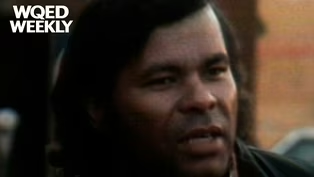
This features an interview with Russell Sims from the Council of Three Rivers American Indian Center
This segment of WQED Weekly features an interview with Russell Sims, the director of the Council of Three Rivers American Indian Center. He talks about the importance of having a support system for Native Americans living in Allegheny County, how he plans on raising his children to understand their heritage, and some of the issues that Native Americans currently face.
Problems playing video? | Closed Captioning Feedback
Problems playing video? | Closed Captioning Feedback
WQED Weekly is a local public television program presented by WQED
WQED Weekly
Three Rivers American Indian Center
Clip | 6m 32sVideo has Closed Captions
This segment of WQED Weekly features an interview with Russell Sims, the director of the Council of Three Rivers American Indian Center. He talks about the importance of having a support system for Native Americans living in Allegheny County, how he plans on raising his children to understand their heritage, and some of the issues that Native Americans currently face.
Problems playing video? | Closed Captioning Feedback
Where to Watch WQED Weekly
WQED Weekly is available to stream on pbs.org and the PBS app.
Welcome.
Okay.
Hello.
Mr.
Sims speaking.
Russell Sims is the director of the Council of Three Rivers American Indian Center in Homewood Brushton.
He supervises a volunteer staff there that tries to solve problems for Indians and at the same time, strengthen their Indian identity.
Russell is also a husband and father of two small children.
His work at the center is very important to his kids, although they don't realize it now.
He wants to give them a strong identity like he got from his parents.
- You want some new records.
Let's understand the problem, you know, like, 25, 30, 40 years ago, you know, where you had no organizations or anything to back up what somebody wanted to do or just have their, what we call their rights recognized.
They brought us up to understand, the fact that we were Indian people and recognize it and be proud of it.
So what did you do all day?
But Russell wants his children to be as comfortable with that identity out on the street as at home.
Not like when he was a kid.
You know, I can remember, recall my dad talking about when he first moved in the Braddock area, you know, and went down to put his application at, one of the big steel companies there.
We talked about, the long lines of people, you know, and, and who was being hired and who weren't, you know, so, like, he had to make a decision, you know, like, what ethnic he's going to go with to secure a job, you know, things like that.
You know, let's let's say it.
What did he decide?
He decided to go as black.
Okay.
Because in those days, there was nothing, period to be an Indian.
Now Geneva and Russell have to face the same problems his parents faced 30 years ago.
Raising children with an identity and a culture they can hold on to.
And since Geneva is black and Russell is Indian, they want their kids to know about both cultures.
Until they can become of age, where they can really think for themselves and make decisions for themselves, they'll grow up understanding all ethnics.
Okay, as much as I can hand down or teach them, theyll know, okay.
As much of the black things that he can get into, you know, he'll get into much, many Indian things he can get into.
You know, he'll get into.
Same with my daughter.
Once they come of age, it's their decision.
That's the basic philosophy at the Indian Center.
Give each person the freedom to choose his own identity and way of life.
Unfortunately, if it's the Indian way, the familiar problems of poverty may block the path.
At the center, Russell, Assistant Director Bill Hayes and the staff try to solve problems of housing, jobs and legal hassles for Indians.
Billy had a problem.
Anne, how about stepping over here for a minute?
Mrs.
Walker just called in Sandy Walker, and she has a problem.
She notified us a couple of days ago that she be calling today.
She needs housing.
She has three children.
She possibly needs employment.
For the time being, we'd like to set her up with welfare.
They also remain aware of the emotional problems of being an Indian.
And I think once they start coming into the center, they can get an idea of how many others are having the same problems and that they can get support from others in the same situation.
Yeah, that's a good idea.
The most difficult problem to solve, though, is somehow debunking the myths and stereotypes about Indians.
We've seen too many cowboy and Indian movies and they've had a profound effect on us.
People can't relate to Indian people as, Indians, because of the stereo myth.
You know what an Indian is?
What he's all about.
Usually they associate him with, like, just for say, housing, like a teepee or his looks, you know, the Western look, the high cheekbones and the long hair.
The cultural activities at the center are potentially their most constructive and destructive activities at the same time.
It's the dancing and drumming and beating classes that involve the children and show them Indian traditions they can see with their own eyes.
But it is these same activities that perpetuate those old oppressive stereotypes.
We have, Polish people here in this city.
When you hear different Polish events and things, you don't have people running with their cameras and, you know, taking pictures or something of this nature.
We've held different, events here in the city.
And we had to put up with the fact that, when we beat on the drum and stuff, we brought the cameras.
You know, people came with their cameras to take the showing of some spectacular something.
And frankly, we're not spectacular anything.
We're not pedestal people.
We just want to be, you know, regular human beings and, you know, we don't want to be the greatest, and we don't want to be the lesser.
We just want to be normal.
 New
NewVideo has Closed Captions
This segment features a story about backyard gardeners. (8m 18s)
 New
NewUniversity of Pittsburgh’s Hockey Club
Video has Closed Captions
This segment features a story about the University of Pittsburgh’s Hockey Club. (5m 50s)
 New
NewVideo has Closed Captions
This segment highlights a Ukrainian cultural festival. (11m 36s)
 New
NewTransportation Challenges for Disabled Persons
Video has Closed Captions
This segment explores the transportation challenges people with disabilities face. (5m 56s)
 Now Playing
Three Rivers American Indian Center
Video has Closed Captions
This features an interview with Russell Sims from the Council of Three Rivers American Indian Center (6m 32s)
 New
NewSleight of Hand Magic by Paul Gertner
Video has Closed Captions
This segment features an interview and live performance by sleight of hand magician Paul Gertner. (6m 1s)
 New
NewVideo has Closed Captions
This segment features a visit to a sexual health clinic. (6m 12s)
 New
NewVideo has Closed Captions
This segment features a story about the Schuman Center, a juvenile detention center. (7m 42s)
 New
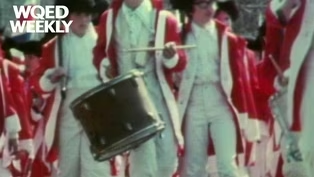
NewReenactment Battles at Lexington and Concord
Video has Closed Captions
This segment features a reenactment of the battles of Lexington and Concord by grade school children (6m 53s)
 New
NewVideo has Closed Captions
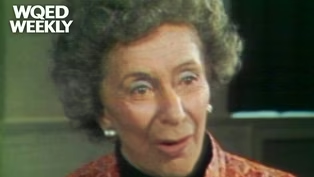
This highlights Reach to Recovery, a program that supports women recovering from mastectomies. (7m 26s)
 New
NewVideo has Closed Captions
This highlights the Powder Mill Nature Reserve and the work of environmental activist Ruth Scott. (9m 18s)
 New
NewVideo has Closed Captions
This segment explores a police counseling program. (5m 52s)
 New
NewPittsburgh Penguins Financial Problems
Video has Closed Captions
This segment features a story about the Pittsburgh Penguins’ financial problems. (7m 14s)
 New
NewVideo has Closed Captions
This segment features an interview with Pittsburgh Mayor Pete Flaherty. (5m 39s)
 New
NewVideo has Closed Captions
This segment of WQED Weekly features a story about penny candy. (5m 13s)
 New
NewVideo has Closed Captions
This features an interview with, Oliver Mason, a former City of Pittsburgh police officer. (8m 3s)
 New
NewNational Organization for Non-Parents
Video has Closed Captions
This is about the National Organization for Non-parents, a group supporting child-free couples. (7m 15s)
 New
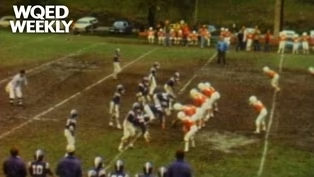
NewMeridian Elementary School Football Team
Video has Closed Captions
This segment features footage of the Meridian Elementary School football team. (10m 20s)
 New
NewVideo has Closed Captions
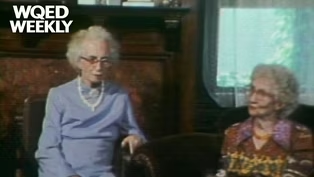
This segment features an interview with Sarah and Rachel McClelland. (8m 54s)
 New
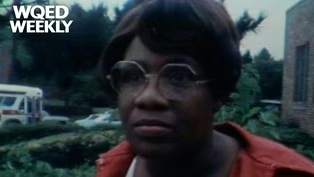
NewMaintenance in Terrace Village
Video has Closed Captions
This explores maintenance problems in low-income housing run by the Pittsburgh Housing Authority. (8m 52s)
 New
NewVideo has Closed Captions
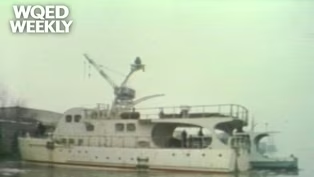
This segment features an interview with Leon Bibber, a man who spent 19 years building a boat. (7m 10s)
 New
NewVideo has Closed Captions
This segment highlights Jim Nagle performing as Kimo the Clown. (5m 30s)
 New
NewVideo has Closed Captions
This segment features an interview with Kim Nagel, and 18-year-old running for school board director (8m 17s)
 New
NewVideo has Closed Captions
This segment features a story about Jane Grey Swisshelm, a feminist and abolitionist from the 1800s. (4m 58s)
 New
NewVideo has Closed Captions
This segment features a story about a high school senior internship program. (7m 28s)
 New
NewVideo has Closed Captions
This segment features a story about community service and support work. (8m 46s)
 New
NewVideo has Closed Captions
This segment features an interview with actor Frank Gorshin about growing up in Pittsburgh. (4m 46s)
 New
NewVideo has Closed Captions
This WQED Weekly features a story about a foster grandparent program for children with disabilities. (4m 17s)
 New
NewFiscal Crunch of PennDot and City Hall
Video has Closed Captions
This segment explores PennDOT and the City of Pittsburgh’s financial problems. (7m 38s)
 New
NewFifth Avenue High School Basketball Team
Video has Closed Captions
This segment features a story about the Fifth Avenue High School basketball team. (7m 59s)
 New
NewVideo has Closed Captions
This segment features an interview with local farmer Dick Koons. (8m 50s)
 New
NewVideo has Closed Captions
This segment highlights a program that supports the children of couples who are getting divorced. (6m 47s)
 New
NewVideo has Closed Captions
This segment explores decriminalizing marijuana possession in Pennsylvania. (9m 16s)
 New
NewVideo has Closed Captions
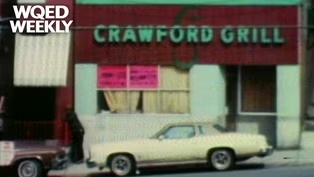
This segment features a story about the Crawford Grill, a jazz bar in the Hill District. (8m 38s)
 New
NewVideo has Closed Captions
This segment features an interview with community advocate Franklin Wilhamina “Frankie” Pace (7m 35s)
 New
NewThe Claysville McGuffey Recorder
Video has Closed Captions
This segment features a story about Gene Shaw, the owner of the Claysville McGuffey Recorder. (8m 33s)
 New
NewCitizens Band Radio and Truck Driving
Video has Closed Captions
This segment features a story about citizens band radios and truck driving. (4m 16s)
 New
NewVideo has Closed Captions
This segment features a story about life performing in a circus. (9m)
 New
NewVideo has Closed Captions
This features a short film titled “A Christmas Night Story” created by Nicolas and Sandrine Schoen. (6m 27s)
 New
NewCeinwen King-Smith - A Blind Teacher at Hillel Academy
Video has Closed Captions
This segment features an interview with Ceinwen King-Smith, a blind teacher at Hillel Academy. (4m 35s)
 New
NewBreast Cancer Detection Center
Video has Closed Captions
This segment follows a screening appointment at the Breast Cancer Detection Center in Oakland. (7m 5s)
 New
NewVideo has Closed Captions
This segment explores donating blood at the Central Blood Bank of Pittsburgh. (3m 15s)
 New
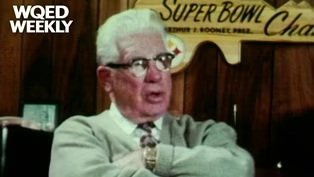
NewArthur ‘Art’ J. Rooney Interview
Video has Closed Captions
This segment features an interview with Arthur ‘Art’ Rooney. (7m 29s)
 New
NewVideo has Closed Captions
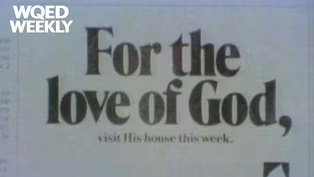
This segment explores ad campaigns encouraging people to attend church. (4m 36s)
Providing Support for PBS.org
Learn Moreabout PBS online sponsorship New Episode
- News and Public Affairs

Top journalists deliver compelling original analysis of the hour's headlines.
 New Episode
- News and Public Affairs

Today's top journalists discuss Washington's current political events and public affairs.

 New Episode
 New Episode
 New Episode
 New Episode
 New Episode
 New Episode
 New Episode
 New Episode
Support for PBS provided by:
WQED Weekly is a local public television program presented by WQED