WQED Weekly
The Crawford Grill
Clip | 8m 38sVideo has Closed Captions
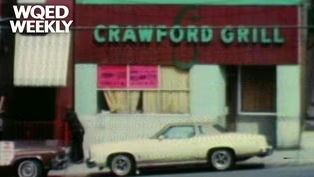
This segment features a story about the Crawford Grill, a jazz bar in the Hill District.
This segment of WQED Weekly features a story about the Crawford Grill, a jazz bar in the Hill District. Reporter Don Marbury reminisces about growing up in the Hill and what the Crawford Grill was like in the 50s and 60s. Owners William Robinson Sr. and William “Buzz” Robinson Jr. talk about how it became a jazz bar and the shift in clientele after the assassination of Dr. Martin Luther King.
Problems playing video? | Closed Captioning Feedback
Problems playing video? | Closed Captioning Feedback
WQED Weekly is a local public television program presented by WQED
WQED Weekly
The Crawford Grill
Clip | 8m 38sVideo has Closed Captions
This segment of WQED Weekly features a story about the Crawford Grill, a jazz bar in the Hill District. Reporter Don Marbury reminisces about growing up in the Hill and what the Crawford Grill was like in the 50s and 60s. Owners William Robinson Sr. and William “Buzz” Robinson Jr. talk about how it became a jazz bar and the shift in clientele after the assassination of Dr. Martin Luther King.
Problems playing video? | Closed Captioning Feedback
Where to Watch WQED Weekly
WQED Weekly is available to stream on pbs.org and the PBS app.
To look at the Hill district today.
One would not guess that it has a full rich black history.
And other times in other years, unique activities abounded.
Culturally, very few other black communities had anything on Pittsburgh's Hill District.
I remember walking these streets as a young teenager with a transistor radio in hand, ear plugs securely in place, with the local soul station loudly broadcasting the top 40 tune.
I guess I was typical of that day, and that age in that time was deeply enamored with music and its performers, and would go anywhere just to hear anybody play.
You see, that time when I was a teenager was not an era of great social consciousness.
I didn't realize that I was a deprived child.
A child living in a substandard neighborhood, a slum, a ghetto.
For kids like me.
It wasn't that we weren't aware of being poor, but it was part of our everyday lives.
So it really wasn't any big thing.
To us, the all encompassing concern that one big factor in our lives was music.
The people that made those wonderful sounds that we listened to each and every day.
And the all encompassing vehicle, the kind of utopian outlet for expression of that musical concern that we had was the Crawford Grill, which at that time had the reputation of being one of the finest jazz nightspots in all of these.
Saturday nights really used to be the best time when I would stand on this exact corner, just watching the crowds of people go in and out of the Grill and just really diggin on the music.
My memories are at the very early 60s, when the Crawford Grill was riding a crest of success and had a national reputation.
During those days, when stars like Johnny Lytle would play the Grill, equal numbers of blacks and whites would pack the club.
Then came the late 60s social upheaval, racial confrontations and riots with the fear that many of the Grill's white customers began to feel and the continuing deterioration of the Hill district, the image of the Grill as Pittsburgh's jazz Mecca, the home of the stars, faded.
Was 80% white.
Now we begin to feel effect here only after the death of Martin Luther King.
And then, of course, after the, the disturbance, then it began to turn in ghetto where we never thought in terms of it being a ghetto when we started here.
I would have never thought in terms of vesting what I have here, not in a ghetto, But after the death of Martin Luther King, why, you know, and these things began to happen.
White people began, stop coming in.
And not only that, we had a fine class of, Negroes that stopped coming in.
Although Robinson only alluded to the problems his club and the Hill experienced and are still experiencing, members of the community were much more graphic in their descriptions.
Well the clientele is not the same, you know, because, what do you expect on the Hill?
And, you know, they still have some pretty nice groups in there, but they're just not pulling the crowd because people are scared to come to the Hill.
And, you know, in my opinion, if they clean it up a little bit, then maybe, you know, it might change a lot of things.
It was beautiful.
90% of the clientele in there was white.
You could go in and sit down and enjoy yourself.
Your music, come out your car, be there.
You can leave it open.
Nobody bothered it.
Everything was beautiful.
Time to rise, Rover.
Look like in black.
Is nothing here but black, now they just rip everybody off.
They have to have a security cop out there on the weekends to walk you to your car and watch the car.
This is the place to go.
Its the best place on the Hill.
It's the best place in the Hill.
Do you think the white population will ever come back to the Crawford Grill?
Yes, sure.
Certainly, certainly they'll come back here.
Its bad in there.
Parking is bad, you know, and things like that.
But outside of that, it'd be all right to have to go.
It's, you know, it's a place that you can go and relax and feel comfortable in and, you know, without this, you know, the Hill District is just a dresser, you know, because we don't have any place that we can go to more or less call ourself going out to the limelight.
You know, if you want to try to get dressed up, you know, like to go somewhere, carry your lady.
I want this place.
You got to go.
Today, the Grill has fallen from its jazz pedestal.
A more common atmosphere now prevails than in the days when the Grill was indeed more than just a neighborhood hangout.
I got away from the idea of a neighborhood bar, and to get away from the neighborhood bar, we had to bring people from every area.
That is well in Allegheny County, to price dairy Ohio, with Union, everything.
And then that's when I got the idea, when I brought Sam Nowlin in as an organist.
Leroy Brown in as a five piece combo.
I brought Walt Harper in.
The careers of jazz stars like Ramsey Lewis were launched at the Grill, according to Robinson, and stars like Art Blakey, Max Roach, Horace Silver, Cal Tjader, Chet Baker, Hazel Scott and Arthur Prysock were all jazz regulars during the club's heyday.
Between New York and Chicago, the Crawford Grill was known as one of the biggest jazz houses in the country.
But without, without, without reference to that.
I think what it all represented was a system that people were free to manipulate, and as a result, we had the opportunity to succeed during that period of time.
The Crawford Grill, an institution with a rich past, the home of the stars, but an institution with a seemingly nebulous future.
But whatever happens, it will not compromise its ideology of integration.
And both father and son see a renewal of the Grills once so vital spirit in the Hill district.
I mean if we had to keep it just as a place to sell whiskey, or just a place where anybody come.
We wouldn't be interested.
We are interested in people, the type of people, the class of people that we've been accustomed to, that we've had here today.
And as long as I am his father and he's my son, I hope he maintains that same thing.
 New
NewVideo has Closed Captions
This segment features a story about backyard gardeners. (8m 18s)
 New
NewUniversity of Pittsburgh’s Hockey Club
Video has Closed Captions
This segment features a story about the University of Pittsburgh’s Hockey Club. (5m 50s)
 New
NewVideo has Closed Captions
This segment highlights a Ukrainian cultural festival. (11m 36s)
 New
NewTransportation Challenges for Disabled Persons
Video has Closed Captions
This segment explores the transportation challenges people with disabilities face. (5m 56s)
 New
NewThree Rivers American Indian Center
Video has Closed Captions
This features an interview with Russell Sims from the Council of Three Rivers American Indian Center (6m 32s)
 New
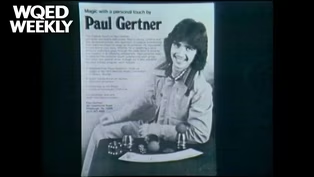
NewSleight of Hand Magic by Paul Gertner
Video has Closed Captions
This segment features an interview and live performance by sleight of hand magician Paul Gertner. (6m 1s)
 New
NewVideo has Closed Captions
This segment features a visit to a sexual health clinic. (6m 12s)
 New
NewVideo has Closed Captions
This segment features a story about the Schuman Center, a juvenile detention center. (7m 42s)
 New
NewReenactment Battles at Lexington and Concord
Video has Closed Captions
This segment features a reenactment of the battles of Lexington and Concord by grade school children (6m 53s)
 New
NewVideo has Closed Captions
This highlights Reach to Recovery, a program that supports women recovering from mastectomies. (7m 26s)
 New
NewVideo has Closed Captions
This highlights the Powder Mill Nature Reserve and the work of environmental activist Ruth Scott. (9m 18s)
 New
NewVideo has Closed Captions
This segment explores a police counseling program. (5m 52s)
 New
NewPittsburgh Penguins Financial Problems
Video has Closed Captions
This segment features a story about the Pittsburgh Penguins’ financial problems. (7m 14s)
 New
NewVideo has Closed Captions
This segment features an interview with Pittsburgh Mayor Pete Flaherty. (5m 39s)
 New
NewVideo has Closed Captions
This segment of WQED Weekly features a story about penny candy. (5m 13s)
 New
NewVideo has Closed Captions
This features an interview with, Oliver Mason, a former City of Pittsburgh police officer. (8m 3s)
 New
NewNational Organization for Non-Parents
Video has Closed Captions
This is about the National Organization for Non-parents, a group supporting child-free couples. (7m 15s)
 New
NewMeridian Elementary School Football Team
Video has Closed Captions
This segment features footage of the Meridian Elementary School football team. (10m 20s)
 New
NewVideo has Closed Captions
This segment features an interview with Sarah and Rachel McClelland. (8m 54s)
 New
NewMaintenance in Terrace Village
Video has Closed Captions
This explores maintenance problems in low-income housing run by the Pittsburgh Housing Authority. (8m 52s)
 New
NewVideo has Closed Captions
This segment features an interview with Leon Bibber, a man who spent 19 years building a boat. (7m 10s)
 New
NewVideo has Closed Captions
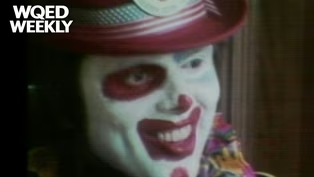
This segment highlights Jim Nagle performing as Kimo the Clown. (5m 30s)
 New
NewVideo has Closed Captions
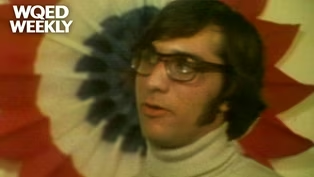
This segment features an interview with Kim Nagel, and 18-year-old running for school board director (8m 17s)
 New
NewVideo has Closed Captions
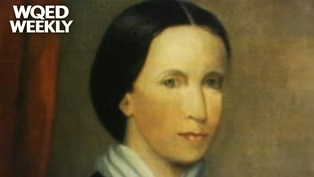
This segment features a story about Jane Grey Swisshelm, a feminist and abolitionist from the 1800s. (4m 58s)
 New
NewVideo has Closed Captions
This segment features a story about a high school senior internship program. (7m 28s)
 New
NewVideo has Closed Captions
This segment features a story about community service and support work. (8m 46s)
 New
NewVideo has Closed Captions
This segment features an interview with actor Frank Gorshin about growing up in Pittsburgh. (4m 46s)
 New
NewVideo has Closed Captions
This WQED Weekly features a story about a foster grandparent program for children with disabilities. (4m 17s)
 New
NewFiscal Crunch of PennDot and City Hall
Video has Closed Captions
This segment explores PennDOT and the City of Pittsburgh’s financial problems. (7m 38s)
 New
NewFifth Avenue High School Basketball Team
Video has Closed Captions
This segment features a story about the Fifth Avenue High School basketball team. (7m 59s)
 New
NewVideo has Closed Captions
This segment features an interview with local farmer Dick Koons. (8m 50s)
 New
NewVideo has Closed Captions
This segment highlights a program that supports the children of couples who are getting divorced. (6m 47s)
 New
NewVideo has Closed Captions
This segment explores decriminalizing marijuana possession in Pennsylvania. (9m 16s)
 Now Playing
Video has Closed Captions
This segment features a story about the Crawford Grill, a jazz bar in the Hill District. (8m 38s)
 New
NewVideo has Closed Captions
This segment features an interview with community advocate Franklin Wilhamina “Frankie” Pace (7m 35s)
 New
NewThe Claysville McGuffey Recorder
Video has Closed Captions
This segment features a story about Gene Shaw, the owner of the Claysville McGuffey Recorder. (8m 33s)
 New
NewCitizens Band Radio and Truck Driving
Video has Closed Captions
This segment features a story about citizens band radios and truck driving. (4m 16s)
 New
NewVideo has Closed Captions
This segment features a story about life performing in a circus. (9m)
 New
NewVideo has Closed Captions
This features a short film titled “A Christmas Night Story” created by Nicolas and Sandrine Schoen. (6m 27s)
 New
NewCeinwen King-Smith - A Blind Teacher at Hillel Academy
Video has Closed Captions
This segment features an interview with Ceinwen King-Smith, a blind teacher at Hillel Academy. (4m 35s)
 New
NewBreast Cancer Detection Center
Video has Closed Captions
This segment follows a screening appointment at the Breast Cancer Detection Center in Oakland. (7m 5s)
 New
NewVideo has Closed Captions
This segment explores donating blood at the Central Blood Bank of Pittsburgh. (3m 15s)
 New
NewArthur ‘Art’ J. Rooney Interview
Video has Closed Captions
This segment features an interview with Arthur ‘Art’ Rooney. (7m 29s)
 New
NewVideo has Closed Captions
This segment explores ad campaigns encouraging people to attend church. (4m 36s)
Providing Support for PBS.org
Learn Moreabout PBS online sponsorship New Episode
- News and Public Affairs

Top journalists deliver compelling original analysis of the hour's headlines.
 New Episode
- News and Public Affairs

Today's top journalists discuss Washington's current political events and public affairs.

 New Episode
 New Episode
 New Episode
 New Episode
 New Episode
 New Episode
 New Episode
 New Episode
Support for PBS provided by:
WQED Weekly is a local public television program presented by WQED