WQED Weekly
Divorce
Clip | 6m 47sVideo has Closed Captions
This segment highlights a program that supports the children of couples who are getting divorced.
This segment of WQED Weekly highlights a program that supports the children of couples who are getting divorced. The program leaders talk about the kinds of services they offer both to children and to parents with or without custody. They explain how giving children space to talk about what they might be feeling helps them transition into a new family dynamic.
Problems playing video? | Closed Captioning Feedback
Problems playing video? | Closed Captioning Feedback
WQED Weekly is a local public television program presented by WQED
WQED Weekly
Divorce
Clip | 6m 47sVideo has Closed Captions
This segment of WQED Weekly highlights a program that supports the children of couples who are getting divorced. The program leaders talk about the kinds of services they offer both to children and to parents with or without custody. They explain how giving children space to talk about what they might be feeling helps them transition into a new family dynamic.
Problems playing video? | Closed Captioning Feedback
Where to Watch WQED Weekly
WQED Weekly is available to stream on pbs.org and the PBS app.
Any issue hasn't come up about how did how did it how they explained the divorce situation to their friends?
We talked about that last week as as possibly an issue, when a child says, well, you know, is it painful at school to explain that my, my parents are divorced.
Have you ever gotten that kind of feedback them?
My oldest son, who's 16, had a very difficult time at the at the beginning, he did not want his friends to know he was.
He reacted with, I don't want anyone to pity me.
And I really was concerned.
And... - I think basically what we're trying to do is to help parents and their children to deal more effectively with the event of separation and divorce as it occurs in their lives.
And, to help them look at alternative ways of coping with the problems that occur around that, such as visitation problems, problems when their children are acting up, help them learn how to communicate as parents with each other, even though they no longer live together.
Tonight we're going to hear a story about one little boy's divorce, and the story is called Zachary's Divorce.
And here's a picture of Zachary.
Kim's heard this story before, and she thinks it's a pretty good one.
So let's see how it goes.
On this particular Saturday morning, Zachary's toes woke up first.
They wiggled and wiggled and wiggled.
We want to elicit more of the children's feelings around their feelings around separation and divorce.
And so this evening we're reading them a story entitled Zachary's Divorce, which is a short story explaining one child's feeling when he wakes up one morning and, realizes that father is not there, though this separation has been explained prior to him.
What did Zachary mean when he said it was his divorce?
I don't know, He thought it was his fault.
Yeah.
Thank you.
Children have a lot less difficulty than adults do, and they will begin a lot quicker talking about their feelings, as long as they're sure that adults are going to accept them as they are.
And as they get in touch and know that others are accepting of what they are, they're they're free to talk about them and also to learn ways of controlling them.
Well, on Wednesday evenings every two weeks, we have our custodial parents group and they are the parents who have custody of their children and they're in one room talking about the kinds of problems that they have, from week to week, as well as anticipating and looking for solutions and problem solving.
In the other room, then, are their children who are looking at and dealing with their feelings and the kinds of problems that separation and divorce have brought for them.
You know, like my daughter seems to be perfectly happy with the fact that we are still separated and not divorced.
She always brings it up and reminds me you're, still separated.
As is, if, though, you know, the word divorce was still a difficult topic for her.
And my younger daughter doesn't seem to question this whole setup at all.
She likes the idea of having her father some place and me, someplace she gets two parents doing all kinds of things for her.
She loves it, really.
She's perfectly happy.
One of the things we hope is that that we can help parents and children to promote a relationship after the divorce, that the child can maintain his relationship with his parents, with both of them separately, that the parents can maintain a relationship with themselves around the child, to promote a sense of security, a sense of continuity of care.
I'm sad because my daddy was really nice.
He gave us lots of money and stuff like that, and he is really nice.
He gave us anything we wanted.
And now my mom is kind of strict.
My dad isn't.
My dad, is like a little bit to my sister and not not to my sister.
My brother, me.
And I don't know, I think I was sad because I had a whole list of friends and like they compete on this bus I go to now.
They tease me.
You know, another bus they dont.
I think one of the most delightful things after our last children's group is the children evaluated the group and, and told us what they thought they learned.
And one of the things they learned that they felt was the most important, that it was all right to have feelings and it was all right to tell people about them.
And that, even though they were angry with their parents and they were angry about what had happened, that they found that when they told their parents, it did make them feel better.
How did Zachary's mom help him out?
She seemed to help him out a lot By telling him that it isnt his divorce.
Yes.
He doesn't have to worry about it.
We've talked about a number of issues, and that applies specifically to the parent who does not have custody of their children.
Is it ever difficult when you do find out that things are okay without you.
Doesn't that hurt a little bit?
The first time I called her, to ask her how she was doing and everything, she she talked for a minute or so, and she said, daddy, I want to go out and play with my friend now.
And it, I says, okay babe.
So we hung up, and at first I felt a little bad about it because she didn't want to talk to me.
And then I start thinking about it.
And then I thought, well, this is good.
She's getting adjusted to her new environment, and and this will be good for her.
The people who experienced separation and divorce, do not have psychiatric problems.
They have problems that anyone would have in this kind of situation.
So what we're saying is being a resource to them is that we're available to you during this period of time, and maybe we have, educational information.
We have, an idea of the kinds of things your child is experiencing.
And we can help you learn about those things.
 New
NewVideo has Closed Captions
This segment features a story about backyard gardeners. (8m 18s)
 New
NewUniversity of Pittsburgh’s Hockey Club
Video has Closed Captions
This segment features a story about the University of Pittsburgh’s Hockey Club. (5m 50s)
 New
NewVideo has Closed Captions
This segment highlights a Ukrainian cultural festival. (11m 36s)
 New
NewTransportation Challenges for Disabled Persons
Video has Closed Captions
This segment explores the transportation challenges people with disabilities face. (5m 56s)
 New
NewThree Rivers American Indian Center
Video has Closed Captions
This features an interview with Russell Sims from the Council of Three Rivers American Indian Center (6m 32s)
 New
NewSleight of Hand Magic by Paul Gertner
Video has Closed Captions
This segment features an interview and live performance by sleight of hand magician Paul Gertner. (6m 1s)
 New
NewVideo has Closed Captions
This segment features a visit to a sexual health clinic. (6m 12s)
 New
NewVideo has Closed Captions
This segment features a story about the Schuman Center, a juvenile detention center. (7m 42s)
 New
NewReenactment Battles at Lexington and Concord
Video has Closed Captions
This segment features a reenactment of the battles of Lexington and Concord by grade school children (6m 53s)
 New
NewVideo has Closed Captions
This highlights Reach to Recovery, a program that supports women recovering from mastectomies. (7m 26s)
 New
NewVideo has Closed Captions
This highlights the Powder Mill Nature Reserve and the work of environmental activist Ruth Scott. (9m 18s)
 New
NewVideo has Closed Captions
This segment explores a police counseling program. (5m 52s)
 New
NewPittsburgh Penguins Financial Problems
Video has Closed Captions
This segment features a story about the Pittsburgh Penguins’ financial problems. (7m 14s)
 New
NewVideo has Closed Captions
This segment features an interview with Pittsburgh Mayor Pete Flaherty. (5m 39s)
 New
NewVideo has Closed Captions
This segment of WQED Weekly features a story about penny candy. (5m 13s)
 New
NewVideo has Closed Captions
This features an interview with, Oliver Mason, a former City of Pittsburgh police officer. (8m 3s)
 New
NewNational Organization for Non-Parents
Video has Closed Captions
This is about the National Organization for Non-parents, a group supporting child-free couples. (7m 15s)
 New
NewMeridian Elementary School Football Team
Video has Closed Captions
This segment features footage of the Meridian Elementary School football team. (10m 20s)
 New
NewVideo has Closed Captions
This segment features an interview with Sarah and Rachel McClelland. (8m 54s)
 New
NewMaintenance in Terrace Village
Video has Closed Captions
This explores maintenance problems in low-income housing run by the Pittsburgh Housing Authority. (8m 52s)
 New
NewVideo has Closed Captions
This segment features an interview with Leon Bibber, a man who spent 19 years building a boat. (7m 10s)
 New
NewVideo has Closed Captions
This segment highlights Jim Nagle performing as Kimo the Clown. (5m 30s)
 New
NewVideo has Closed Captions
This segment features an interview with Kim Nagel, and 18-year-old running for school board director (8m 17s)
 New
NewVideo has Closed Captions
This segment features a story about Jane Grey Swisshelm, a feminist and abolitionist from the 1800s. (4m 58s)
 New
NewVideo has Closed Captions
This segment features a story about a high school senior internship program. (7m 28s)
 New
NewVideo has Closed Captions
This segment features a story about community service and support work. (8m 46s)
 New
NewVideo has Closed Captions
This segment features an interview with actor Frank Gorshin about growing up in Pittsburgh. (4m 46s)
 New
NewVideo has Closed Captions
This WQED Weekly features a story about a foster grandparent program for children with disabilities. (4m 17s)
 New
NewFiscal Crunch of PennDot and City Hall
Video has Closed Captions
This segment explores PennDOT and the City of Pittsburgh’s financial problems. (7m 38s)
 New
NewFifth Avenue High School Basketball Team
Video has Closed Captions
This segment features a story about the Fifth Avenue High School basketball team. (7m 59s)
 New
NewVideo has Closed Captions
This segment features an interview with local farmer Dick Koons. (8m 50s)
 Now Playing
Video has Closed Captions
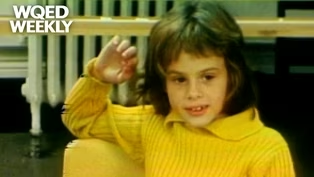
This segment highlights a program that supports the children of couples who are getting divorced. (6m 47s)
 New
NewVideo has Closed Captions
This segment explores decriminalizing marijuana possession in Pennsylvania. (9m 16s)
 New
NewVideo has Closed Captions
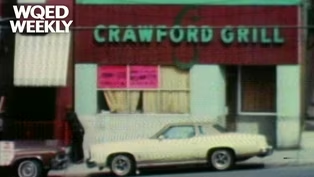
This segment features a story about the Crawford Grill, a jazz bar in the Hill District. (8m 38s)
 New
NewVideo has Closed Captions
This segment features an interview with community advocate Franklin Wilhamina “Frankie” Pace (7m 35s)
 New
NewThe Claysville McGuffey Recorder
Video has Closed Captions
This segment features a story about Gene Shaw, the owner of the Claysville McGuffey Recorder. (8m 33s)
 New
NewCitizens Band Radio and Truck Driving
Video has Closed Captions
This segment features a story about citizens band radios and truck driving. (4m 16s)
 New
NewVideo has Closed Captions
This segment features a story about life performing in a circus. (9m)
 New
NewVideo has Closed Captions
This features a short film titled “A Christmas Night Story” created by Nicolas and Sandrine Schoen. (6m 27s)
 New
NewCeinwen King-Smith - A Blind Teacher at Hillel Academy
Video has Closed Captions
This segment features an interview with Ceinwen King-Smith, a blind teacher at Hillel Academy. (4m 35s)
 New
NewBreast Cancer Detection Center
Video has Closed Captions
This segment follows a screening appointment at the Breast Cancer Detection Center in Oakland. (7m 5s)
 New
NewVideo has Closed Captions
This segment explores donating blood at the Central Blood Bank of Pittsburgh. (3m 15s)
 New
NewArthur ‘Art’ J. Rooney Interview
Video has Closed Captions
This segment features an interview with Arthur ‘Art’ Rooney. (7m 29s)
 New
NewVideo has Closed Captions
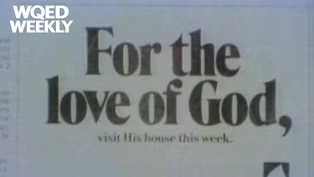
This segment explores ad campaigns encouraging people to attend church. (4m 36s)
Providing Support for PBS.org
Learn Moreabout PBS online sponsorship New Episode
- News and Public Affairs

Top journalists deliver compelling original analysis of the hour's headlines.
 New Episode
- News and Public Affairs

Today's top journalists discuss Washington's current political events and public affairs.


 New Episode
 New Episode
 New Episode
 New Episode
 New Episode
 New Episode
 New Episode
 New Episode
Support for PBS provided by:
WQED Weekly is a local public television program presented by WQED