WQED Weekly
Breast Cancer Detection Center
Clip | 7m 5sVideo has Closed Captions
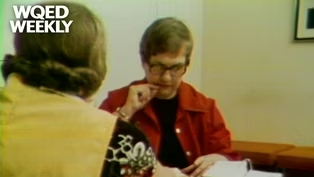
This segment follows a screening appointment at the Breast Cancer Detection Center in Oakland.
This segment of WQED Weekly follows a breast cancer screening appointment at the Breast Cancer Detection Center in Oakland. The patient receives a thermogram, a mammogram, and a physical examination. Staff at the clinic explain the importance of regular self-examinations, early detection, and education in improving the cure rate for breast cancer.
Problems playing video? | Closed Captioning Feedback
Problems playing video? | Closed Captioning Feedback
WQED Weekly is a local public television program presented by WQED
WQED Weekly
Breast Cancer Detection Center
Clip | 7m 5sVideo has Closed Captions
This segment of WQED Weekly follows a breast cancer screening appointment at the Breast Cancer Detection Center in Oakland. The patient receives a thermogram, a mammogram, and a physical examination. Staff at the clinic explain the importance of regular self-examinations, early detection, and education in improving the cure rate for breast cancer.
Problems playing video? | Closed Captioning Feedback
Where to Watch WQED Weekly
WQED Weekly is available to stream on pbs.org and the PBS app.
In a modern office building in Oakland, there is a project underway which may be very literally a matter of life and death.
The breast Cancer Detection Center is screening women between the ages of 35 and 70 to find out if early detection of breast cancer can save lives.
Yes.
That's right.
Alright.
Now this is a consent form that we ask you to fill out the top part here.
It explains the program and your signature would go here.
And then the references that we ask you to bring in will go on those lines.
One of 29 such centers across the country, funded by the National Cancer Institute and the American Cancer Society, the Breast Cancer Detection Center uses specially designed machines and techniques to uncover possible abnormalities in the breast.
Do you have any breast cancer history in your family?
No, no, alright then routine checkup is usually what we marked for that one, now.
And page two.
How did you hear about the program?
A friend told me about it.
How many times has the doctor examined your breast?
Well, every time I go for an examination.
Once a year, every year.
Good.
Okay.
Do you do self breast exams every month?
Regularly?
No.
Not regularly, no.
Well, you're in for a lecture then.
If you don't do it regularly.
Why don't you do it regularly?
I don't know, I guess I just don't even think about it.
I'm not.
Not in the habit of doing it.
It seems as if you go to the doctor once a year that would be enough.
No, it isn't enough.
If you go to your doctor once a year.
Say you went in January.
Something started growing within your breast, whether it be a just a cyst or a tumor in March.
You didn't go back to your doctor for nine months until the next January.
That would have nine months to grow.
And that is against you.
That is time working against you.
If you do your breast every month you went in January, the doctor checked you.
You were all right.
March.
You felt something.
You could call your doctor immediately and say, doctor, I think I found some a lump and he would tell you to come in.
There, time is working for you.
Not nine months against you, but you are right on top of the situation, and it's the most important thing that you can do.
You.
The breasts are right there for you to examine.
They're not hidden.
Okay, okay.
That's good.
She's then escorted in into the dressing room, where she changes into a paper gown and proceeds on to the waiting room from the waiting room, she's called by the technician to have a thermogram done.
Before the woman can have a thermogram done, she has to sit in a room with a temperature of 68 to 70 degree 70 degrees for approximately 8 to 10 minutes.
We have to lower your outside body temperature so that we can get a good heat reading on our thermogram exam.
Okay.
Take a hold of the bar above your head.
Step forward slightly.
Try not to move.
This is not an x-ray.
It's an infrared scanner that picks up the heat from your breast.
Turn to your right about halfway.
Theres a theory that increased heat in one breast could indicate that there may be some abnormal growth in that one breast.
The thermogram is never used alone.
It's always used in correlation with the mammogram and the physical exam.
Okay.
Do you want to step right over here, take your top off.
Put it on the stand.
I'd like you to have a seat on this stool.
Have you ever had any children?
No.
Okay.
Sit up real straight.
This is your breast X-ray.
Okay.
I want you to sit real still and I will move you.
Okay.
Sit up real straight.
Okay.
Now you're going to feel some compression on your breast.
Now, it will be a little tight.
Okay?
Now hold very still and don't breathe.
All participants agree to an annual examination over a five year period.
Most women's examinations fall within normal limits.
Those who do not are immediately referred to their own physician.
Slingback.
Okay.
Why dont you sit up real straight.
Okay.
During a picture, right hand on top of your hand.
That's an eyebrow straight.
Hold your left breast back.
You can lean away just.
We use a Xerox process here so that the X-ray picture comes out on paper instead of black film.
In the picture, it's blue and white.
It shows us a detailed X-ray of the breast and the chest wall and the rib cage.
Finally, a physical examination of the breasts and instruction in the simple procedures of self breast examination are carried out by a nurse.
Although the primary purpose of the yearly visit is an examination, it also serves as an important educational tool.
Out there.
So would you put your hands on your hips Alright, raise your hands over your head thats fine, put your hands back on your hips.
So far we've screened 6050 women.
And what is your ultimate goal?
We plan to screen 10,000 women and follow these 10,000 women for five years.
The cure rate for breast cancer today is no better than it was 35 years ago.
But early detection, the mission of the breast cancer Detection Center and prompt treatment can dramatically increase the chances for cure.
 New
NewVideo has Closed Captions
This segment features a story about backyard gardeners. (8m 18s)
 New
NewUniversity of Pittsburgh’s Hockey Club
Video has Closed Captions
This segment features a story about the University of Pittsburgh’s Hockey Club. (5m 50s)
 New
NewVideo has Closed Captions
This segment highlights a Ukrainian cultural festival. (11m 36s)
 New
NewTransportation Challenges for Disabled Persons
Video has Closed Captions
This segment explores the transportation challenges people with disabilities face. (5m 56s)
 New
NewThree Rivers American Indian Center
Video has Closed Captions
This features an interview with Russell Sims from the Council of Three Rivers American Indian Center (6m 32s)
 New
NewSleight of Hand Magic by Paul Gertner
Video has Closed Captions
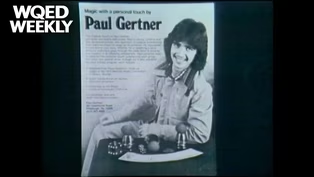
This segment features an interview and live performance by sleight of hand magician Paul Gertner. (6m 1s)
 New
NewVideo has Closed Captions
This segment features a visit to a sexual health clinic. (6m 12s)
 New
NewVideo has Closed Captions
This segment features a story about the Schuman Center, a juvenile detention center. (7m 42s)
 New
NewReenactment Battles at Lexington and Concord
Video has Closed Captions
This segment features a reenactment of the battles of Lexington and Concord by grade school children (6m 53s)
 New
NewVideo has Closed Captions
This highlights Reach to Recovery, a program that supports women recovering from mastectomies. (7m 26s)
 New
NewVideo has Closed Captions
This highlights the Powder Mill Nature Reserve and the work of environmental activist Ruth Scott. (9m 18s)
 New
NewVideo has Closed Captions
This segment explores a police counseling program. (5m 52s)
 New
NewPittsburgh Penguins Financial Problems
Video has Closed Captions
This segment features a story about the Pittsburgh Penguins’ financial problems. (7m 14s)
 New
NewVideo has Closed Captions
This segment features an interview with Pittsburgh Mayor Pete Flaherty. (5m 39s)
 New
NewVideo has Closed Captions
This segment of WQED Weekly features a story about penny candy. (5m 13s)
 New
NewVideo has Closed Captions
This features an interview with, Oliver Mason, a former City of Pittsburgh police officer. (8m 3s)
 New
NewNational Organization for Non-Parents
Video has Closed Captions
This is about the National Organization for Non-parents, a group supporting child-free couples. (7m 15s)
 New
NewMeridian Elementary School Football Team
Video has Closed Captions
This segment features footage of the Meridian Elementary School football team. (10m 20s)
 New
NewVideo has Closed Captions
This segment features an interview with Sarah and Rachel McClelland. (8m 54s)
 New
NewMaintenance in Terrace Village
Video has Closed Captions
This explores maintenance problems in low-income housing run by the Pittsburgh Housing Authority. (8m 52s)
 New
NewVideo has Closed Captions
This segment features an interview with Leon Bibber, a man who spent 19 years building a boat. (7m 10s)
 New
NewVideo has Closed Captions
This segment highlights Jim Nagle performing as Kimo the Clown. (5m 30s)
 New
NewVideo has Closed Captions
This segment features an interview with Kim Nagel, and 18-year-old running for school board director (8m 17s)
 New
NewVideo has Closed Captions
This segment features a story about Jane Grey Swisshelm, a feminist and abolitionist from the 1800s. (4m 58s)
 New
NewVideo has Closed Captions
This segment features a story about a high school senior internship program. (7m 28s)
 New
NewVideo has Closed Captions
This segment features a story about community service and support work. (8m 46s)
 New
NewVideo has Closed Captions
This segment features an interview with actor Frank Gorshin about growing up in Pittsburgh. (4m 46s)
 New
NewVideo has Closed Captions
This WQED Weekly features a story about a foster grandparent program for children with disabilities. (4m 17s)
 New
NewFiscal Crunch of PennDot and City Hall
Video has Closed Captions
This segment explores PennDOT and the City of Pittsburgh’s financial problems. (7m 38s)
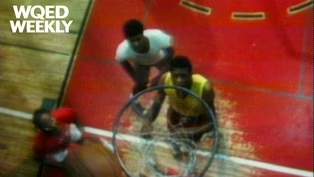 New
NewFifth Avenue High School Basketball Team
Video has Closed Captions
This segment features a story about the Fifth Avenue High School basketball team. (7m 59s)
 New
NewVideo has Closed Captions
This segment features an interview with local farmer Dick Koons. (8m 50s)
 New
NewVideo has Closed Captions
This segment highlights a program that supports the children of couples who are getting divorced. (6m 47s)
 New
NewVideo has Closed Captions
This segment explores decriminalizing marijuana possession in Pennsylvania. (9m 16s)
 New
NewVideo has Closed Captions
This segment features a story about the Crawford Grill, a jazz bar in the Hill District. (8m 38s)
 New
NewVideo has Closed Captions
This segment features an interview with community advocate Franklin Wilhamina “Frankie” Pace (7m 35s)
 New
NewThe Claysville McGuffey Recorder
Video has Closed Captions
This segment features a story about Gene Shaw, the owner of the Claysville McGuffey Recorder. (8m 33s)
 New
NewCitizens Band Radio and Truck Driving
Video has Closed Captions
This segment features a story about citizens band radios and truck driving. (4m 16s)
 New
NewVideo has Closed Captions
This segment features a story about life performing in a circus. (9m)
 New
NewVideo has Closed Captions
This features a short film titled “A Christmas Night Story” created by Nicolas and Sandrine Schoen. (6m 27s)
 New
NewCeinwen King-Smith - A Blind Teacher at Hillel Academy
Video has Closed Captions
This segment features an interview with Ceinwen King-Smith, a blind teacher at Hillel Academy. (4m 35s)
 Now Playing
Breast Cancer Detection Center
Video has Closed Captions
This segment follows a screening appointment at the Breast Cancer Detection Center in Oakland. (7m 5s)
 New
NewVideo has Closed Captions
This segment explores donating blood at the Central Blood Bank of Pittsburgh. (3m 15s)
 New
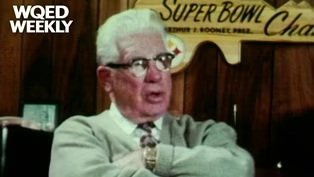
NewArthur ‘Art’ J. Rooney Interview
Video has Closed Captions
This segment features an interview with Arthur ‘Art’ Rooney. (7m 29s)
 New
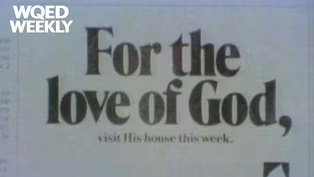
NewVideo has Closed Captions
This segment explores ad campaigns encouraging people to attend church. (4m 36s)
Providing Support for PBS.org
Learn Moreabout PBS online sponsorship New Episode
- News and Public Affairs

Top journalists deliver compelling original analysis of the hour's headlines.
 New Episode
- News and Public Affairs

Today's top journalists discuss Washington's current political events and public affairs.


 New Episode
 New Episode
 New Episode
 New Episode
 New Episode
 New Episode
 New Episode
 New Episode
Support for PBS provided by:
WQED Weekly is a local public television program presented by WQED