WQED Weekly
Oliver Mason Interview
Clip | 8m 3sVideo has Closed Captions
This features an interview with, Oliver Mason, a former City of Pittsburgh police officer.
This segment of WQED Weekly features a story about, and interview with, Oliver Mason, a former City of Pittsburgh police officer. Residents of the Hill District give varying opinions on his service. Oliver talks about his philosophy towards law enforcement and his various injuries on the job. Former colleagues talk about what it was like to work with him.
Problems playing video? | Closed Captioning Feedback
Problems playing video? | Closed Captioning Feedback
WQED Weekly is a local public television program presented by WQED
WQED Weekly
Oliver Mason Interview
Clip | 8m 3sVideo has Closed Captions
This segment of WQED Weekly features a story about, and interview with, Oliver Mason, a former City of Pittsburgh police officer. Residents of the Hill District give varying opinions on his service. Oliver talks about his philosophy towards law enforcement and his various injuries on the job. Former colleagues talk about what it was like to work with him.
Problems playing video? | Closed Captioning Feedback
Where to Watch WQED Weekly
WQED Weekly is available to stream on pbs.org and the PBS app.
His name is Oliver Mason, a retired City of Pittsburgh policeman.
Looking at him today, it might be hard to believe that for over 20 years, this quiet, grandfatherly man was one of the most controversial figures to ever serve on the city's police force.
He is a legend in the police department and in his Hill district, where he fight crime during the 40s, 50s and 60s.
But he is a controversial legend, a true to life study and contrast, in public opinion.
Mason, the cop's life is the stuff of which the movies and television police shows are made.
And when asking about his days as a policeman in the Hill district, the opinions and stories about Pittsburgh's toughest black cop abound.
Well, when Mr.
Mason was a policeman up here, I've been up here on this block for almost 30 some years, and he used to man this block.
You didn't have to put up any gates.
Nobody went in alleys.
He shut the doors at night.
Your businesses were protected.
And he maned it by himself.
He was a real policeman.
When he said stop, he meant stop.
And that's what he did.
He was really a blessing when he was up in here.
And I would be a long time before we get another cop can do it is when people wanted somebody to go where places was critical.
They came and got.
They came and got Mr.
Mason and he would go there.
Well, I think he was a fine policeman.
I think that, he really tried to, tear out the law and, I think if wed had, quite a few Masons up here, more Masons than what we had, I don't think the Hill district would have been, infested with the hoodlum that we've had.
I heard that he was hard on the ones that didn't want to act right.
So as myself, I stayed a long ways away from him.
That's all I can tell you about the man.
Telling you the truth.
And I heard he was no good, right?
I mean, my father told me.
Yeah, well.
- Said he had trouble with him.
Said he was mean, you know.
Yeah.
He was always waving his guns and around and stuff, you know, threaten people with the gun, his gun.
I think he was kind.
If I seen him on this side I got on the side of the street.
He was a good policeman.
He was stern.
He went by the block and everybody respect him.
Basically, to come down this side of the street and say, give me that side.
When he come back on the other side, was nobody on this side.
You know?
And he did love with beer.
Guys asked for drinks.
So that's what I've said.
He's a good cop.
Even though the public opinion still wages over him, his scrapbooks and walls are full of commendations, awards, citations and pictures of his accomplishments.
Even though everyone calls him a legend, today, Mason, the cop at age 72, lives quietly in an elderly high rise and does not acknowledge his colorful past.
After being wounded 11 times after having engaged in numerous gun battles with criminals, after having been a neighborhood hero for 20 years, he still feels he wasn't doing anything special.
All I was doing was my job.
My duty.
You have to be a little bit afraid.
It all depends on what you.
Who you were going after.
If you were going after someone bad, you always look to the worst.
Like any policeman.
Today, he.
He knows it, when he knows he's going after a man that's, reputed to be bad.
He knows what he's up against, but he cant turn back.
When you had to use your revolver, what went through your mind?
Well, I wouldn't use it unless it was necessary.
When it was necessary, I used it.
But due to the fact of my training, I had to use it with efficiency.
Otherwise I wouldn't be here.
You've been shot twice?
- Wounded 11 times, but shot twice.
Head busted open into my eyes.
Been hospitalized.
I‘d have that many times.
Didn't it ever make you want to quit?
No.
It was more of a challenge.
Somebody had to do it.
But the men who work with Mason have quite a different opinion on what made him a legend in the Hill district.
Yes, he was a loner.
He preferred to work by himself.
And, as I say, he, he was a tough kind of guy, you know?
And the people, not so much fear, but I think respect is the word they had for Oliver.
It wasn't, it wasn't a fear, but it was a respect.
Cause when you were wrong or wrong.
And he wouldnt hesitate no matter what your reputation was in the community.
or how large you were, or how bad in quotation marks you were supposed to be.
If you, came up against Oliver, you just had to go one way or the other.
Would you describe him as a tough cop?
Very tough cop.
He had a nice reputation, and, he was one of the few officers that always did get his man.
Well, actually, Ollie was an easygoing person, but he was very dedicated.
And, hours mean nothing going as far as working was always out in the area.
You could see him at 3:00 in the morning.
You see him at 2:00 in the afternoon.
He was always working, and he worked mostly by himself.
To the criminal he was considered a hard man and a tough man.
But to the people on the right side of the law, the merchant and the citizen, they considered him a very good man, a very conscientious man.
And to the youngsters in the street, he was a friend.
He carried a couple of guns as I understand.
- Yes, he did.
And you know what I never knew which side which side he was going to pull one from.
I can also tell you that, when the government agencies would be looking for somebody, they would always come up here.
That's in the Hill district here.
They come up here and, they would get ahold of Oliver.
That's from the post Office Department or the Secret Service department.
And if they had a picture of the fellow, Oliver worked the clock around.
He worked there.
I worked around the clock.
He wouldn't.
They wouldn't go home until he found the fellow.
And invariably, he would find them.
Some place.
Oliver Mason will never see himself as anyone special, even though the factual and fictional accounts of his exploits will continue to grow.
As far as he's concerned, he was just a policeman doing his job, a job that now needs to be left to today's policeman.
Do you miss being on the police force?
Do you wish you were still were a regular patrolman or detective with the city police?
No, I don't miss it.
And I wouldn't want it.
I'm too old.
I know I'm not as active as I was.
And, it's for the younger men to do.
Knowing that people need help.
And you got to be there.
You.
You got to stop them.
Otherwise you won't be able to live where you live.
Wherever that person lives, the policemen, his own community wouldnt be the same.
It'll spread to any community.
So he would be living in fear in his own neighborhood.
So hes go to meet that challenge?
And it is a challenge.
 New
NewVideo has Closed Captions
This segment features a story about backyard gardeners. (8m 18s)
 New
NewUniversity of Pittsburgh’s Hockey Club
Video has Closed Captions
This segment features a story about the University of Pittsburgh’s Hockey Club. (5m 50s)
 New
NewVideo has Closed Captions
This segment highlights a Ukrainian cultural festival. (11m 36s)
 New
NewTransportation Challenges for Disabled Persons
Video has Closed Captions
This segment explores the transportation challenges people with disabilities face. (5m 56s)
 New
NewThree Rivers American Indian Center
Video has Closed Captions
This features an interview with Russell Sims from the Council of Three Rivers American Indian Center (6m 32s)
 New
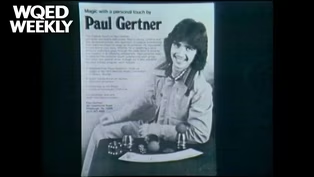
NewSleight of Hand Magic by Paul Gertner
Video has Closed Captions
This segment features an interview and live performance by sleight of hand magician Paul Gertner. (6m 1s)
 New
NewVideo has Closed Captions
This segment features a visit to a sexual health clinic. (6m 12s)
 New
NewVideo has Closed Captions
This segment features a story about the Schuman Center, a juvenile detention center. (7m 42s)
 New
NewReenactment Battles at Lexington and Concord
Video has Closed Captions
This segment features a reenactment of the battles of Lexington and Concord by grade school children (6m 53s)
 New
NewVideo has Closed Captions
This highlights Reach to Recovery, a program that supports women recovering from mastectomies. (7m 26s)
 New
NewVideo has Closed Captions
This highlights the Powder Mill Nature Reserve and the work of environmental activist Ruth Scott. (9m 18s)
 New
NewVideo has Closed Captions
This segment explores a police counseling program. (5m 52s)
 New
NewPittsburgh Penguins Financial Problems
Video has Closed Captions
This segment features a story about the Pittsburgh Penguins’ financial problems. (7m 14s)
 New
NewVideo has Closed Captions
This segment features an interview with Pittsburgh Mayor Pete Flaherty. (5m 39s)
 New
NewVideo has Closed Captions
This segment of WQED Weekly features a story about penny candy. (5m 13s)
 Now Playing
Video has Closed Captions
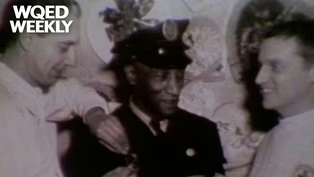
This features an interview with, Oliver Mason, a former City of Pittsburgh police officer. (8m 3s)
 New
NewNational Organization for Non-Parents
Video has Closed Captions
This is about the National Organization for Non-parents, a group supporting child-free couples. (7m 15s)
 New
NewMeridian Elementary School Football Team
Video has Closed Captions
This segment features footage of the Meridian Elementary School football team. (10m 20s)
 New
NewVideo has Closed Captions
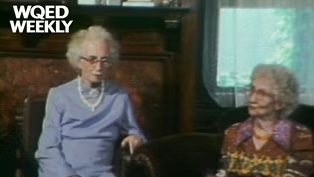
This segment features an interview with Sarah and Rachel McClelland. (8m 54s)
 New
NewMaintenance in Terrace Village
Video has Closed Captions
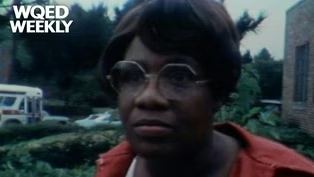
This explores maintenance problems in low-income housing run by the Pittsburgh Housing Authority. (8m 52s)
 New
NewVideo has Closed Captions
This segment features an interview with Leon Bibber, a man who spent 19 years building a boat. (7m 10s)
 New
NewVideo has Closed Captions
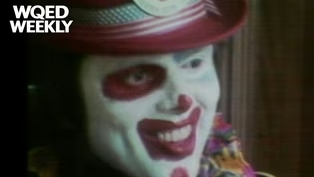
This segment highlights Jim Nagle performing as Kimo the Clown. (5m 30s)
 New
NewVideo has Closed Captions
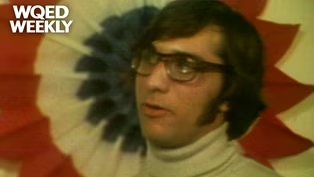
This segment features an interview with Kim Nagel, and 18-year-old running for school board director (8m 17s)
 New
NewVideo has Closed Captions
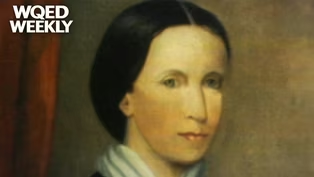
This segment features a story about Jane Grey Swisshelm, a feminist and abolitionist from the 1800s. (4m 58s)
 New
NewVideo has Closed Captions
This segment features a story about a high school senior internship program. (7m 28s)
 New
NewVideo has Closed Captions
This segment features a story about community service and support work. (8m 46s)
 New
NewVideo has Closed Captions
This segment features an interview with actor Frank Gorshin about growing up in Pittsburgh. (4m 46s)
 New
NewVideo has Closed Captions
This WQED Weekly features a story about a foster grandparent program for children with disabilities. (4m 17s)
 New
NewFiscal Crunch of PennDot and City Hall
Video has Closed Captions
This segment explores PennDOT and the City of Pittsburgh’s financial problems. (7m 38s)
 New
NewFifth Avenue High School Basketball Team
Video has Closed Captions
This segment features a story about the Fifth Avenue High School basketball team. (7m 59s)
 New
NewVideo has Closed Captions
This segment features an interview with local farmer Dick Koons. (8m 50s)
 New
NewVideo has Closed Captions
This segment highlights a program that supports the children of couples who are getting divorced. (6m 47s)
 New
NewVideo has Closed Captions
This segment explores decriminalizing marijuana possession in Pennsylvania. (9m 16s)
 New
NewVideo has Closed Captions
This segment features a story about the Crawford Grill, a jazz bar in the Hill District. (8m 38s)
 New
NewVideo has Closed Captions
This segment features an interview with community advocate Franklin Wilhamina “Frankie” Pace (7m 35s)
 New
NewThe Claysville McGuffey Recorder
Video has Closed Captions
This segment features a story about Gene Shaw, the owner of the Claysville McGuffey Recorder. (8m 33s)
 New
NewCitizens Band Radio and Truck Driving
Video has Closed Captions
This segment features a story about citizens band radios and truck driving. (4m 16s)
 New
NewVideo has Closed Captions
This segment features a story about life performing in a circus. (9m)
 New
NewVideo has Closed Captions
This features a short film titled “A Christmas Night Story” created by Nicolas and Sandrine Schoen. (6m 27s)
 New
NewCeinwen King-Smith - A Blind Teacher at Hillel Academy
Video has Closed Captions
This segment features an interview with Ceinwen King-Smith, a blind teacher at Hillel Academy. (4m 35s)
 New
NewBreast Cancer Detection Center
Video has Closed Captions
This segment follows a screening appointment at the Breast Cancer Detection Center in Oakland. (7m 5s)
 New
NewVideo has Closed Captions
This segment explores donating blood at the Central Blood Bank of Pittsburgh. (3m 15s)
 New
NewArthur ‘Art’ J. Rooney Interview
Video has Closed Captions
This segment features an interview with Arthur ‘Art’ Rooney. (7m 29s)
 New
NewVideo has Closed Captions
This segment explores ad campaigns encouraging people to attend church. (4m 36s)
Providing Support for PBS.org
Learn Moreabout PBS online sponsorship New Episode
- News and Public Affairs

Top journalists deliver compelling original analysis of the hour's headlines.
 New Episode
- News and Public Affairs

Today's top journalists discuss Washington's current political events and public affairs.

 New Episode
 New Episode
 New Episode
 New Episode
 New Episode
 New Episode
 New Episode
 New Episode
Support for PBS provided by:
WQED Weekly is a local public television program presented by WQED