WQED Weekly
Reach to Recovery
Clip | 7m 26sVideo has Closed Captions
This highlights Reach to Recovery, a program that supports women recovering from mastectomies.
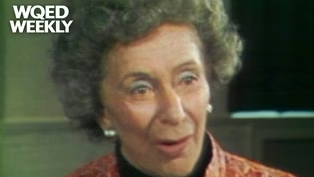
This segment of WQED Weekly features a story about Reach to Recovery, a support program for women who have had mastectomies due to breast cancer. Program creator Terese Lasser describes the rigorous training volunteers receive, the kinds of support they offer to women who are recovering from surgery, and some of the goals she has for the program.
Problems playing video? | Closed Captioning Feedback
Problems playing video? | Closed Captioning Feedback
WQED Weekly is a local public television program presented by WQED
WQED Weekly
Reach to Recovery
Clip | 7m 26sVideo has Closed Captions
This segment of WQED Weekly features a story about Reach to Recovery, a support program for women who have had mastectomies due to breast cancer. Program creator Terese Lasser describes the rigorous training volunteers receive, the kinds of support they offer to women who are recovering from surgery, and some of the goals she has for the program.
Problems playing video? | Closed Captioning Feedback
Where to Watch WQED Weekly
WQED Weekly is available to stream on pbs.org and the PBS app.
Reached to Recovery is a program of the American Cancer Society.
A rehabilitation program for women who have had breast surgery.
It's designed to help them meet their physical, psychological, and cosmetic needs.
Reached to Recovery works through volunteer visitors, a carefully selected and trained core of women who have successfully adjusted to their own breast surgery.
Now well established in hospitals across the country, this pioneering program was begun in 1952 by Mrs.
Theresa Lasser of New York City.
After my own operation, when I needed to know how to do certain things.
There wasn't anyone to whom I could turn.
My doctor suggested that I talk to my nurse.
My nurse, unfortunately, knew less than I. Okay now.
She can only go this far, but you're going to show her what she hopes to attain ultimately.
Now, I'm going to do it much more rapidly, and we will be doing it with a patient in the hospital because it has to be done very, very slowly.
I'm sticking to this wall.
It's a strange.
Please notice I have left the the wall and my arms have gone up and now I'm going to coax her to get a little bit more stretch out of this.
And how do we do this ?
Please, Mrs.
Jones, will you straighten that elbow for me?
Just a little bit?
You don't touch me.
You don't touch me.
I do this myself.
I do this myself.
You see, I've got myself another couple of inches.
My head is still against the wall.
I am relaxed, and now I come in until my fingertips touch and the inner part of my arms are touching my ears.
Now, remember, your patient cannot do this in the hospital.
You are showing her what she has to do ultimately.
Next time your feet should be far enough away from the wall so that you're comfortable.
Your knee should be flexed.
Your entire forearm should be resting against the wall, completely relaxed, with your fingers cupped, and you start going up slowly, slowly.
I think this first lady is too far away from the wall.
Get a little closer and the second one is too.
You can't do it comfortably that far away from the wall.
I think I've answered every question I can think of that any woman has ever asked.
And what we have in this book are simple words, plus pictures of all kinds, which show precisely how to do everything we suggest to the patient in the hospital room.
And these have all been checked very carefully by physiotherapist.
Doctors in physical medicine as well as physiotherapists.
Exercises are not the only thing which are carefully checked out.
Mrs.
Lasser trains volunteers with almost military precision before accepting them as hospital visitors.
A volunteer must be a woman who has had a mastectomy and who is so well groomed and fitted with a prosthesis that she is able to give the patient an emotional boost at a very difficult time.
After 23 years of training volunteers, Mrs.
Lasser is convinced that she knows what will work.
Our training is very rigorous and the weaklings fall by the wayside.
I just don't accept it.
...You at any point.
Throw it out from the shoulder.
You don't have to catch it, but throw it out.
And what you're doing is not right.
So stand up, move away and throw the ball out.
Don't face her.
Move away.
Throw it out, from your arm.
Separate your legs.
Remember, we have a standard position.
I was married to a very gentle man.
He took his cues from me.
When I returned home, I believe because I had become abhorrent to myself that I was equally as abhorrent to him.
So I dressed and undressed in a closet and he went into the bathroom.
Well, that had not been the usual procedure, and months went by, and I was quite young then, and he did not come near me sexually, so I thought I truly was obnoxious to him.
And I kept thinking, well he want to divorce, and anyday now he's going to ask for one.
Until I wrote the very first thing that I ever wrote at the insistence of my doctor, when I put down, when I actually felt as a human being what had happened to me after my surgery, my reactions to that surgery, the lack of help, all that went into just a little sample brochure.
My husband, who was a writer, he was the man who wrote your know Income tax that you see on the stamps.
And he was a very prolific writer and a very fine one.
Knowing I was going to show this to the doctor, I said, would you mind looking at this, dear?
And he looked at it, and then I saw something which I had never seen before.
I saw him weeping, and he said, My God, what have I done to you?
And then I realized that I, in my own stupidity, had done it to us, and only by the grace of God had I kept my marriage together.
I think once a woman recognizes that she's living.
The next thought is, if she's unmarried, will a man ever be interested in me?
If she's young and she's married, how can I burden a young man with this for the rest of his life?
As she goes on in years and regardless of years, depending upon how much of a woman she is.
Yes, I would say without question that this is the thing that most women talk to me about.
There are still doctors who feel.
And, you know, I think rightfully so, that perhaps a volunteer is likely to do or say something that might be harmful to his patient.
What they don't understand is the tremendous care we exercised in accepting a volunteer to visit in the room of a patient.
We will accept anyone who wants to work with us, but that patient who visits another patient is very carefully screened for her emotional background.
We take a temporary breast form, and hopefully some civic minded citizen or group of people will underwrite the cost of the temporary bras, which we hope will be given as they are in the rest of the country, because the American Cancer Society cannot afford to give them, even though they cost only $15 a dozen.
But we would like each patient that we call upon to be given a form and a bra to wear home so that when she returns home and if she meets a little nosy neighbor and she has decided she doesn't want to tell, that's entirely up to her.
She looks as she looked when she went to the hospital.
No one need to know unless she chooses to tell.
 New
NewVideo has Closed Captions
This segment features a story about backyard gardeners. (8m 18s)
 New
NewUniversity of Pittsburgh’s Hockey Club
Video has Closed Captions
This segment features a story about the University of Pittsburgh’s Hockey Club. (5m 50s)
 New
NewVideo has Closed Captions
This segment highlights a Ukrainian cultural festival. (11m 36s)
 New
NewTransportation Challenges for Disabled Persons
Video has Closed Captions
This segment explores the transportation challenges people with disabilities face. (5m 56s)
 New
NewThree Rivers American Indian Center
Video has Closed Captions
This features an interview with Russell Sims from the Council of Three Rivers American Indian Center (6m 32s)
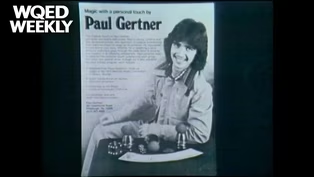 New
NewSleight of Hand Magic by Paul Gertner
Video has Closed Captions
This segment features an interview and live performance by sleight of hand magician Paul Gertner. (6m 1s)
 New
NewVideo has Closed Captions
This segment features a visit to a sexual health clinic. (6m 12s)
 New
NewVideo has Closed Captions
This segment features a story about the Schuman Center, a juvenile detention center. (7m 42s)
 New
NewReenactment Battles at Lexington and Concord
Video has Closed Captions
This segment features a reenactment of the battles of Lexington and Concord by grade school children (6m 53s)
 Now Playing
Video has Closed Captions
This highlights Reach to Recovery, a program that supports women recovering from mastectomies. (7m 26s)
 New
NewVideo has Closed Captions
This highlights the Powder Mill Nature Reserve and the work of environmental activist Ruth Scott. (9m 18s)
 New
NewVideo has Closed Captions
This segment explores a police counseling program. (5m 52s)
 New
NewPittsburgh Penguins Financial Problems
Video has Closed Captions
This segment features a story about the Pittsburgh Penguins’ financial problems. (7m 14s)
 New
NewVideo has Closed Captions
This segment features an interview with Pittsburgh Mayor Pete Flaherty. (5m 39s)
 New
NewVideo has Closed Captions
This segment of WQED Weekly features a story about penny candy. (5m 13s)
 New
NewVideo has Closed Captions
This features an interview with, Oliver Mason, a former City of Pittsburgh police officer. (8m 3s)
 New
NewNational Organization for Non-Parents
Video has Closed Captions
This is about the National Organization for Non-parents, a group supporting child-free couples. (7m 15s)
 New
NewMeridian Elementary School Football Team
Video has Closed Captions
This segment features footage of the Meridian Elementary School football team. (10m 20s)
 New
NewVideo has Closed Captions
This segment features an interview with Sarah and Rachel McClelland. (8m 54s)
 New
NewMaintenance in Terrace Village
Video has Closed Captions
This explores maintenance problems in low-income housing run by the Pittsburgh Housing Authority. (8m 52s)
 New
NewVideo has Closed Captions
This segment features an interview with Leon Bibber, a man who spent 19 years building a boat. (7m 10s)
 New
NewVideo has Closed Captions
This segment highlights Jim Nagle performing as Kimo the Clown. (5m 30s)
 New
NewVideo has Closed Captions
This segment features an interview with Kim Nagel, and 18-year-old running for school board director (8m 17s)
 New
NewVideo has Closed Captions
This segment features a story about Jane Grey Swisshelm, a feminist and abolitionist from the 1800s. (4m 58s)
 New
NewVideo has Closed Captions
This segment features a story about a high school senior internship program. (7m 28s)
 New
NewVideo has Closed Captions
This segment features a story about community service and support work. (8m 46s)
 New
NewVideo has Closed Captions
This segment features an interview with actor Frank Gorshin about growing up in Pittsburgh. (4m 46s)
 New
NewVideo has Closed Captions
This WQED Weekly features a story about a foster grandparent program for children with disabilities. (4m 17s)
 New
NewFiscal Crunch of PennDot and City Hall
Video has Closed Captions
This segment explores PennDOT and the City of Pittsburgh’s financial problems. (7m 38s)
 New
NewFifth Avenue High School Basketball Team
Video has Closed Captions
This segment features a story about the Fifth Avenue High School basketball team. (7m 59s)
 New
NewVideo has Closed Captions
This segment features an interview with local farmer Dick Koons. (8m 50s)
 New
NewVideo has Closed Captions
This segment highlights a program that supports the children of couples who are getting divorced. (6m 47s)
 New
NewVideo has Closed Captions
This segment explores decriminalizing marijuana possession in Pennsylvania. (9m 16s)
 New
NewVideo has Closed Captions
This segment features a story about the Crawford Grill, a jazz bar in the Hill District. (8m 38s)
 New
NewVideo has Closed Captions
This segment features an interview with community advocate Franklin Wilhamina “Frankie” Pace (7m 35s)
 New
NewThe Claysville McGuffey Recorder
Video has Closed Captions
This segment features a story about Gene Shaw, the owner of the Claysville McGuffey Recorder. (8m 33s)
 New
NewCitizens Band Radio and Truck Driving
Video has Closed Captions
This segment features a story about citizens band radios and truck driving. (4m 16s)
 New
NewVideo has Closed Captions
This segment features a story about life performing in a circus. (9m)
 New
NewVideo has Closed Captions
This features a short film titled “A Christmas Night Story” created by Nicolas and Sandrine Schoen. (6m 27s)
 New
NewCeinwen King-Smith - A Blind Teacher at Hillel Academy
Video has Closed Captions
This segment features an interview with Ceinwen King-Smith, a blind teacher at Hillel Academy. (4m 35s)
 New
NewBreast Cancer Detection Center
Video has Closed Captions
This segment follows a screening appointment at the Breast Cancer Detection Center in Oakland. (7m 5s)
 New
NewVideo has Closed Captions
This segment explores donating blood at the Central Blood Bank of Pittsburgh. (3m 15s)
 New
NewArthur ‘Art’ J. Rooney Interview
Video has Closed Captions
This segment features an interview with Arthur ‘Art’ Rooney. (7m 29s)
 New
NewVideo has Closed Captions
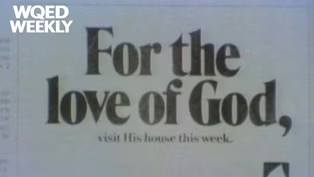
This segment explores ad campaigns encouraging people to attend church. (4m 36s)
Providing Support for PBS.org
Learn Moreabout PBS online sponsorship New Episode
- News and Public Affairs

Top journalists deliver compelling original analysis of the hour's headlines.
 New Episode
- News and Public Affairs

Today's top journalists discuss Washington's current political events and public affairs.


 New Episode
 New Episode
 New Episode
 New Episode
 New Episode
 New Episode
 New Episode
 New Episode
Support for PBS provided by:
WQED Weekly is a local public television program presented by WQED