WQED Weekly
The Schuman Center
Clip | 7m 42sVideo has Closed Captions
This segment features a story about the Schuman Center, a juvenile detention center.
This segment of WQED Weekly explores issues around juvenile justice and incarceration through a story about the Schuman Center, a juvenile detention center. It includes several interviews, including one with Ed Ray, an intake officer at the Schuman Center, and Ken Neely, the leader of a citizen’s task force on juvenile justice. They discuss the center’s broad intake policy and the Pittsburgh city
Problems playing video? | Closed Captioning Feedback
Problems playing video? | Closed Captioning Feedback
WQED Weekly is a local public television program presented by WQED
WQED Weekly
The Schuman Center
Clip | 7m 42sVideo has Closed Captions
This segment of WQED Weekly explores issues around juvenile justice and incarceration through a story about the Schuman Center, a juvenile detention center. It includes several interviews, including one with Ed Ray, an intake officer at the Schuman Center, and Ken Neely, the leader of a citizen’s task force on juvenile justice. They discuss the center’s broad intake policy and the Pittsburgh city
Problems playing video? | Closed Captioning Feedback
Where to Watch WQED Weekly
WQED Weekly is available to stream on pbs.org and the PBS app.
There are no particular set criteria because every case is a different case.
When you put them into that setting, the inducement is there to relate to his peers, to pick up delinquent habits and to, repeat delinquency behavior.
I think this instrument, this institution is full sometimes because it's not big enough.
Okay, well, I didn't have a seat over here.
You see that stuff in... Saturday nights Ed Ray works the intake desk at Shuman Center.
He talks to the police.
He makes the phone calls.
He describes for official records what goes on there.
And he decides who goes home and who stays.
The $36 fine is picking up.
I was worried about my head.
Is brought me to the hospital.
They treated me and they took me to jail.
A problem lies with the intake procedures at Shuman center.
As we understand it, there are a number of intake officers who are all operating relatively independently.
The the juvenile judges have not, given the intake workers a strong set of criteria to use.
As far as we know, very little is on paper as to what criteria to use.
The result, then, is intake workers who are somewhat confused about what their direction should be set from the court and applying their own standards.
Now, I don't think we've had a particular criteria.
We have, we discuss, situations.
When was the last time you had or how frequently do you have meetings of the of that type to discuss?
Well, the, I guess, maybe, as the, the necessity occurs.
Perhaps if we had, 12 judges, that could be in the intake department.
This might be ideal.
I don't know, but I think basically our intake department does a good job.
And the reason I say that is very rarely do we at a detention hearing release a youngster that the intake department has felt should be held.
Certainly.
Under Pennsylvania law, a juvenile can be detained for three reasons.
Okay.
It's an intentionally ambiguous law that is supposed to give intake officers like Ed Ray the flexibility to make decisions based on the unique circumstances of each case.
Mary Caracas is Ed Ray's boss.
We are detaining those children who really pose a threat to themselves or others, with serious runaway risks.
It's the unusual child who is detained, where possibly he should be elsewhere.
The system relies heavily on the experience and judgment of the intake officers.
Not everyone likes that system.
Ken Neely leads a citizen's task force on juvenile justice.
What we are maintaining is that indeed, it's.
It's the judges, the judge, who has the authority and the understanding that the judges at juvenile court should indeed establish for their intake workers so that there is not a differential process at intake.
Basic guideline criteria, which are legal and based on the statutes of the State of Pennsylvania.
Everyone agrees that it takes a while to forget being arrested and locked up in a place like Shuman.
Can I keep this?
And I think it's file commission after here.
Yes.
17.
Yeah.
No, 15 for me now for two years older than I am.
claim.
Not.
Guilty for drinking.
So, hey, we have trouble just like any other family.
Yeah.
You know, here and there.
I'm talking about you.
Just temporarily.
Parents were called.
They said its been an issue.
I was accused of.
I was accused of being taking my brother's jacket.
Okay.
See?
When was that?
Last night I was accused.
They're only alleged delinquents.
That's like you being picked up for an alleged offense and being held in an institution.
Told you have to go to jail.
Told you have to make your bed.
Told you have to do all of these things, none of which would be required of you.
Were you able to go home?
Many kids do need to be locked up, everyone agrees.
The argument is over how many and why.
There are no alternatives to locking them up in Shuman.
Some alternatives that United Mental Health and the Citizens Task Force for Juvenile Justice have proposed include home detention, Foster home detention and group homes.
And they'd all accomplish the same thing.
That is, remove soft core delinquents from the prison atmosphere of the Shuman center.
Very few such alternatives now exist.
One factor is that the county has shown that its commitment is to the development, maintenance, and operation of the Shuman center a very costly, structure, over $8 million to construct it.
I believe their operating costs are running around a million a year.
They have to put vast sums of energy into operating that building, and this certainly is an indication of priorities.
This is where I think that organizations such as United Mental Health, have fallen down.
They have not provided us with alternatives.
They they criticize us for taking youngsters into a detention home that they say don't belong here.
We, being the community groups, have always and still do offer our assistance in developing alternatives, however possible.
But, we recognize that the priorities of the county seem to be clearly based on fiscal considerations, to be with Shuman center.
One thing is clear the Shuman center is there, and it's going to be used.
Kids are going to continue to be kept there.
How many?
Depends largely on the intake policy on what happens at the front door.
Our position is that until it becomes clear in this county to parents to, programs that deal with delinquents, to the police until it becomes clear that Shuman center is not going to be used as a dumping ground, it's not going to be an open door policy with very little criteria applied.
We're not going to have alternatives.
Some people say we're a dumping ground, too.
And I think that, that might be an apt description, but I would much rather air on the side of caution than, than say, oh, let them go.
We don't need to do anything because I'm convinced that there are many girls who are now leading productive lives that would have ended up dead in the gutter somewhere if we had done what our critics say.
Saying that is, if they want to run, let them run.
You can't do anything.
I'm convinced you can do something with some kids.
And its probably confiscated.
They'll probably keep them.
Okay, give me my name.
Here.
Yeah, that.
Yeah, yeah, yeah.
They get him.
Okay.
Don't rush back.
 New
NewVideo has Closed Captions
This segment features a story about backyard gardeners. (8m 18s)
 New
NewUniversity of Pittsburgh’s Hockey Club
Video has Closed Captions
This segment features a story about the University of Pittsburgh’s Hockey Club. (5m 50s)
 New
NewVideo has Closed Captions
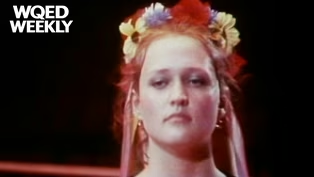
This segment highlights a Ukrainian cultural festival. (11m 36s)
 New
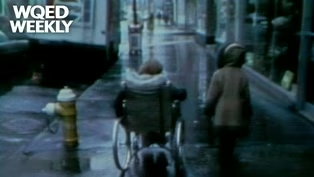
NewTransportation Challenges for Disabled Persons
Video has Closed Captions
This segment explores the transportation challenges people with disabilities face. (5m 56s)
 New
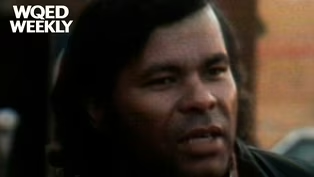
NewThree Rivers American Indian Center
Video has Closed Captions
This features an interview with Russell Sims from the Council of Three Rivers American Indian Center (6m 32s)
 New
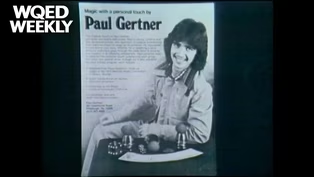
NewSleight of Hand Magic by Paul Gertner
Video has Closed Captions
This segment features an interview and live performance by sleight of hand magician Paul Gertner. (6m 1s)
 New
NewVideo has Closed Captions
This segment features a visit to a sexual health clinic. (6m 12s)
 Now Playing
Video has Closed Captions
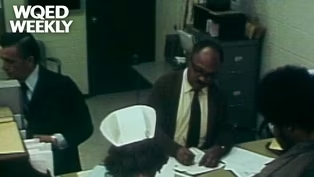
This segment features a story about the Schuman Center, a juvenile detention center. (7m 42s)
 New
NewReenactment Battles at Lexington and Concord
Video has Closed Captions
This segment features a reenactment of the battles of Lexington and Concord by grade school children (6m 53s)
 New
NewVideo has Closed Captions
This highlights Reach to Recovery, a program that supports women recovering from mastectomies. (7m 26s)
 New
NewVideo has Closed Captions
This highlights the Powder Mill Nature Reserve and the work of environmental activist Ruth Scott. (9m 18s)
 New
NewVideo has Closed Captions
This segment explores a police counseling program. (5m 52s)
 New
NewPittsburgh Penguins Financial Problems
Video has Closed Captions
This segment features a story about the Pittsburgh Penguins’ financial problems. (7m 14s)
 New
NewVideo has Closed Captions
This segment features an interview with Pittsburgh Mayor Pete Flaherty. (5m 39s)
 New
NewVideo has Closed Captions
This segment of WQED Weekly features a story about penny candy. (5m 13s)
 New
NewVideo has Closed Captions
This features an interview with, Oliver Mason, a former City of Pittsburgh police officer. (8m 3s)
 New
NewNational Organization for Non-Parents
Video has Closed Captions
This is about the National Organization for Non-parents, a group supporting child-free couples. (7m 15s)
 New
NewMeridian Elementary School Football Team
Video has Closed Captions
This segment features footage of the Meridian Elementary School football team. (10m 20s)
 New
NewVideo has Closed Captions
This segment features an interview with Sarah and Rachel McClelland. (8m 54s)
 New
NewMaintenance in Terrace Village
Video has Closed Captions
This explores maintenance problems in low-income housing run by the Pittsburgh Housing Authority. (8m 52s)
 New
NewVideo has Closed Captions
This segment features an interview with Leon Bibber, a man who spent 19 years building a boat. (7m 10s)
 New
NewVideo has Closed Captions
This segment highlights Jim Nagle performing as Kimo the Clown. (5m 30s)
 New
NewVideo has Closed Captions
This segment features an interview with Kim Nagel, and 18-year-old running for school board director (8m 17s)
 New
NewVideo has Closed Captions
This segment features a story about Jane Grey Swisshelm, a feminist and abolitionist from the 1800s. (4m 58s)
 New
NewVideo has Closed Captions
This segment features a story about a high school senior internship program. (7m 28s)
 New
NewVideo has Closed Captions
This segment features a story about community service and support work. (8m 46s)
 New
NewVideo has Closed Captions
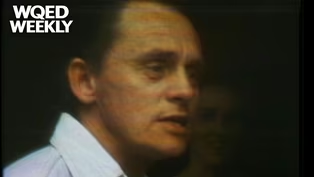
This segment features an interview with actor Frank Gorshin about growing up in Pittsburgh. (4m 46s)
 New
NewVideo has Closed Captions
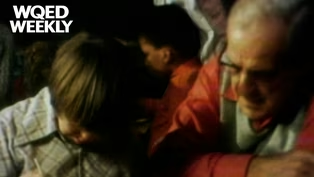
This WQED Weekly features a story about a foster grandparent program for children with disabilities. (4m 17s)
 New
NewFiscal Crunch of PennDot and City Hall
Video has Closed Captions
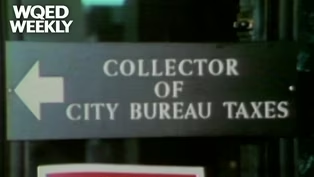
This segment explores PennDOT and the City of Pittsburgh’s financial problems. (7m 38s)
 New
NewFifth Avenue High School Basketball Team
Video has Closed Captions
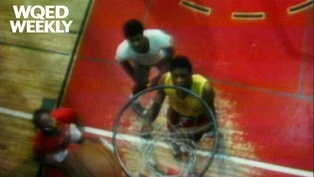
This segment features a story about the Fifth Avenue High School basketball team. (7m 59s)
 New
NewVideo has Closed Captions
This segment features an interview with local farmer Dick Koons. (8m 50s)
 New
NewVideo has Closed Captions
This segment highlights a program that supports the children of couples who are getting divorced. (6m 47s)
 New
NewVideo has Closed Captions
This segment explores decriminalizing marijuana possession in Pennsylvania. (9m 16s)
 New
NewVideo has Closed Captions
This segment features a story about the Crawford Grill, a jazz bar in the Hill District. (8m 38s)
 New
NewVideo has Closed Captions
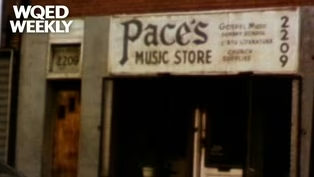
This segment features an interview with community advocate Franklin Wilhamina “Frankie” Pace (7m 35s)
 New
NewThe Claysville McGuffey Recorder
Video has Closed Captions
This segment features a story about Gene Shaw, the owner of the Claysville McGuffey Recorder. (8m 33s)
 New
NewCitizens Band Radio and Truck Driving
Video has Closed Captions
This segment features a story about citizens band radios and truck driving. (4m 16s)
 New
NewVideo has Closed Captions
This segment features a story about life performing in a circus. (9m)
 New
NewVideo has Closed Captions
This features a short film titled “A Christmas Night Story” created by Nicolas and Sandrine Schoen. (6m 27s)
 New
NewCeinwen King-Smith - A Blind Teacher at Hillel Academy
Video has Closed Captions
This segment features an interview with Ceinwen King-Smith, a blind teacher at Hillel Academy. (4m 35s)
 New
NewBreast Cancer Detection Center
Video has Closed Captions
This segment follows a screening appointment at the Breast Cancer Detection Center in Oakland. (7m 5s)
 New
NewVideo has Closed Captions
This segment explores donating blood at the Central Blood Bank of Pittsburgh. (3m 15s)
 New
NewArthur ‘Art’ J. Rooney Interview
Video has Closed Captions
This segment features an interview with Arthur ‘Art’ Rooney. (7m 29s)
 New
NewVideo has Closed Captions
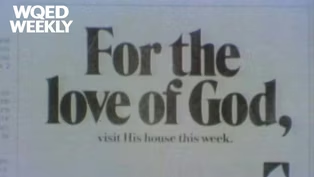
This segment explores ad campaigns encouraging people to attend church. (4m 36s)
Providing Support for PBS.org
Learn Moreabout PBS online sponsorship New Episode
- News and Public Affairs

Top journalists deliver compelling original analysis of the hour's headlines.
 New Episode
- News and Public Affairs

Today's top journalists discuss Washington's current political events and public affairs.


 New Episode
 New Episode
 New Episode
 New Episode
 New Episode
 New Episode
 New Episode
 New Episode
Support for PBS provided by:
WQED Weekly is a local public television program presented by WQED