
Skeletons: Make A Connection
Clip: Special | 1m 4sVideo has Closed Captions
Your skeleton has different types of joints. Find out how they help us move.
The joints of the skeletal system help us move. We have more than one type of joint. Learn how these different joints operate.
Problems playing video? | Closed Captioning Feedback
Problems playing video? | Closed Captioning Feedback
Science Trek is a local public television program presented by IdahoPTV
Major Funding by the Laura Moore Cunningham Foundation and the Idaho National Laboratory. Additional Funding by Sparklight, the Friends of Idaho Public Television and the Corporation for Public Broadcasting.
Skeletons: Make A Connection
Clip: Special | 1m 4sVideo has Closed Captions
The joints of the skeletal system help us move. We have more than one type of joint. Learn how these different joints operate.
Problems playing video? | Closed Captioning Feedback
Where to Watch Science Trek
Science Trek is available to stream on pbs.org and the PBS app.
Science Trek
Science Trek is a place where parents, kids, and educators can watch short, educational videos on a variety of science topics. Every Monday Science Trek releases a new video that introduces children to math, science, technology, engineering, and math (STEM) career potentials in a fun, informative way.[MUSIC] Joan Cartan-Hansen, Host: A joint is where two bones connect.
You have fixed joints like those in the skull.
They don't move.
You have joints that move just a little, like the joints in the vertebrae in your spine.
And you have six kinds of moveable joints.
In a ball and socket joint, one bone has a rounded head and the other has a cup-like feature.
Your shoulder and hip have a ball and socket joint.
A hinge joint works like a door, opening and closing.
Your elbow has a hinge joint.
A pivot joint swivels like the joint that rotates your forearm.
A condyloid joint moves but doesn't rotate, like the finger joints.
A gliding joint has a smooth surfaces that slips over one another.
Your wrist has a gliding joint.
And finally, a saddle joint.
It allows movement back and forth and side to side, like the joint at the base of your thumb.
Without all of these different kinds of joints, you couldn't move.
And that's why they are an important part of the skeletal system.
For more information about skeletons and the skeletal system, check out the science trek website.
You'll find it at science trek dot org
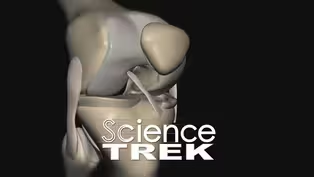
Skeletons: Holding It Together
Video has Closed Captions
Clip: Special | 1m 4s | How is your skeleton held together? (1m 4s)
Providing Support for PBS.org
Learn Moreabout PBS online sponsorship New Episode
- Science and Nature

Explore scientific discoveries on television's most acclaimed science documentary series.




 New Season


 New Season


Support for PBS provided by:
Science Trek is a local public television program presented by IdahoPTV
Major Funding by the Laura Moore Cunningham Foundation and the Idaho National Laboratory. Additional Funding by Sparklight, the Friends of Idaho Public Television and the Corporation for Public Broadcasting.