
Skeletons: Holding It Together
Clip: Special | 1m 4sVideo has Closed Captions
How is your skeleton held together?
The skeletal system is more than just bones. You have ligaments and cartilage to help hold it all together.
Problems playing video? | Closed Captioning Feedback
Problems playing video? | Closed Captioning Feedback
Science Trek is a local public television program presented by IdahoPTV
Major Funding by the Laura Moore Cunningham Foundation and the Idaho National Laboratory. Additional Funding by Sparklight, the Friends of Idaho Public Television and the Corporation for Public Broadcasting.
Skeletons: Holding It Together
Clip: Special | 1m 4sVideo has Closed Captions
The skeletal system is more than just bones. You have ligaments and cartilage to help hold it all together.
Problems playing video? | Closed Captioning Feedback
Where to Watch Science Trek
Science Trek is available to stream on pbs.org and the PBS app.
Science Trek
Science Trek is a place where parents, kids, and educators can watch short, educational videos on a variety of science topics. Every Monday Science Trek releases a new video that introduces children to math, science, technology, engineering, and math (STEM) career potentials in a fun, informative way.[MUSIC] Joan Cartan-Hansen, Host: The skeletal system is more than just bones.
It also has cartilages and ligaments.
Cartilage is a strong, smooth tissue that helps cover and protect joints and bones.
There are three main types of cartilage.
Elastic cartilage provides flexibility and structure.
You'll find it in places like your nose and outer ear.
Fibrocartilage is found in places like your knee and the discs between vertebrae in your spine.
It's tough and inflexible and designed to reduce friction as the joints move.
And hyaline cartilage is found at the end of bones.
It's slippery and allows the joints to move smoothly.
Ligaments are tough, elastic tissue.
They connect bones to bones, and give the joints support.
Some ligaments restrict movement, while other are more elastic.
Now, I should mention something about tendons.
Tendons connect muscles to bones and help transmit force.
Tendons are sometimes confused with ligaments.
So remember, ligaments connect bones to bones and tendons connect muscles to bones.
For more information about skeletons check out the science trek website.
You'll find it at science trek dot org
Video has Closed Captions
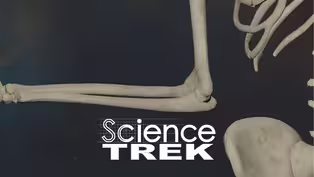
Clip: Special | 1m 4s | Your skeleton has different types of joints. Find out how they help us move. (1m 4s)
Providing Support for PBS.org
Learn Moreabout PBS online sponsorship New Episode
- Science and Nature

Explore scientific discoveries on television's most acclaimed science documentary series.





 New Season


 New Season


Support for PBS provided by:
Science Trek is a local public television program presented by IdahoPTV
Major Funding by the Laura Moore Cunningham Foundation and the Idaho National Laboratory. Additional Funding by Sparklight, the Friends of Idaho Public Television and the Corporation for Public Broadcasting.