
July 17, 2026 - PBS News Hour full episode
7/17/2026 | 57m 46sVideo has Closed Captions
July 17, 2026 - PBS News Hour full episode
July 17, 2026 - PBS News Hour full episode
Problems playing video? | Closed Captioning Feedback
Problems playing video? | Closed Captioning Feedback
Major corporate funding for the PBS News Hour is provided by BDO, BNSF, Consumer Cellular, American Cruise Lines, and Raymond James. Funding for the PBS NewsHour Weekend is provided by...
July 17, 2026 - PBS News Hour full episode
7/17/2026 | 57m 46sVideo has Closed Captions
July 17, 2026 - PBS News Hour full episode
Problems playing video? | Closed Captioning Feedback
Where to Watch PBS News Hour
PBS News Hour is available to stream on pbs.org and the PBS app.
Providing Support for PBS.org
Learn Moreabout PBS online sponsorshipGEOFF BENNETT: Good evening.
I'm Geoff Bennett.
Amna Nawaz is away.
On the "NewsHour" tonight: President Trump once again tries to sow doubt in the election process.
But newly declassified documents he points to as evidence fail to back up his claims.
Amid widespread destruction, Gazans find a way to watch the World Cup, bringing brief moments of joy and of hope.
MOHAMMED SAID SHAABAN, Soccer Player (through translator): I want I want to travel abroad and install my prosthetics.
I want to play soccer with my friends and play at the World Cup.
GEOFF BENNETT: And Christopher Nolan's blockbuster adaptation of "The Odyssey" opens to rave reviews.
Why the ancient story has enduring resonance.org.
EMILY WILSON, Author, "Crossing the Wine-Dark Sea: Journeys Through Ancient Literature": It's about community.
It's about who belongs in a particular place, what it means to have a home.
(BREAK) GEOFF BENNETT: Welcome to the "News Hour."
The Trump administration is escalating its efforts to exert greater federal control over the nation's elections.
Today, Homeland Security Secretary Markwayne Mullin threatened local election officials with jail time if they refused to cooperate with administration requests for voter data.
It follows President Trump using a prime-time address to revive debunked claims about the integrity of American elections and to call for more restrictive voting laws ahead of the November midterms.
For a closer look at what the president said and what the facts show, we turn to our White House correspondent, Liz Landers.
DONALD TRUMP, President of the United States: No trust, no greatness.
LIZ LANDERS: New claims about old grievances with little evidence to back it up.
In a prime-time address, President Donald Trump tried to influence the conversation around election security just months before the midterms.
DONALD TRUMP: Tonight, I'm announcing the immediate declassification and release of critical intelligence revealing shocking vulnerabilities in our election infrastructure.
LIZ LANDERS: Armed with newly declassified files, his central target was a familiar foreign adversary, China.
DONALD TRUMP: The People's Republic of China carried out what is believed to be the largest compromise of election data in history, resulting in China's illicit acquisition of 220 million U.S.
voter files.
LIZ LANDERS: The president painted a dark picture of U.S.
election security, but a close look at the White House's own released documents reveal a different reality.
Throughout hundreds of pages of heavily redacted files, the intelligence community discusses China's attempts to potentially influence the 2020 election, though it's often presented as potential dangers, with no evidence that the attempts were successful.
In fact, one declassified document explicitly states that -- quote -- "Publicly available U.S.
voter registration information for six states was downloaded by the People's Republic of China 'redacted' in 2022, well past the 2020 election."
David Becker, a former Department of Justice attorney who runs the Center for Election Innovation and Research, said Trump's claims are false.
DAVID BECKER, Executive Director, Center for Election Innovation and Research: The reality is, it wasn't a hack.
As much as we might not like the fact that China is trying to acquire as much data as it can on Americans, the voter lists in the United States are public.
There's a public voter list in every state.
It's available for purchase.
Sometimes, it's free.
LIZ LANDERS: Mr.
Trump also alleged a coordinated campaign by Beijing to target his political standing... DONALD TRUMP: They fought like hell not to have a Donald Trump to win, and for good reason.
LIZ LANDERS: ... and turned his focus to the hardware of democracy itself.
DONALD TRUMP: They're vulnerable and they're easily compromised.
LIZ LANDERS: Becker said unfounded conspiracies regarding foreign tampering do not match American safeguards.
DAVID BECKER: So we have had all paper ballots in the United States since at least 2020.
The only state that doesn't have paper ballots currently is Louisiana.
LIZ LANDERS: Becker added, these ballots leave a verifiable physical trail reviewed by the voter.
DAVID BECKER: The voter has reviewed the ballot every time, and that's why we know that our vote counts are correct.
It's not that we trust the machines.
Any machine could malfunction.
Our machines are under very strict chain of custody.
They're not connected to the Internet.
LIZ LANDERS: The president did not stop at China.
He also pointed to electronic voting machines, using a foreign example to warn of domestic vulnerabilities.
DONALD TRUMP: The CIA obtained reporting of a specific plot to do a big number in favor of the corrupt Maduro regime in Venezuela.
And that's exactly what happened, conspiring to digitally rig their own country's elections in 2020, and that's what they did.
LIZ LANDERS: But those efforts would only be possible if every step of the election process was under Venezuelan government control, which is why the documents released conclude such efforts to manipulate vote totals would not work in the U.S.
Mr.
Trump also took aim at immigration, linking border crossings directly to the ballot box.
DONALD TRUMP: According to the DHS review, state voter rolls and public records, they identified approximately 278,000 noncitizens who are registered to vote in federal elections.
LIZ LANDERS: The report did not say how that number was reached.
Homeland Security Secretary Markwayne Mullin was unable to say in a press conference today how many, if any, of those people actually were able to vote.
The president used the speech to pressure Congress to pass the SAVE America Act, a sweeping voter I.D.
and proof of citizenship bill.
But federal databases and screening tools used to identify noncitizens have been repeatedly shown to erroneously flag United States citizens.
Inaccuracies frequently surface when the systems rely on outdated records or attempt to verify the citizenship status of naturalized Americans.
It accumulates false positives so often that a federal judge just last month blocked the Trump administration from using it, adding it has haphazardly combined and repurposed -- quote -- "the private information of millions of Americans, including citizenship data that they knew to be unreliable."
The president's repeated false claims do serve one political goal, preemptively sowing doubts ahead of the November midterms.
Becker says, despite all that, elections will run smoothly.
DAVID BECKER: I have every confidence the election is going to be secure.
It's also going to be convenient for voters to participate in.
And whoever the voters choose to serve, those people are going to take office.
LIZ LANDERS: For the "PBS News Hour," I'm Liz Landers.
GEOFF BENNETT: For perspective, we turn now to Sue Gordon.
She spent 30 years in the intelligence community, serving as principal deputy director of national intelligence during President Trump's first term, the highest-ranking career intelligence official in the country at that time.
Sue Gordon, welcome back to the "News Hour."
SUE GORDON, Former U.S.
Principal Deputy of National Intelligence: Thanks.
Glad to be here.
GEOFF BENNETT: The president in his speech last night focused heavily on China and what he described as newly revealed intelligence about the 2020 election.
Based on what has been made public, did you hear anything that changes the intelligence community's fundamental assessment of what happened in 2020?
SUE GORDON: No, on three levels.
Number one, that China and other nation-states are interested in influencing our elections to achieve their purposes is not new.
It's something we have been focused on specifically since 2016.
So the idea that they also want to pursue advantage through that route is not new.
I didn't see anything or hear anything that surprised me.
And the other thing is, I think people just need to know, intelligence is just the beginning of a process.
Intelligence is simply intent.
So it is a long way, even if there are new data there, from new data that says China has an intent to do something to getting to an activity, to an impact and to an outcome.
And so 2020 is settled.
It's settled, right?
There's just nothing in there that changes that.
But it's not just the intelligence assessment of intention.
It is the far broader assessment that we looked at the election, and it was sound, and saw no evidence of impact.
GEOFF BENNETT: The president also suggested that intelligence about China was in some way suppressed or kept from him.
SUE GORDON: Yes.
GEOFF BENNETT: You served as principal deputy director of national intelligence during his first term.
How plausible is it that intelligence of this significance would have been deliberately withheld from the president?
SUE GORDON: Now, remember, I'm of that community and believe in those women and men who sign up for the -- to support the Constitution, but it's -- it makes no sense.
So, first, let's go back to 2016, where the intelligence community was screaming at the top of its lungs of Russian intention to influence our elections beginning of the first Trump administration.
So it has from that point been an incredible focus of the intelligence community.
And the other thing I think that gets lost when President Trump talks about himself and that people are interested in harming him, when intelligence looks at activities, it is those activities that are intended to undermine our nation, our democracy.
So the idea that you would have this group of people who spend their lives keeping America safe for democracy would somehow keep information about foreign attempts to undermine that same thing they serve is just -- doesn't work.
And look at 2016 with how much effort we put into it, even though in those years President Trump wasn't as interested in hearing it from us.
GEOFF BENNETT: Is there an irony here, an unfortunate irony, that by repeatedly suggesting that American elections are in some way compromised, that the president is advancing one of the objectives by countries like Russia and China, objectives that they have pursued?
SUE GORDON: Yes, 100 percent.
And I think -- I think -- I'm pretty sure I said it to President Trump in the first administration, and I will say it again.
The grand bargain of a democracy is that anyone can run for office and everyone accepts the outcome.
And when things happen to change that bargain and let Americans believe that maybe that's not true, that has served the purpose of our adversaries and competitors.
And so they don't even have to achieve any real effect if we just increasingly distrust that which is so fundamental to who we are.
In other words, the greatest threat to America is that we stop believing in ourselves.
And when the president sows this kind of, in my estimation, ill-founded discontent about our institutions, he's in fact done that work.
GEOFF BENNETT: One thing that can be confusing for the American people who are watching all of this unfold is that there is this conflation of a very real intelligence threat posed by China and all of these claims that aren't supported by the evidence.
So, how do you separate legitimate concerns about foreign influence and cyber vulnerabilities from unsupported claims that an election result was in some way corrupted?
SUE GORDON: Yes, so that's a really great question.
I think the intelligence community can be accused of being arcane in its language sometimes, but it is very transparent about how much work is going on by adversaries to influence our campaign, and that is by supporting different candidates, by putting money into our system, to getting information to understand how they might shape what our voters believe.
That's influence.
And that is very real, very possible, very aggressive, and hard to counter, because that is just working democracy the way it works.
The other piece is interference, and that is physically doing damage and changing one vote for A to one vote to B. That is really hard to do.
And, again, since 2016, there's been so much work.
The beginning of this episode on "News Hour" was very clear in terms of how much work has been -- gone on to make sure that our election process is secure.
And the other thing that's really a strength of our election process is that it is run locally.
And so the idea that someone would be able to get into it and create a systemic effect that would matter is vanishingly small, even though you have to watch it all the time.
But, right now, I just think that difference between influence, which is shaping opinion, which is going on right now, and interference, which is changing outcome, is still very clear and where our assessment falls.
GEOFF BENNETT: Sue Gordon, always good to speak with you.
Thanks for joining us.
SUE GORDON: You bet.
Great to see you.
GEOFF BENNETT: Well, late today, a federal district court again rejected the Justice Department's bid to obtain state voter rolls for what is now the 16th straight time.
Our Liz Landers is back now with a view from those responsible for running our elections.
LIZ LANDERS: For more on how state election administrators are responding to the president's speech, I'm joined now by two election officials in key battleground states, Arizona Secretary of State Adrian Fontes and Gabe Sterling of the Georgia Secretary of State's Office.
Gentlemen, thank you for joining "News Hour."
ADRIAN FONTES (D), Arizona Secretary of State: Thanks for having us.
GABRIEL STERLING, Georgia Voting System Implementation Manager: Happy to be here.
LIZ LANDERS: Secretary Fontes, I'm going to start with you.
How do you respond to the president's claim from last night's speech that nearly 280,000 noncitizens are registered to vote nationwide and the accusations that Democrats do not care about this issue?
Do you?
ADRIAN FONTES: Well, I care about the issue.
I just don't think that the president has his facts right.
And I don't think he's telling the entire story.
I think his numbers are wrong.
In fact, when we dug a little bit deeper into some of the documentation, we know the numbers are wrong.
And we have got better things to do than listen to the president's grievance from 2020.
We have got an election to run.
And I think election administrators across the country understand that they have work to do.
We are professionals.
We have been running great elections for a very long time.
And, interestingly, you never heard the president complaining about what happened in 2024, did you?
And so I think, as to this subject particularly, this particular president lacks credibility to the degree that his comments were really given the weight that they deserve, which is not much.
LIZ LANDERS: Gabe, the president said that Georgia was one of 18 states whose voter files were compromised by China, 220 million files in total nationwide.
Is this new information and should this concern voters?
GABRIEL STERLING: Well, no, not really, because the reality is notice what he said specifically.
The first thing he said was, they bought it.
They bought it because this is the publicly available information.
And what is the theory of the crime here?
What are they going to do with it?
This is stuff that anybody can get.
They can't change a vote.
They can't change a tally.
They can't take your vote away.
None of that works.
And if you go back to the original March 2021 intelligence assessment, it was already there in large part.
And we know they were trying to do this.
So this has had no outcome, and everything in the supporting documentation has said nothing has happened anywhere in 2020, 2022, 2024, and now going into 2026.
LIZ LANDERS: I'm seeing Secretary Fontes nodding his head to what you're saying right now, Gabe.
Secretary Fontes, you're a Democrat.
Gabe, you're a Republican.
You don't necessarily agree all the time on political issues, but you seem to be aligned on this.
It seems like you both agree that these revelations do not change the results of the 2020 election.
Secretary Fontes, I will let you answer first.
ADRIAN FONTES: Well, yes, it doesn't change the results because our elections are run by professionals who can distinguish between their duty and their opinion.
I think what's really important here, let's just go back to that voter data question of the voter rolls.
We want certain portions of our voter rolls to be public, like they are public right now, because that way folks who know how these systems work can look at who's registered to vote, can go to a cast vote record later, and they can verify that only registered voters voted.
That is a safeguard.
That is a transparency issue.
That is an access question, and it keeps us accountable.
We know this, those of us who do this work.
So, Gabe and the folks in Georgia, they do a great job.
Folks across the country do a great job.
The problem we have is, the lies from the White House are making us look terrible, and that's problematic for our voters.
LIZ LANDERS: Gabe, did you hear anything in last night's speech that makes you rethink what happened in 2020 and the election that was certified in Georgia?
GABRIEL STERLING: Well, of course not.
None of this is a revelation.
This is all stuff we have all known as election administrators.
And I'm just happy to see that the White House and the federal government is catching up to our election administrators, who have been working for the last 10, 15, 20 years.
We deal with these issues every day.
We deal with the fact that people try to register and they shouldn't be trying to register.
We deal with list maintenance.
We deal with logic and action testing for our machines.
These are constant things that we do.
We are always improving.
We are always measuring.
And the stuff last night, here's the real issue.
I think a lot of what he said last night was true.
But it was cast in such a way to make it seem nefarious and awful.
He said, there are all these -- they have your data.
There are all these noncitizens on the registration list.
What he didn't say was, they voted.
LIZ LANDERS: Mr.
Secretary, you are in the middle of election preparation right now.
Arizona has primaries on Tuesday.
Does anything you heard last night make you think you need to check or reconsider anything for those elections this coming week?
ADRIAN FONTES: Nope.
Nothing I heard last night is going to make a hill of beans a difference here in Arizona nor anywhere else in the country, I think.
Gabe said it very well.
There's nothing new here.
There's nothing revelatory here.
In fact, I think I told someone recently I was kind of disappointed.
I was hoping to hear something new, so that we can make another improvement, so that we can adjust another system to benefit our voters.
But there is nothing new here.
And I don't think that anybody who is reasonable and who understands how to see facts for what they are can give this speech from last night any sort of credibility.
We are going to continue to do what we do.
We do it well.
All of the analysis and checks and audits and the scrutiny we have been under for years has proven that out.
And, by the way, our voters love doing what they do.
And, in Arizona, 85 percent of us vote by mail.
We're going to keep doing it whether or not the president of the United States likes it.
It's none of his business what we do in Arizona.
He needs -- he's got a lot of other things that he should be thinking about.
LIZ LANDERS: Gabe, final question for you.
There was mention last night in these speeches and then again today from the homeland security secretary of future investigations into election officials who do not cooperate with DHS or the Department of Justice in turning over some of these voter rolls.
What is your response to that?
Will you cooperate?
GABRIEL STERLING: And, as a Republican, I don't want a centralized database of voters, because at some point a Democrats come into presidency, and they can say everybody can vote.
This is about federalism.
This is about the Constitution.
This is about state control.
And as a Republican, I want my team to win elections.
Every time the president brings this up, we end up doing worse than elections.
Last night, when he mentioned Michigan specifically, I thought that Jocelyn Benson should send him a thank you note for all the money she's going to raise because he mentioned her state.
And the Republican nominee there just got worse off than he would before.
In Georgia, we're a swing state, and we have a Senate race, a governor's race that are really tight.
And none of our candidates want to be talking about this because it doesn't help us get swing voters.
It's just coo coo ca choo crazy town.
And it's just -- I wish they would focus on the right things, which is to make sure the states run good elections.
And guess what?
They already do.
2020 was safe.
2022 was safer.
2024 was safer.
And 2026 is going to be safer than those.
LIZ LANDERS: Gabe Sterling of the Georgia Secretary of State's Office, Adrian Fontes of Arizona, thank you both so much for your time.
ADRIAN FONTES: Happy to be here.
GABRIEL STERLING: Thank you, Liz.
ADRIAN FONTES: Good to talk to you, Gabe.
GEOFF BENNETT: In the day's other headlines: Health concerns are growing as wildfire smoke from Canada is blanketing large parts of the U.S.
That's led to unsafe air quality conditions for tens of millions of Americans from the Upper Midwest to the mid-Atlantic and New England.
The deeper purple here indicates air that's considered hazardous.
Detroit was among the most polluted cities in the world today as thick smoke blotted out the skyline and obscured the sun.
The haze also settled over Washington, D.C., carrying fine particles that can be more toxic than typical air pollution.
Across a wide stretch of the country, from Chicago to Manhattan, people wore masks and limited their time outdoors.
LARRION HARMON, Chicago Tourist: Come out the subway, chest started to get me some issues, nose was burning.
I can taste it.
So I'm just sitting here like, wow, I really need a mask.
BARBARA GLICKSTEIN, Nurse: I follow the air quality and heat announcements, and I'm only out because I have to run a quick errand.
Otherwise, I'd be inside.
GEOFF BENNETT: The wildfire smoke will linger across the Northeast for much of the weekend, but forecasters expect the skies to clear by Sunday afternoon in New Jersey in time for the World Cup final between Spain and Argentina.
Food supplier Taylor Farms is recalling all of its iceberg lettuce sourced from Central Mexico after it was linked to an ongoing cyclosporiasis outbreak.
The company says the move is voluntary and that no branded salads or kits are associated with the outbreak.
Earlier, the CDC confirmed that lettuce supplied to some Taco Bell locations was linked to the outbreak.
The agency warned consumers in Michigan, Indiana, Ohio, Kentucky, and West Virginia to avoid eating shredded lettuce at the fast-food chain.
Officials have confirmed more than 1,600 cases across at least 34 states, with thousands of more suspected cases.
Democratic lawmakers are demanding answers about the vetting of federal immigration officers following an Associated Press report about the ICE agent who shot and killed a Colombian man in Maine earlier this week.
Close relatives and his ex-wife told the AP that David Brouillette is an Army veteran with a history of violence and serious mental health issues.
They say he never should have been given a badge and a gun.
DHS says the officer -- quote -- "feared for the public safety" after the motorist, Johan Sebastian Guerrero, attempted to flee the scene in his vehicle.
DHS has not provided evidence to support that account.
Yesterday, Guerrero's widow remembered him as a loving partner and a devoted father.
KAROLINA ROJAS, Partner of Johan Sebastian Guerrero (through translator): Now my daughter asks about her dad, and I don't have the strength to tell her that dad won't come back., that she will no longer be able to hug him and tell him: "Dad, I love you."
Every night, she asks about him.
She always slept next to him, and now she can't.
GEOFF BENNETT: The top Democrat on the House Homeland Security Committee, Congressman Bennie Thompson, is calling for an investigation into what he calls a senseless tragedy.
The U.S.
military says it launched a round of strikes on Iran for a seventh straight night.
Earlier, the U.S.
escalated its air campaign by attacking bridges, including a span that links Iran's main port with roads leading to Tehran.
Iranian officials say recent U.S.
strikes have killed dozens of people, and for the first time acknowledged damage to power infrastructure.
Iran responded by hitting power and water desalination plants in nearby Kuwait, among other targets.
In the U.K., Andy Burnham officially took over as head of the governing Labor Party today, a final step on his path to being the next British prime minister.
GEOFF BENNETT: The former mayor of Greater Manchester was the only contender in today's leadership contest after winning wide support among labor lawmakers in Parliament.
He will replace outgoing Prime Minister Keir Starmer, who faced growing anger over his handling of the economy and a number of leadership missteps.
In his first speech in the new role, Burnham pledged to, in his words, fix the big things that politics has neglected.
ANDY BURNHAM, British Labor Party Leader: We are united, and we put the power that comes from that unity at the service of people and places who have been waiting too long for politics to let them hope again.
GEOFF BENNETT: Burnham faces a daunting task ahead amid sluggish economic growth and deep political divisions.
He's set to officially become the country's 59th prime minister on Monday.
The White House and defense officials are defending the practice of low-altitude military flyovers after the latest incident raised safety concerns.
This pass by the Blue Angels over a crowded beach in Florida sent chairs, sand and umbrellas flying.
After a flight debrief, the acting secretary of the Navy said there would be no reprimands or firings, adding -- quote -- "That's the sound of freedom."
And Defense Secretary Pete Hegseth wrote on social media that -- quote -- "The flyovers will continue until morale improves."
But the commanding officer of the Blue Angels has acknowledged that the maneuver was unsafe.
On Wall Street today, stocks tumbled to close out the week amid ongoing weakness in A.I.
shares.
By the close, the Dow Jones industrial average had fallen more than 400 points.
The Nasdaq sank around 360 points.
The S&P 500 also finished the week in negative territory.
Still to come on the "News Hour": David Brooks and Jonathan Capehart weigh in on the president's prime-time address and recent ICE killings; Gazans find a brief reprieve from war by watching the World Cup; and a classics expert discusses the new film adaptation of "The Odyssey."
President Trump once again putting false claims about the 2020 election at the center of the national political debate is where we start as we turn tonight to the analysis of Brooks and Capehart.
That's "The Atlantic"'s David Brooks and Jonathan Capehart of MS NOW.
Good evening, gentlemen.
JONATHAN CAPEHART: Hey, Geoff.
GEOFF BENNETT: So, David, what did you hear in that speech last night?
What do you think President Trump is trying to accomplish here?
DAVID BROOKS: Oh, subtle.
I couldn't figure it out.
He was -- he's got to get more original in his confabulation.
I mean, he's just stuck on this 2020 thing.
There's never been any evidence.
There's no evidence.
I think the good news is, he doesn't have any policies to actually ruin our election system, as we heard from the secretaries of state.
So we're going to have fair elections in this country.
But it still has a corrosive effect on America to give that speech.
A, you're -- it's a sign to America that we don't have to weigh evidence here.
We don't have to, like, consider what's true or not.
And that's -- this has been a long Trump story, of course.
But I was reminded of a line that used to be in John McCain's campaign speeches in 2000, where he said a healthy skepticism has turned into a thoroughgoing cynicism about public life.
And this is a long-term trend where people think they're all crooks, they're all crooks, it's all rotten.
And it's a very easy pose to adopt, but it's a false one.
I am always happy when you have people like Sue Gordon, the intelligence officer, on the show, because Americans get to see what an intelligence officer looks what a federal employee looks like, what those two secretaries of state look like.
And they are good, honest people doing a professional job because they love their country.
And the idea that they're all crooks, it's all deep state, aside from being cynical and corrosive, it's just a lie.
We have spent our life covering these people, and it's mostly very good people doing the best they can, not for a lot of money.
GEOFF BENNETT: Jonathan, why do you think the president is still relitigating this six years after the election?
JONATHAN CAPEHART: Well, I think he's relitigating it now because, as the kids say, he's scared.
JONATHAN CAPEHART: He's very scared about what could happen if Democrats retake the House and retake the Senate.
He has said as much on the record.
If they take over, I will be investigated.
And, quite frankly, there are reasons to investigate him and members of his administration.
But I thought last night's speech was a complete waste of time.
To David's point, it was all a rehash of things we have heard before.
And in the end, it was just a rah-rah for his SAVE America Act, which is going nowhere, not because of the fault of Democrats, but because of Republicans who have problems with that bill.
When it comes to the deep state, the thing I kept thinking was, but wait, if you have problems with the 2020 election and you're blaming it on the deep state, that was your administration.
So, as much as he did it from the East Room and there was all the pageantry of the presidency, but in the end, I don't think he did himself any favors.
GEOFF BENNETT: And, David, we spoke on this program last night with Ty Cobb, who was the special counsel during the first Trump administration, and he offered an extraordinary warning.
He said that he believes that President Trump is laying the predicate for an emergency declaration around the elections.
Do you see the guardrails holding if President Trump tries to use the apparatus of the federal government to intervene more directly in how elections are administered?
DAVID BROOKS: I think so.
A lot of people have thought that this is a predicate for some future action.
I think, if you look at the things he's tried to do, we're helped by the fact that these are mostly state-run things, so he does not have control.
And what isn't state run is usually congressionally run.
And so he has tried.
The thing he's done successfully is the gerrymandering in Texas.
He has rigged elections and Democrats have helped in California.
So that part he was successful at in degrading our elections.
But pretty much everything else he's done through executive order and other things, courts have overruled him.
And so I do not believe he will have the power to actually affect our elections.
GEOFF BENNETT: How do you see it, Jonathan?
JONATHAN CAPEHART: Although I am a little concerned about what happens on Election Day.
Congressman Jim Himes was on with my colleague Lawrence O'Donnell last night, and he warned that, yes, what the president is doing is laying the predicate for stealing the election, and he said, for instance, what happens if they seize the ballot boxes from particular jurisdictions?
What happens to the chain of custody?
That is when democracy will be at its most tenuous.
And, sure, you can race to court and try to get them back, but the action's already done.
And so I hope you're right that we are going to have a free and fair election this November.
But I have a healthy imagination, and I hope that folks who care about free and fair elections also have a healthy imagination and are prepared for any and every scenario that could happen.
DAVID BROOKS: One little quick point.
The gentleman from Georgia, the secretary of state there, he made the crucial point, this does not help Republicans.
And, in Georgia, if you remember, when there was a run-off for two Senate seats a few years ago, Trump basically said, oh, don't bother, it's all rigged.
GEOFF BENNETT: Right.
DAVID BROOKS: So guess what?
Republicans sat at home.
And that's why Republicans like that gentleman are so upset with what he's doing right now.
GEOFF BENNETT: I want to shift our focus in the time that remains to immigration enforcement, because we have seen now two more people killed in encounters with ICE agents involving vehicles, a Mexican national in Houston, a Colombian national in Maine, neither of whom was the original target of the ICE operation.
The administration briefly paused these -- certain vehicle stops, before President Trump intervened and reversed that decision.
And then there was this other encounter in a Las Vegas airport, and this video posted on social media appears to show plainclothes ICE agents handcuffing a man.
He seemed to not know who they were or what was happening.
And then these agents walk away after they realize they were being filmed, and this man is left with a handcuff still attached.
Turns out he was later detained and arrested at LAX, the Los Angeles Airport, when he landed.
All of that to say, when you put all of these incidents together, plus what happened in Minneapolis, what does that say about how the administration is using federal law enforcement and whether there are sufficient rules, training, hiring, or accountability when things like this happen?
JONATHAN CAPEHART: There's none of that.
We already know that there's not enough training.
We already know that there isn't any accountability.
With the shooting in Maine, the federal agents took the person involved away.
And that, what we just saw there, is outrageous.
Imagine, anyone watching, if a person with no identifying information on them that they're law enforcement comes up to you with handcuffs and tries to arrest you, doesn't identify themselves, how would you react?
I mean, you would try to run away, you would be angry, you would be filled with umbrage, the people around him filming and yelling.
This is not the way -- if you want to enforce our immigration laws, this is not the way to do it.
It makes me question, what is the real goal of the administration?
Is it to get immigration under control, or is it something else more nefarious?
GEOFF BENNETT: What about that, the perceived normalization of federal force in American life?
DAVID BROOKS: Yes, when I was a baby right-winger, I think right-winger, I... DAVID BROOKS: Not a red diaper baby, whatever the opposite is.
I don't know.
I remember going to a think tank.
I won't name it because I'm not positive.
And they showed us a movie of what would happen if big government liberals took over the government, and they had an image of plainclothes federal officers abducting innocent Americans.
And we just saw that.
And it's done in a Republican administration.
And so we have come a long way, baby.
And I think what it what it says, nothing says tyranny like people in plainclothes grabbing a guy in an airport.
The thing -- the part of this policy I really object to -- and all the training and all that stuff, I agree with Jonathan, but I just hate quotas.
When you tell ICE people or cops, you have got to rack up this many arrests in this much time, that has nothing to do with the underlying problem.
It's just a number.
And of course they're going to do whatever they can to meet that number.
And of course you're going to get abuse.
Of course you're going to get these auto stops, because, with an auto stop, you don't have to have a search warrant if you do when you go to somebody's home.
And of course you're going to get in the most aggressive form of I'm going to make my number.
And it's that act of setting a number, aside from all the other flaws, that gins up this game into something really... GEOFF BENNETT: What about that, it undermines the legitimacy of the underlying law enforcement?
JONATHAN CAPEHART: Well, yes, because the -- it's to reach the number.
If you are two arrests away from getting the boss off your back, then you don't care what the law says, what the rules are.
And also we cannot forget that these folks are aided and abetted by a Supreme Court decision that basically legalized racial profiling in these instances.
So everyone thought that things were getting better after Minneapolis, and I think those of us who were paying attention, it was for now, and we're seeing that the for now, we are back to where we were during Minneapolis.
GEOFF BENNETT: Jonathan Capehart and David Brooks, thanks, as always.
JONATHAN CAPEHART: Thanks.
DAVID BROOKS: Thank you.
GEOFF BENNETT: The largest World Cup in history draws to a close this weekend, and Sunday's final is expected to be watched by more than one billion people.
Tonight, we have a look at how the world's most popular sporting event is being marked in a place where celebration has become rare.
As Nick Schifrin reports with producer Shams Odeh, the tournament has helped Palestinians in Gaza find moments of connection and hope.
NICK SCHIFRIN: Thousands of miles from soccer's biggest stage is a landscape of crushed concrete, where children play on the remnants of war, and one child's dream is to sit atop the soccer world and one day win the World Cup.
Ten-year-old Mohammed Shaaban might have lost both legs and his right hand in an Israeli airstrike, but not his ability to dribble or love for soccer.
Inside the family's canvas home, his mom is his teammate, every pass proof the war has not claimed everything.
SONDOS BASHIR, Mother of Mohammed Shaaban (through translator): Mohammed is talented in soccer.
He loves to watch the World Cup.
His favorite player is Ronaldo.
His goal is to play before the world, and he will not forget the pain he's in until he achieves this goal.
I pray that he becomes a source of pride for Arabs and Arab teams.
NICK SCHIFRIN: The family's been displaced a dozen times, carrying Mohammed for miles with no wheelchair.
His mother, Sondos, struggles to keep him safe and distracted from ongoing dangers.
She's desperate to let Mohammed heal, possible only if they find a way out.
SONDOS BASHIR (through translator): Every six months or so, Mohammed has needed surgery because of the deep scar tissue caused by rat bites.
Rats cause these infections, and when it gets really bad, he's undergone further surgery.
I don't want Mohammed to suffer any more.
NICK SCHIFRIN: He pushes himself further than most of us would be able to go, past the fences that war built around him, to precious moments with friends, just a boy playing the game he loves.
MOHAMMED SAID SHAABAN, Soccer Player (through translator): When we play outside, we constantly hear gunshots.
We run away because we're terrified.
Our only resort is to play between the tents.
I want to travel abroad and install my prosthetics.
I want to play soccer with my friends and play at the World Cup.
NICK SCHIFRIN: For a people living through war, the beautiful game offered a brief escape from a still ugly reality, especially when their Arab neighbor Egypt played.
The crowd gathered wherever they could find a seat.
When Egypt scored... (CHEERING) NICK SCHIFRIN: ... a shared celebration, a reminder there is still a wide world beyond the rubble.
They gathered in the shadow of shattered buildings and watched through bombed walls that have become windows.
Egypt publicly dedicated its victories to Palestinians.
AHMED MIQDAD, Gaza Resident and Egypt Fan (through translator): Today, I walked three miles to reach this place so I could celebrate with my family and my people.
They are attending as if it were their match, as if it were their country.
NICK SCHIFRIN: And their coach.
On Gaza's beach, artists carved a tribute to Egyptian coach Hossam Hassan, whose message resonated beyond the pitch.
HOSSAM HASSAN, Egyptian World Cup Team Coach: So I am a message through football, the soft power in the world.
Let the Palestinian people live.
Live.
They do not want anything, just to live.
NICK SCHIFRIN: But in Gaza, there is still death, last week, another funeral for Mohamed Al-Waheidi.
He was an aid worker who helped displaced families and organize the World Cup screenings.
His family says an Israeli airstrike killed him in a taxi on his way to watch Egypt play Argentina.
Israel says he wasn't the target, and they were aiming at a Hamas operative.
His family refutes that.
NASHAAT AL-WAHEIDI, Cousin of Mohamed Al-Waheidi (through translator): It was also targeting the joy of the Palestinian people during the World Cup for Egypt, which raised the Palestinian flag before any other flag or banner.
NICK SCHIFRIN: Since last October's cease-fire, the U.N.
says more than 1,000 Palestinians in Gaza have been killed, an inconsolable mother.
Here, grief is measured in generations.
And yet life still finds a way.
There might be no white paint, but there's water and rocks and a need to not be defined by war.
Soccer is for everyone.
A displaced camp becomes the pitch.
Teams of red and blue play a homegrown World Cup.
BILAL HAMDAN, Soccer Match Organizer (through translator): This game cannot change their reality, but at least it changes their mood for the day.
We want to send a kind message to the world that we hope our lives can slowly get better from the current state.
NICK SCHIFRIN: And so, in this place where the war has taken so much, the game gives kids the chance to be kids again.
With Shams Odeh in Gaza, for the "PBS News Hour," I'm Nick Schifrin.
GEOFF BENNETT: Christopher Nolan's "The Odyssey" is shaping up to be one of the biggest movies of the year.
The highly anticipated film is already breaking ticket sales records.
Jeffrey Brown takes a look now at what's driving the excitement and why a story that's nearly 3,000 years old continues to resonate today.
It's part of our arts and culture series, Canvas.
JEFFREY BROWN: Once again, Odysseus is struggling to return home.
MATT DAMON, Actor: No one could stand between me and home.
I heard the gods.
JEFFREY BROWN: This time in Christopher Nolan's film version of "The Odyssey," reportedly costing some $250 million, starring Matt Damon in the title role, Anne Hathaway as his wife, Penelope, and a big cast filled with other stars to tell a big story... ACTRESS: Who doesn't understand pain or blood?
JEFFREY BROWN: ... the end of the Trojan War and the 10-year journey of Odysseus back to the island of Ithaca.
All of it, of course, stems from the original epic poem attributed to Homer and dating back as far as the eighth century B.C.
One renowned recent translation was done by University of Pennsylvania classic scholar Emily Wilson, who also translated Homer's "Iliad," and who, in a previous "News Hour" appearance, showed us her "Odyssey" and Iliad tattoos.
Her forthcoming book of essays on classics, translation, and more is titled "Crossing the Wine-Dark Sea."
And Emily Wilson joins us now.
Thanks so much for being with us.
So, speaking of crossing the wine-dark sea, here we have Odysseus doing it again.
What is this story about for you at its core?
EMILY WILSON, Author, "Crossing the Wine-Dark Sea: Journeys Through Ancient Literature": There's so much.
It's hard to sum up an epic poem, isn't it?
But it's a poem about a homecoming from war and how that journey affects everyone that Odysseus encounters.
So it's about community.
It's about who belongs in a particular place, what it means to have a home.
And it's about the relationship between hosts and guests.
JEFFREY BROWN: We should say you were not involved with the film, but I did see that the director, Christopher Nolan, he cited your translation, and particularly that first line of the epic that begins, "Tell me about a complicated man."
So who was Odysseus?
EMILY WILSON: Odysseus, as that first line already hints, is multiple.
And that's part of the secret of his survival.
Many of his epithets in the original Greek start with the prefix polloi, meaning many.
And so he's much turning, he's much crafty.
He's complicated, in that he can be many different characters, many different disguises.
He can be many men to many different people.
JEFFREY BROWN: On the one hand, a real adventure story, of course, with monsters and myths and fighting and everything, but you're saying also something much deeper that has long captured the imagination.
EMILY WILSON: Exactly.
It's a profound poem about communities, families, heroism, fame, memory.
Half the poem is not adventures.
And I really hope that it -- that the Nolan movie has both the big budget action elements of the poem, but also something about emotional and social subtlety and depth.
JEFFREY BROWN: In the run-up to the film, of course, there was so much talk about it.
Some of it involved the use of American accents and modern dialogue.
TOM HOLLAND, Actor: My dad is coming home.
ROBERT PATTINSON, Actor: You're pining for a daddy you didn't even know, like some sniveling bastard.
JEFFREY BROWN: What do you think, as a translator?
Is something lost in that approach, or is that perhaps a right approach to reach a mass audience?
EMILY WILSON: I mean, I personally am very fond of Homer's words, but, of course, that's not the only thing that one can do with the Homeric poems.
I mean, going back even to the sixth and fifth centuries BCE, people have been reinventing these stories for different genres, different performance contexts.
"The Iliad" and "The Odyssey" were the basis for a huge amount of Athenian drama, where people like Aeschylus and Euripides were reinventing these myths for the Athenian stage, reinventing them also in terms of how can we make this poem resonate with the ongoing Peloponnesian War?
So I don't think Nolan is doing something in a way completely different from what those ancient poets were doing in reinventing myth.
And also with different tools, you can tell different stories, right?
Different media can say different things.
Film is a visual storytelling medium in a way that epic poetry is not.
JEFFREY BROWN: There are also questions, of course, about casting and perhaps inevitably these days on social media questions about the casting of Helen of Troy by a Black actress, Lupita Nyong'o, very renowned actress, of course, with some suggesting this was an example of Hollywood's wokeness.
Does any of that surprise you?
EMILY WILSON: There's nothing surprising whatsoever about it.
And there's also nothing surprising whatsoever about the idea that people think, at least some people performatively online suggest that, of course, we know exactly what a daughter of Zeus born from a swan's egg would look like.
Seems to me that that maybe is not entirely a real realistic story to start with, and that we need for Helen of Troy somebody who looks magical and looks as if she can have an almost divine capacity to see through the disguises and stories of others.
It doesn't seem to me that it's entirely unambiguous that a daughter of Zeus must look a particular way within -- how do we translate that into some mortal woman is playing a daughter of Zeus.
Why aren't they getting outraged about that?
JEFFREY BROWN: So, as someone who has been long steeped in this, what are you -- what are you going to look for in the film?
EMILY WILSON: I'm going to try and just have an open mind.
I'm excited about the fact that there are themes that are already part of Christopher Nolan's concerns that are essential in "The Odyssey," for instance, the themes of time and memory and sophisticated narrative techniques, where we're juxtaposing the past, the present, the future with one another, and themes of communication and miscommunication across time and space.
JEFFREY BROWN: And, finally, in this era when the humanities are being cut so many places, devalued in others, and when we hear so much about people not reading in depth, not reading epic poetry, certainly, what's the case for the classics today?
EMILY WILSON: Well, I really hope that this film helps to bring some more people back to the idea that, yes, you should read big books and you should read ancient, alien, different books that will take you to a different time and place.
One of the big arguments for doing so is that we're living in this time of an extraordinary change.
There's an unpredictability to the future, and in that context, learning something about how the world is radically different now from the way it was 2,500 years ago, and we can imagine societies very different from our own, that's part of what the study of antiquity, including reading ancient poems like "The Odyssey," can give us.
JEFFREY BROWN: All right, Emily Wilson, translator of "The Odyssey" and "The Iliad," thank you so much.
EMILY WILSON: Thank you so much.
GEOFF BENNETT: Finally tonight, we have an excerpt from Judy Woodruff's podcast, "In Pursuit of Happiness," this one on conspiracy theories.
They may seem like a modern phenomenon, but they have been part of America's story since the nation's founding.
Here, Judy speaks with journalist and author Jesse Walker about the surprising role that conspiracy thinking played during the American Revolution.
JUDY WOODRUFF: There were real conspiracies.
There were real conspiracies around trying to get rid of George Washington.
JESSE WALKER, Author, "The United States of Paranoia: A Conspiracy Theory": For that matter.
I mean, if you're having a revolution, you're engaged in conspiracy right there.
So -- but at the same time, I mean, the Declaration of Independence, everyone remembers the sort of bill of particulars, all the reasons they're revolting.
They call it the train of abuses and usurpations.
What people often forget, or maybe it's just sort of washed over them when they read it in school, is that the Declaration also calls these abuses a design.
And they say the purpose of that design is to bring us under absolute despotism.
I mean, the founding fathers were in many cases driven by a conspiratorial vision of what Great Britain was up to, the idea not just that they were taking away Americans' liberty and self-government, but that they were aiming to impose tyranny and maybe ultimately to impose it on England.
JUDY WOODRUFF: But are you saying that's what the founders, some of the founders believed?
JESSE WALKER: Yes.
JUDY WOODRUFF: That they were going to be enslaved?
JESSE WALKER: Yes.
I mean, there's the letter George Washington wrote where he says actually enslaved like the Blacks that we hold with the power over today.
I don't remember the exact phrase.
So, yes, and it's -- Gordon Wood, who just passed away, the great historian of the American Revolution, had a great article in the early 1980s where he talked about the sort of -- the sort of approach to evidence in that era.
And in general, there was an idea that you could infer people's intentions -- infer people's intentions by what they did.
So there is a passage in Jefferson, future President Thomas Jefferson, where he says -- this is not a direct quote, this is me paraphrasing -- if it was just one encroachment on our freedoms, that could just be an accident, but when it happens again and again through multiple governments, that to means that there's a plot against us.
JUDY WOODRUFF: So, who was behind the stirring it up and making it bigger than it was.
I mean, I read a little bit about Samuel Adams and his role in all this.
Was there... JESSE WALKER: Oh.
Well, I mean, that's actually -- there's also British conspiracy theories about who was stirring up the Americans.
I mean, long before there was an alliance between the American revolutionaries and the French, there were people, loyalists who were convinced that there was basically outside agitators from France who were stirring up the rebellion, and no real American actually wanted to revolt.
So that's -- that also was part of the picture too.
JUDY WOODRUFF: I mean, you have gone so far as to say that conspiracy theories, I mean, starting at the beginning, have become woven into our history, into our lives.
I mean, that sounds -- I mean, to some of us, that sounds like a pretty bold declaration.
Do you believe that?
JESSE WALKER: Yes, yes, yes.
I write what I believe.
JESSE WALKER: There's -- I mean, and I don't think that's just true of America, by the way.
My book is a history of American conspiracy theories, but I think it's human -- all human beings have the capacity to -- we are a pattern-seeking, storytelling creature.
We're always trying to connect the dots to figure out what we can't see.
And there's tons we can't see.
JUDY WOODRUFF: Do you -- I mean, do you make a distinction between what were the real conspiracies that were taking place and the theories?
JESSE WALKER: Oh, sure.
We were talking earlier about the founding fathers and their sort of fears that there was a sort of plot to bring America, the colonies, under absolute despotism.
I don't think any plot like that existed.
I think that the English were improvising, the same as anyone else.
But, at the same time, there really were these restrictions on people's liberties and self-government.
There were good reasons for the American revolution to happen.
It's just this is the sort of more apocalyptic version of the story is the one that often gets told in these pamphlets with lots of capital letters and so on.
So... GEOFF BENNETT: You can watch that full episode and more from the "In Pursuit of Happiness" podcast on our YouTube page or wherever you get your podcasts.
Well, it's Friday, friends, and that means "Washington Week With "The Atlantic" later tonight right here on PBS.
This weekend, on "Horizons," William Brangham looks at why alcohol has become more deadly than all other drugs combined in this country.
And on "Compass Points," Nick Schifrin sits down with the author of "The Theater," which recounts one of Russia's most notorious war crimes against Ukraine and the devastating effect it's had on survivors.
Watch both on our YouTube channel, wherever you get your podcasts, or on your local PBS station.
And that is the "News Hour" for tonight and this week.
I'm Geoff Bennett.
For all of us here at the "PBS News Hour," thanks for spending part of your evening with us.
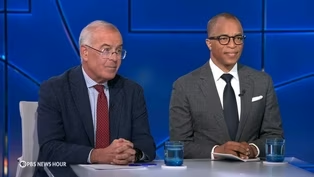
Brooks and Capehart on Trump's election claims
Video has Closed Captions
Brooks and Capehart on what Trump is trying to accomplish with his election claims (9m 19s)
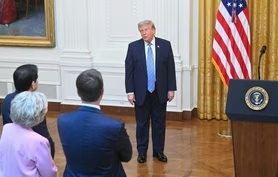
Documents fail to back up Trump's election claims
Video has Closed Captions
Trump tries to undermine trust in elections, but documents don't support his claims (5m 37s)
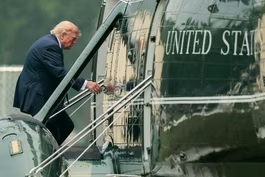
Former intelligence official on Trump's election allegations
Video has Closed Captions
Former intelligence official weighs Trump's election security allegations (6m 48s)
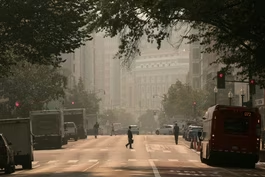
News Wrap: Smoke from wildfires leads to unsafe air quality
Video has Closed Captions
News Wrap: Smoke from wildfires leads to unsafe air quality in U.S. (6m 6s)
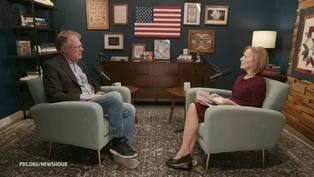
The role of conspiracy theories in the American Revolution
Video has Closed Captions
The surprising role of conspiracy theories in the American Revolution (4m 29s)
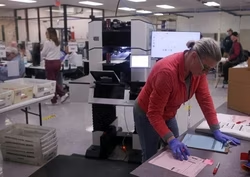
State officials on Trump's efforts to reshape elections
Video has Closed Captions
Battleground state election officials respond to Trump's efforts to reshape voting process (7m 33s)

Why the ancient story of ‘The Odyssey’ still resonates today
Video has Closed Captions
Why the ancient story of ‘The Odyssey’ still resonates today (7m 23s)

World Cup brings Gazans moments of hope amid devastation
Video has Closed Captions
World Cup brings Gazans moments of joy and hope amid devastation (5m 10s)
Providing Support for PBS.org
Learn Moreabout PBS online sponsorship New Episode
- News and Public Affairs

Today's top journalists discuss Washington's current political events and public affairs.

- News and Public Affairs

FRONTLINE is investigative journalism that questions, explains and changes our world.

 New Episode
 New Episode
 New Episode
 New Episode
 New Episode
 New Episode
 New Episode
 New Episode
Support for PBS provided by:
Major corporate funding for the PBS News Hour is provided by BDO, BNSF, Consumer Cellular, American Cruise Lines, and Raymond James. Funding for the PBS NewsHour Weekend is provided by...