
October 26, 2026 - PBS News Hour full episode
10/26/2026 | 57m 46sVideo has Closed Captions
October 26, 2026 - PBS News Hour full episode
October 26, 2026 - PBS News Hour full episode
Problems playing video? | Closed Captioning Feedback
Problems playing video? | Closed Captioning Feedback
Major corporate funding for the PBS News Hour is provided by BDO, BNSF, Consumer Cellular, American Cruise Lines, and Raymond James. Funding for the PBS NewsHour Weekend is provided by...
October 26, 2026 - PBS News Hour full episode
10/26/2026 | 57m 46sVideo has Closed Captions
October 26, 2026 - PBS News Hour full episode
Problems playing video? | Closed Captioning Feedback
Where to Watch PBS News Hour
PBS News Hour is available to stream on pbs.org and the PBS app.
Providing Support for PBS.org
Learn Moreabout PBS online sponsorshipAMNA NAWAZ: Good evening.
I'm Amna Nawaz.
Geoff Bennett is away.
On the "NewsHour" tonight: It's election season at home and abroad.
In the U.S., candidates make their final pitch to voters with control of Congress in the balance.
In Israel, a referendum on Benjamin Netanyahu, where voters will cast their ballot in the first election since the October 7 attacks.
And Brazil rejects a right-wing shift and reelects longtime leftist leader Lula da Silva, but his challenger refuses to concede.
(BREAK) AMNA NAWAZ: Welcome to the "News Hour."
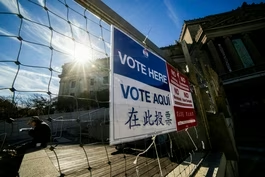
It is crunch time for candidates across the country, as tomorrow marks exactly one week from Election Day.
President Trump is spending today campaigning in ruby-red Mississippi, a state he won by almost 23 points two years ago.
And it was the battleground state of Michigan that saw a political heavyweight bout this weekend between Mr.
Trump and former President Barack Obama.
Liz Landers reports.
LIZ LANDERS: Stumping in swing states this weekend, President Trump laid out what's at stake in the looming midterm elections now just eight days away.
In the tight Michigan race that will help decide control of the Senate between former Republican Congressman Mike Rogers and Democrat Abdul El-Sayed, the president attacked El-Sayed's faith and said he would be a threat to national security.
DONALD TRUMP, President of the United States: I'm here to keep a jihadist Muslim Brotherhood member from becoming a United States senator.
And that's the fact.
We're not going to let that happen.
The people of Michigan are going to defeat Abdul Mohamed Sayed.
ABDUL EL-SAYED (D), Michigan Senatorial Candidate: I don't care how he pronounces my name.
I don't even care that he remembers my whole name, because he can just go on and call me senator after November.
LIZ LANDERS: El-Sayed, who would be the nation's first Muslim Senator, said Trump's attacks were a distraction from voters' concerns about the economy.
In a contentious interview on NBC's "Meet the Press," El-Sayed's opponent, Mike Rogers, dug in on his allegations linking El-Sayed to the Muslim Brotherhood, even though there is no evidence that El-Sayed has any affiliation with the group.
KRISTEN WELKER, Moderator, "Meet The Press": Is that up to your standard, calling... MIKE ROGERS (R), Michigan Senatorial Candidate: No, I don't.
I have never called him a terrorist.
I have never called him a terrorist.
This election is about me versus Abdul.
I mean, he's a Democrat Socialists of America-aligned candidate who has these pretty radical support groups that don't like America.
LIZ LANDERS: Former President Barack Obama brought his own firepower to the trail, rallying Democratic voters in two Midwestern battlegrounds on Saturday, telling crowds in Michigan and Ohio that Trump was responsible for rising costs because of the war with Iran.
BARACK OBAMA, Former President of the United States: The current president chose to make a series of bad decisions.
(CHEERING) BARACK OBAMA: Most importantly, he decided to start an unnecessary war that nobody has for -- nobody voted for.
DONALD TRUMP: Washington, D.C., is looking so beautiful.
LIZ LANDERS: And as President Trump has made many mentions of his Washington, D.C., renovation projects while on the trail, the former president mocked that preoccupation.
BARACK OBAMA: What's up with the gold?
Everything more gold.
He's got the white ass looking like Saddam Hussein opened a Cheesecake Factory.
LIZ LANDERS: Voters who waited in line for Mr.
Trump and Mr.
Obama's rallies this weekend spoke about what will draw them to the polls.
KEN GUNNELS, Michigan Resident: Why am I here?
I'm here for the future of this country, because I know we're at a crossroads.
SHARDAY BARNWELL, Ohio Resident: Education, health care, just general access and affordability.
Life is just hard for everybody right now.
LIZ LANDERS: On that issue most important to Americans, the economy, President Trump had this to say while in Georgia: DONALD TRUMP: President Trump is talking about all the money they're making while people are suffering at the pump.
That will be the headline.
But I said, I don't give a damn.
I'm going to say it.
We're making a freaking fortune.
Our country is getting stronger and stronger all the time.
LIZ LANDERS: Vice President Vance had this to stay in Belgrade, Montana, today: J.D.
VANCE, Vice President of the United States: As proud as I am of the last 18 months, we have done a lot, but there is still so much more that we can do together.
LIZ LANDERS: Mr.
Trump cast his own ballot on Saturday in Florida, joining nearly 30 million Americans who have already voted early.
The president has in the past called early voting ridiculous, one of his many lines of attack on elections in America.
Meantime, the attorney general defended the Trump administration's preemptive lawsuit against Alaska state election officials, where the DOJ sued late last week to block the certification of the election if the Democrat wins.
Blanche said there could be confusion over the incumbent Republican senator facing off against another candidate with almost the exact same name.
TODD BLANCHE, U.S.
Attorney General: If there is litigation -- there may not be, but if there is litigation brought by others after the election because of possible voter confusion, that the ballots are kept in a way that the Alaska state -- that the Alaska state election system can determine who the accurate winner is.
LIZ LANDERS: It's a move that the president says he directed.
The Justice Department also defended another challenge to how states administer their elections in a legal battle playing out in California after the federal government asked state officials there to review and set aside more than 20,000 ballots that they believe were sent to noncitizens.
In a rare Sunday argument session, the Ninth Circuit Court of Appeals appeared skeptical of the Justice Department's demand, questioning the timing and authority of the federal government's actions.
And while instances of noncitizens voting are very rare, the Trump administration has made a big push to prosecute these cases.
This morning, the Justice Department announced new charges against 48 noncitizens alleged to have illegally voted or registered to vote.
It is important to note that, even though charges are filed, it does not necessarily mean any illegal voting actually happened.
In the rare instances where noncitizens get registered to vote, there is some administrative confusion and that voting has not taken place there.
Including those charged today, a little more than 200 people have been charged for illegal voting since the start of Trump's second term.
And for prospective, Amna, there were more than 230 million Americans registered in the 2024 presidential election.
AMNA NAWAZ: And, Liz, we saw President Trump weigh in on exactly that on social media today before leaving for Mississippi.
What did he have to say?
LIZ LANDERS: He posted on TRUTH Social that for anyone who turns over voter fraud in past or present elections, that that person will get a million-dollar payout from the government.
However, caveat is that the person has to be convicted.
The president did not explain exactly how this will be -- happen or where the money will come from or whether this is even legal.
But he did also announce something similar last week in the Oval Office, saying that he would personally decide on giving payouts in a whistle-blower protection program that he announced with a $25 million fund just last week.
AMNA NAWAZ: All right, Liz Landers, thank you very much.
LIZ LANDERS: Of course.
AMNA NAWAZ: In the day's other headlines: AI giant Anthropic officially kicked off what could be one of the biggest initial public offerings ever.
The maker of the chatbot Claude will be looking to surpass SpaceX, which recently raised a record $86 billion.
In paperwork filed today, Anthropic said its revenue jumped in the first half of the year, but the company also revealed massive losses.
And its IPO comes amid broader questions about the AI boom and the potential threat posed by the industry.
Anthropic is expected to go public in mid-November.
It plans to list on the Nasdaq under the ticker symbol ANT.
In the Southwest, flood warnings remained in place today in parts of the Four Corners region after days of extreme rainfall swamped areas along the San Juan River.
The flood zone spans the meeting points of Utah, Colorado, Arizona, and New Mexico, where one person was swept away and killed.
As rivers recede and neighborhoods begin to clean up, New Mexico's governor warns the area is still in a rescue and recovery phase.
GOV.
MICHELLE LUJAN GRISHAM (D-NM): It feels, with lovely sunny day and water recedes quickly because we're so dry, it moves, that it feels like everything is done.
Everything is not done.
AMNA NAWAZ: Some residents have not been able to return to their homes and public health officials are assessing whether the floodwaters could be contaminated with raw sewage and chemicals.
At least two Catholic bishops have now expressed regret for taking part in a White House meeting that was later made public.
An administration official shared this video on social media showing a dozen bishops praying with President Trump behind the Resolute Desk last week.
Milwaukee's archbishop later said the event was -- quote -- "manipulated" and was in no way an endorsement of the president.
And the bishop of Des Moines wrote today -- quote -- "I wish I had been more shrewd and less simple, like those who exploited our meeting for partisan political purposes.
I pray I am more prudent and wise going forward."
In New York, a federal judge ruled today that the Trump administration acted illegally when it fired Maurene Comey, daughter of former FBI Director James Comey.
In his ruling, the judge found that her dismissal as a federal prosecutor violated the separation of powers and her right to due process.
Comey had handled the prosecutions of Jeffrey Epstein and Sean Combs, among others.
After her firing last year, Comey sued the Justice Department, saying it was because of her assumed political beliefs and who her father is.
The judge today ordered her to be reinstated with back pay.
And, this evening, we're learning that the DOJ has filed new charges against James Comey.
According to a court document obtained by the "News Hour," these relate to the alleged disclosure of national defense information dating back to 2016.
Comey has already moved to dismiss the case, saying on social media that he is still innocent.
Press freedom advocates sued the Trump administration today over its attempt to ban three media outlets from covering the White House.
The lawsuit was filed on behalf of six plaintiffs, including a Yale history professor, a high school civics teacher, and a student journalist at the University of Pennsylvania.
They argue that: "With such a ban quote it isn't just the press that suffers.
The public loses access to independent reporting and gets something closer to government propaganda."
The White House dismissed the suit, saying that the outlets can report from directly outside the building.
On Wall Street today, stocks managed some decent gains to start the week.
The Dow Jones industrial average added nearly 150 points.
The Nasdaq rose more than 200 points.
The S&P 500 also ended firmly in positive territory.
And we have two passings to report this evening, starting with Emmy Award-winning voice actor Eric Bauza.
ERIC BAUZA, Actor: I'm the new voice of Bugs Bunny.
What's up, Doc?
AMNA NAWAZ: Bauza was best known for voicing Bugs Bunny and many other beloved Looney Tunes characters.
He was also the first person of color to voice Bugs.
Born in Canada, Bauza went on to log more than 400 acting credits across TV and film during his 25-year career.
Recently, he helped to get "Coyote vs.
Acme" into theaters after it was initially shelved by the studio.
The movie went on to make over $100 million worldwide.
L.A.
County officials say Bauza died from a form of heart disease at his home.
Eric Bauza was 46 years old.
And actor Walter Koenig of "Star Trek" fame has died.
WALTER KOENIG, Actor: Captain, the alien ship has changed course and speed, moving directly toward us at warp eight.
AMNA NAWAZ: The Chicago-born Koenig played Russian navigator Pavel Chekov, the sole communist bloc member on the USS Enterprise.
With his youthful looks, heavy Russian accent, and friendly demeanor, Koenig's character helped viewers of the era look past their Cold War present to a more unified future.
He went on to write books about the series and appeared in shows like "Babylon 5."
Koenig's agent says he died from natural causes at his Los Angeles home yesterday.
Walter Koenig was 90 years old.
Still to come on the "News Hour": a student-led movement ousts Serbia's right-wing leader; how political ads in the U.S.
are trying to sway voters in the final days of the midterms; and Tamara Keith and Amy Walter break down the races to watch.
Israelis will go to the polls tomorrow in what many describe as the most consequential election in years.
It's the first vote since the Hamas attack on Israel on 2023 and Israel's war in Gaza in response.
Prime Minister Benjamin Netanyahu has been making the case that he will keep Israel safe.
But the main opposition says Netanyahu failed to prevent the October 7 attack and is blocking an investigation into how warning signs were missed.
Nick Schifrin reports from Tel Aviv.
NICK SCHIFRIN: In Tel Aviv this weekend, a clarion called for change.
Gadi Eisenkot is the former Israeli military chief, son of Moroccan immigrants, and today leader of a coalition trying to unseat Prime Minister Benjamin Netanyahu.
GADI EISENKOT, Israeli Prime Minister Candidate (through translator): Israel and the Israelis will be able to start a new era, an era of growth, of real security, of taking action, an era without lies and manipulations.
LIANNE POLLAK-DAVID, Israeli Parliamentary Candidate: Gadi Eisenkot is the complete opposite of Benjamin Netanyahu.
Gadi Eisenkot is a trustworthy, honest, pragmatic, and a leader that basically has the national interest at heart.
NICK SCHIFRIN: Lianne Pollak-David is a parliamentary candidate in Eisenkot's party, Yashar, Hebrew for Straightforward, a reference to both direction and integrity, that Netanyahu faces charges of corruption.
LIANNE POLLAK-DAVID: Benjamin Netanyahu speaks the most amazing English and how knows how to market himself, but basically has lost complete trust of not just the global arena, but also the U.S.
general public.
NICK SCHIFRIN: This is the first vote since the deadliest day in Israel's history, the October 7 terrorist attacks, when 1,200 Israelis were murdered.
It's also Israel's worst ever intelligence failure, for which Netanyahu has not been held accountable.
Eisenkot vows, as his first action as prime minister, to launch an independent inquiry that he says Netanyahu has blocked.
DEVORA SHARIFIAN BACHAR, Israeli Parliamentary Candidate: It's only because of him.
It's only because of the Israeli prime minister, Benjamin Netanyahu, that we didn't investigate.
NICK SCHIFRIN: Devora Sharifian Bachar is a former Israeli intelligence official and a Yashar candidate for Parliament.
DEVORA SHARIFIAN BACHAR: He wants to investigate himself.
Please, we are not clowns, and we need to understand what to do better, where we go wrong, and we will do so.
NICK SCHIFRIN: After October the 7th, Eisenkot joined Netanyahu's War Cabinet, but resigned and accused Netanyahu of prioritizing politics over security.
Now Eisenkot argues he can finish the wars that Netanyahu can't against Hamas in Gaza, against Hezbollah in Southern Lebanon, where Israel maintains an occupation for the first time in more than 25 years, and the war in Iran that has severely reduced Iran's traditional military, but installed an even harder-line regime.
DEVORA SHARIFIAN BACHAR: In 20 years, I worked in the Israeli intelligence.
If we see Iran still standing, they are rehabilitating their forces.
They're starting to build again those crazy missiles that they throw on us.
NICK SCHIFRIN: And an Eisenkot government vows to crack down on extremist Israeli settlers in the West Bank who've recently attacked journalists and diplomats, as well as Palestinians as they harvest olives.
LIANNE POLLAK-DAVID: Extremist violent groups going out there every single night attacking honest and innocent, basically, civilians on the Palestinian side, but not only that, also diplomats and journalists, this is completely unacceptable.
It does not reflect the Israeli people.
And this government has done nothing to stop it, but also has even fueled that activity.
NICK SCHIFRIN: It is Palestinian violence in the West Bank that Netanyahu highlights, including a Friday attack that killed two Israeli soldiers.
Netanyahu vowed a crackdown as part of his argument he alone can provide security.
And Israeli bulldozers pulled down buildings where the attackers lived.
On the campaign trail, Netanyahu's painted the opposition as dangerous because of a possible alliance with Arab parties.
And Netanyahu has trumpeted his endorsement by President Trump and argued Eisenkot wouldn't maintain their relationship or be able to launch a joint U.S.-Israel attack on Iran.
Netanyahu even reposted an AI image of an Iranian nuclear weapon exploding over Tel Aviv.
BENJAMIN NETANYAHU, Israeli Prime Minister: Donald, we have a job to finish.
You said it, and we will finish it together.
OPHIR FALK, Foreign Policy Adviser to Prime Minister Netanyahu: Israel and the American-Israeli alliance is stronger than ever.
And Iran and the Iranian proxies are weaker than ever.
NICK SCHIFRIN: Ophir Falk is Netanyahu's foreign policy adviser.
OPHIR FALK: The prime minister, again, he promised on day two of the war that he will change the Middle East.
And he has changed the Middle East.
Has he completed, finished the job 100 percent?
Not yet.
He's done about 90 percent.
He still needs to do 10 percent.
He wants to finish the job.
NICK SCHIFRIN: Does that mean that Israel and the United States goes back to war after the U.S.
midterm elections?
OPHIR FALK: Well, I can't comment on when the war will restart or if it will restart.
There's great economic pressure on the Iranian regime.
It might fall that way.
But, as you said, President Trump, the leader of the free world, the leader of the United States, our number one ally, Israel's indispensable ally, sees us as a model ally and wants Netanyahu to win.
This is not a political statement.
It's a policy statement.
The president of the United States wants Prime Minister Netanyahu to win.
Who doesn't want Netanyahu to win?
Iran, the Houthis, Hezbollah, Hamas.
NICK SCHIFRIN: As for the West Bank, Israeli checkpoints feature campaign posters of far right government ministers who've supported the settler movement.
But Falk argues the government has targeted extremist settlers.
OPHIR FALK: There have been over 360 investigations in the past quarter.
There's been 35 arrests in the past quarter of what you call settler violence.
And we won't accept anybody taking the law into their own hands.
Israel is a country of rule of law.
NICK SCHIFRIN: Falk and the government say the focus should be on Palestinian violence against settlers and the Israeli military.
OPHIR FALK: Over 1,530 Palestinian terrorist attack attempts have happened over the past year.
So you got to put that into perspective.
NICK SCHIFRIN: And rights groups say, in response to government claims about crackdowns on settler violence, that more than 90 percent of Israel's investigations into settlers end without an indictment.
And we have seen Israeli soldiers coordinate, even defend settlers across the West Bank -- Amna.
AMNA NAWAZ: And, Nick, as we look ahead to that election tomorrow, walk us through the latest polls.
What do they show us at this point?
NICK SCHIFRIN: Well, it depends on which polls you follow, but Eisenkot's coalition is leading slightly.
But, right now, neither side has enough votes in order to form a coalition that would become the next government.
And a reminder, Amna, as you know, winning the Israeli elections means leading a party that can form a coalition.
The Knesset, the Israeli Parliament, has 120 seats.
So, for a coalition to have a majority, it needs at least 61.
In the last poll release, Netanyahu's Likud Party and its coalition partners have 48 seats, well short of 61.
Eisenkot's coalition is leading with 54, but also short of 61.
He could form what's known as a minority government.
That would be the first time in Israeli history a government started with under 61, but that would only be possible by asking for support from Arab parties.
You see them represented right there in green.
And some in Eisenkot's coalition have already rejected that.
That's a reminder of his fractious and fragile coalition.
He has a party on the left that wants a two-state solution.
He's also got two parties on the right wing of Israeli politics that are against that and are more focused on bringing the ultraorthodox into the military.
Look, the election could tip on a small number of votes.
There also could be a stalemate, Amna.
We have seen that in the past.
That is something that would lead perhaps to more elections, something no Israelis want to see, but it would leave Benjamin Netanyahu as caretaker prime minister.
AMNA NAWAZ: And, Nick, in your reporting, you have described Eisenkot as representing change, but how much change is he really calling for?
NICK SCHIFRIN: It's a very good question, because, as you heard in the story from Eisenkot and his supporters, they believe that they're very different from Benjamin Netanyahu, whether it comes to accountability for October the 7th or even how they will talk to Americans.
They criticize Netanyahu for focusing too much on President Trump.
They want to reach out to more Americans, including Democrats.
But when it comes to Israeli foreign policy, those changes seem to reduce.
First, in Gaza, as I mentioned, Eisenkot promises to finish the fight against Hamas.
But he's warning it might require restarting the war.
In Lebanon, he's admitted that -- quote -- "It will take a lot of time for Hezbollah to be dismantled," so Israeli troops will have to remain in Southern Lebanon.
In Iran, he vows to destroy or dismantle Iran's nuclear program, including with a military strike.
And when it comes to the Palestinians, since October the 7th, the majority of Israelis are in favor of settlement expansion.
And there's very little talk of Gaza, conditions in Gaza 75,000 killed.
WFP says 1.4 million people experiencing acute food insecurity.
What Israelis are focused on, Amna, an election that feels one of the most consequential in years, and a country that is fractured and, frankly, still traumatized from all the wars in the last few years.
AMNA NAWAZ: All right, that is Nick Schifrin reporting from Tel Aviv tonight.
Nick, thank you.
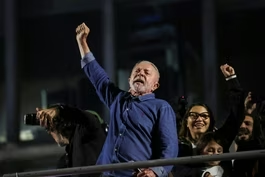
In a closely watched election, Brazil's president, known as Lula, defeated right-wing and Trump-aligned challenger Flavio Bolsonaro last night by nearly 4.5 million votes.
Transportation and weather disruptions in parts of Brazil led to a chaotic final stretch at the polls.
Bolsonaro is now refusing to concede.
And, today, President Trump said the outcome was -- quote -- "rigged."
Stephanie Sy reports.
STEPHANIE SY: On the streets of Rio de Janeiro last night, rejoicing and cheers of relief rang out among Lula supporters.
Brazilian voters narrowly reelected the leftist president, Luiz Inacio da Silva, the 80-year-old Lula beating right-wing senator Flavio Bolsonaro 51 to 48 percent.
Lula addressed supporters in Sao Paulo after the win.
LUIZ INACIO LULA DA SILVA, Brazilian President (through translator): I want you to know that everything I do, I do with you in mind.
All public policies are designed with you in mind.
And you have given me the distinction of being the first president of the republic to be elected four times through democratic means.
This is a historic achievement that I owe to the Brazilian people.
STEPHANIE SY: It's historic in more ways than one.
Lula was the underdog after he lost the first round of voting earlier this month to Flavio, the son of former President Jair Bolsonaro, who was convicted for attempting to stage a coup.
Millions of Brazilians who did not vote in the first round came out Sunday, with voters in Rio de Janeiro and the suburbs of Sao Paulo swinging their support to Lula.
ANA CANDIDA COTRIM, Lula Supporter (through translator): The feeling is that democracy resisted in the midst of authoritarianism, in the midst of the whole world, of the great powers like the United States against Brazil.
And we managed to resist with the strength of the people in the streets and on social media.
STEPHANIE SY: Lula's victory broke a recent right-wing winning streak in Latin America.
Now Brazil and Mexico, Latin America's two most populous countries, have bucked the trend.
Mexico's President Claudia Sheinbaum reacted jubilantly today.
CLAUDIA SHEINBAUM, Mexican President (through translator): It shows that, when the people decide to mobilize and defend their rights, they always win.
And that is a lesson for Brazil, for Mexico, and for the whole world.
STEPHANIE SY: Lula's win was a loss for President Trump's influence in the region.
And echoing Trump and his father, Flavio Bolsonaro refused to admit defeat last night, saying he planned to request an annulment of the election.
FLAVIO BOLSONARO, Brazilian Presidential Candidate (through translator): What happened today was not normal.
It was downright unacceptable.
A Supreme Court justice for the first time in history, a former lawyer for Lula, with a simple stroke of the pen, at the request of a former partner, changed the rules of the game in the middle of the match.
STEPHANIE SY: Stormy weather and transportation troubles had led both candidates to request an extension of voting by two hours.
But in the end, the country's Supreme Court granted Lula's request shortly before polls were set to close.
Supporters of Bolsonaro are crying foul.
JEREMIAS OLIVEIRA, Brasilia, Brazil Resident (through translator): Flavio Bolsonaro has already said he will file to annul this election.
I hope he manages to, because it's not normal, people.
This is wrong.
STEPHANIE SY: Despite attempts to inject doubt, the results are official.
And even right-wing leaders in the region are congratulating Lula.
Flavio Bolsonaro will remain in the Senate through the end of his term, however, and with Congress still dominated by Brazil's right-wing.
Lula's win, while decisive, is far from a mandate.
For the "PBS News Hour," I'm Stephanie Sy.
AMNA NAWAZ: Well, and Brazil isn't the only country with dramatic election results this weekend.
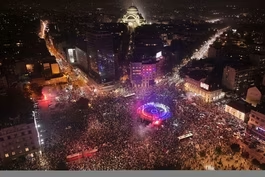
In Serbia, longtime leader Aleksandar Vucic was defeated after an historic election on Sunday brought down his government.
William Brangham joins us now with more.
WILLIAM BRANGHAM: For more on the results from Serbia and how this result is echoing around the world, we turn again to Heather Conley.
She served as deputy assistant secretary of state for European affairs during the George W. Bush administration.
She's now a nonresident fellow at the American Enterprise Institute and works with an international consulting company.
Heather, great to have you back.
Help us understand something.
Your reaction to this?
Because some viewers might think, Serbia is not that big of a nation, under seven million people.
They're not in the E.U.
They're not in NATO.
So how important is this result?
HEATHER CONLEY, American Enterprise Institute: Well, it's extraordinary because of how it came about and the focus of the concern of the protesters.
First and foremost, this was led by students.
It's a young persons' -- it's a movement that doesn't have a leader.
It's decentralized.
It's digitally savvy, and it brought down literally a strongman of Serbia who had all control over the powers, economic, political powers.
And the focus of the protest was on corruption, government corruption, and we're seeing that issue become a real global issue.
And certainly young people are taking to the streets and really, strongly seeking another solution from government.
So I have to say, as a watcher of the Western Balkans, it was like I was watching October 2000, when the people poured out in the streets in Serbia to oust Milosevic.
President Vucic was a member of Milosevic's Cabinet, and this was truly people power.
And it sort of comes along -- we remember the Hungarian election not too long ago that brought in a new leader who also was fighting corruption.
This is also a strike against Russia and China, two countries that were strongly influencing Serbia.
And so it's certainly a win for the people of Serbia, but we will see how they govern from here.
Big question marks to come.
WILLIAM BRANGHAM: Right, because as you were saying, this wasn't Vucic against another candidate.
This was a parliamentary election, and Vucic basically saw that his party was getting drubbed in the polls and conceded this race peacefully.
Did that surprise you how quickly he came forward and said, we have clearly lost, time to move on?
HEATHER CONLEY: Yes, I mean, we always think of the strongman with incredible control over economic powers, that they're not going to go quietly into the night.
There was an hour where the Serbian government, the electoral commission, didn't release the results.
I think they paused, saw how dramatically large it was, and said, look, we can't fight this now.
But if the student-led movement is disorganized, if they cannot form a government, we have all the levers there.
We will try to sort of fight this out another day.
But I was surprised, and good for them for acknowledging this was a historic win.
WILLIAM BRANGHAM: Did the tenacity of this student movement impress you?
I mean, we have seen a lot of protests that have been bubbling up, often youth-driven.
But this one lasted quite a while, and as you were saying, seems quite effective.
Like, I -- when you look at this, the broad scope of what's happening in Europe, does this feel spiritually, philosophically connected to all these other protests that we're seeing?
HEATHER CONLEY: Yes, I like to think we're starting to see some dots connected, particularly with youth movement.
As you said, this started two years ago when a rail station in Novi Sad, Serbia, it was recently renovated and it collapsed, killing 16 people.
It was clearly an example of, again, government corruption that didn't use the right building materials.
There was no accountability.
So these student protesters began to galvanize around, we want credit -- we want the government to be transparent.
We want someone to be held accountable for this.
Over time, though, it grew, and it grew about demanding greater things from government, greater accountability, and it and it grew across Belgrade.
So there's something that they fought for two years and look at what they achieved.
But we're seeing this historically elsewhere.
In Albania very recently, students are now growing against a -- what they believe to be a corrupt investment in Albania that has links to President Trump's family.
We see... WILLIAM BRANGHAM: This is the Kushner and his wife's investment in a luxury resort.
HEATHER CONLEY: Exactly, in Albania.
We're seeing that huge pressure on the government, whereas some we have seen in France in these -- in these protests.
Now, some of them have become violent, but we're seeing where young people, just high schoolers, were saying, I cannot accept anymore.
The fact that I don't have a teacher in my classroom, my classroom isn't working, I want something better.
I demand the government take action.
And now others are joining in that, unions, as well as the Yellow Vest movement.
And even in the Brazil example that you just showed, what appears to be the difference between the first and the second round and the surprising victory by President Lula was a real empowerment, Lula's army of young people, that really were galvanized.
So we're seeing young people taking part.
Turnout is historically high.
But the thing is, they're demanding something different from government, not the same old story.
And a lot of this is focused on corruption and that governments are not addressing critical problems.
You see that in India with the Cockroach movement over elect -- education and removing electoral voter rolls.
WILLIAM BRANGHAM: Right.
HEATHER CONLEY: They are putting real pressure.
So power to the people, power to the young people.
But this isn't a hopeful.
This is desperate and they need action.
WILLIAM BRANGHAM: Heather Conley of the American Enterprise Institute, thank you so much.
HEATHER CONLEY: Thank you.
AMNA NAWAZ: Returning now to the U.S.
midterm elections.
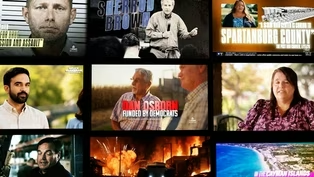
In this final week, campaigns and their allies are making their closing arguments, often 30 seconds at a time.
The amount spent on election advertising this year is enormous, larger than many states' entire annual budgets.
And many of the ads are focused on the question of affordability.
But, as Lisa Desjardins explains, the attacks are also getting more personal and more artificial.
SEN.
SUSAN COLLINS (R-ME): I'm Susan Collins.
JAMES TALARICO (D), TEXAS SENATORIAL CANDIDATE: I'm James Talarico.
REP.
MIKE LAWLER (R-NY): I'm Mike Lawler.
FMR.
SEN.
SHERROD BROWN (D-OH): I'm Sherrod Brown.
LISA DESJARDINS: On battleground state airwaves, phones, and laptops... NARRATOR: It doesn't matter if you live here or here.
LISA DESJARDINS: ... there's no escape from the closing blitz of campaign ads.
Erika Franklin Fowler, co-director Of The Wesleyan Media Project, tracks every one she can.
ERIKA FRANKLIN FOWLER, Co-Director, The Wesleyan Media Project: 2026 will be a record-breaking year for political advertising basically any way you measure it.
LISA DESJARDINS: Wesleyan's latest numbers count more than 250,000 ads airing per week.
And ad tracking firm AdImpact tallies more than 10 billion spent through September, and expect another 1.6 by Election Day, the most in history, including every presidential cycle.
NARRATOR: What do you really know about Rob Sand?
LISA DESJARDINS: Republicans are outspending their Democratic peers, but the gap has narrowed as Election Day draws closer.
Both parties are running on the economy.
WOMAN: Groceries, gas, our health care bills.
LISA DESJARDINS: Wesleyan's data show cost of living as Democrats' top issue, popping up in nearly a quarter of their recent Senate ads.
ERIKA FRANKLIN FOWLER: Democrats are definitely hammering home on the cost of groceries, the cost of gas, that it shouldn't take this much to stay afloat.
LISA DESJARDINS: For Republicans, the economic focus is on taxes.
NARRATOR: More spending that drives up costs.
LISA DESJARDINS: Accounting for one in five of their ads.
MAN: Data center production and energy use in Texas.
LISA DESJARDINS: The literal and metaphorical buzz around data centers represent another shared focus.
ERIKA FRANKLIN FOWLER: It's kind of a double hit.
You can attack corporations, as well as get on board with an issue that is unpopular.
LISA DESJARDINS: President Trump has the lowest approval ratings since Herbert Hoover, but continues to tell rally crowds to "Pretend I'm on the ballot."
But as John Link with AdImpact explained to us, Republicans on the ballot are leaving him out of their ads.
JOHN LINK, AdImpact: Trump nearly disappeared from most messaging, especially on the GOP side.
February of this year, 56 percent of all GOP ads mentioned Trump, in September, less than 1 percent.
LISA DESJARDINS: But Trump inserted himself.
DONALD TRUMP, President of the United States: We will throw off the sick political class that hates our country.
LISA DESJARDINS: Using millions in taxpayer dollars for campaign-style ads before switching to private funding.
WOMAN: When it matters, Susan Collins sides with Trump.
LISA DESJARDINS: Here, Democrats agree with Trump.
They want him seen.
AdImpact finds he is in one out of five of Democratic-aligned ads this month.
NARRATOR: Lawler rams Trump's agenda over the line.
LISA DESJARDINS: Occasionally, an ad itself is an issue.
GOP Ohio gubernatorial candidate Vivek Ramaswamy's campaign drew fire from both parties for this ad.
It features Donna Arthur... DONNA ARTHUR, Mother of Amy Acton: Amy has a serious problem.
LISA DESJARDINS: ... the estranged mother of Democrat Amy Acton, calling her daughter a liar.
AMY ACTON (D), Ohio Gubernatorial Candidate: I haven't seen my birth mother since I was 12.
My mother is not well, and I feel like it was an exploitive thing to do.
LISA DESJARDINS: Acton was removed from the house after her stepfather was charged with raping her.
He fled the state, and her mom stayed with him.
Ramaswamy's campaign is sticking by the ad, planning to spend $4 million airing it.
VIVEK RAMASWAMY (R), Ohio Gubernatorial Candidate: Voters deserve to know what the truth is, and the truth is that this woman is a liar.
LISA DESJARDINS: Voters routinely say they hate attack ads.
MICHAEL WEDDING, Ohio Voter: It's just gross, very, very gross.
SANJAY SRIPATHY, Ohio Voter: There's too many negative ads.
Most of the ads that I have seen are just negative.
LISA DESJARDINS: But, in general, Fowler says on-air attacks can serve a legitimate purpose.
ERIKA FRANKLIN FOWLER: If all of our election messaging was positive, we would have a lot of families and puppies on air.
And I do think the important issues at stake in elections are important to raise, and it's hard to do that without making a contrast.
LISA DESJARDINS: There is a difference, though, between hard-hitting negative ads on issues and sort of personal attack ads.
ERIKA FRANKLIN FOWLER: Over time, we have seen the personal and the policies start to intertwine.
And they definitely had blurred more in recent cycles, especially when you start getting into government ethics and corruption.
SKY ROBERTS, Brother of Virginia Giuffre: My sister Virginia was one of Jeffrey Epstein's victims.
LISA DESJARDINS: Like those harmed by Jeffrey Epstein, who have blasted some members of Congress as not doing enough.
NARRATOR: Dangerous soft-on-crime policies.
LISA DESJARDINS: Outside groups are outspending politicians three to one on attack ads.
Those dynamics aren't new, but technology has introduced a new player.
AI VOICE: Hello there.
I'm Josh Shapiro.
LISA DESJARDINS: AI.
The "News Hour" is watermarking those ads here.
This ad backing Pennsylvania Republican Stacy Garrity features an A.I.-generated video that looks like Democratic Governor Josh Shapiro.
Wesleyan has found 220 A.I.-made ads this cycle, with $137 million behind them.
In 2024, it found less than $50,000; 81 percent come from Republicans or their allies.
ERIKA FRANKLIN FOWLER: We suspect that potentially it's that Democrats face more reputational risk of using AI in their advertising and therefore may be more likely to avoid it.
LISA DESJARDINS: A Republican super PAC has run AI deepfakes of Georgia Senator Jon Ossoff as if he were getting beauty treatments with no disclosure that it's AI.
MAN: Ossoff needs to put down the mascara and join the real world.
LISA DESJARDINS: No federal law requires one.
AI VOICE: This ad was created with AI, thanks to big beautiful data centers.
LISA DESJARDINS: And Wesleyan found nearly three out of four AI ads don't carry one.
ERIKA FRANKLIN FOWLER: The big point to underscore is that, even though we have identified quite a few ads that use AI, there's undoubtedly much more that we cannot detect because it is just that challenging to be able to tell.
LISA DESJARDINS: There are some positive non-AI ads, many of them from candidates.
WOMAN: He shows up for everyone, co-workers, neighbors, and our whole community.
REP.
ASHLEY HINSON (R-IA), Senatorial Candidate: Working across the aisle isn't always easy, but it's how you get results.
LISA DESJARDINS: But the sheer volume of all political ads this year is mind-numbing.
Fowler understands.
ERIKA FRANKLIN FOWLER: Living in a swing state right now is not any fun at all.
And I apologize to all of the viewers who are having to live through it.
LISA DESJARDINS: But Link says, even so, the ads work.
JOHN LINK: If the ads weren't effective, at least perceived effective by these campaigns and marketers, we wouldn't see the dollars being spent.
It's not just to keep up with the Joneses.
LISA DESJARDINS: For the "PBS News Hour," I'm Lisa Desjardins, and I approve this story.
AMNA NAWAZ: To help us understand where the races for House and Senate stand we turn now to our Politics Monday duo.
That is Amy Walter of The Cook Political Report With Amy Walter and Tamara Keith of NPR.
Great to see you both.
TAMARA KEITH: Hello.
AMY WALTER: Great to be here.
AMNA NAWAZ: One week to go.
Here we go.
Let's start with the temperature check on the House.
as both of you have been reporting Democrats' chances of winning control, Amy, look to be very good.
The big question is how big of a majority.
You probably saw House Speaker Mike Johnson, a Republican, obviously, say in a recent interview the idea that Democrats could win a 230-seat majority is ridiculous or hilarious and nonsense were his words.
What are you seeing at The Cook Political Report?
AMY WALTER: Yes, I mean, there was a point probably a year ago when that did seem absolutely ridiculous, the thought that Democrats could gain up to 230 seats.
Today, our prediction of The Cook Political Report is that the range of pickups for Democrats is somewhere between 227 and 237.
The reason things have changed so dramatically in a year, and, again, a year that didn't just feature Republican seats that are in danger, more Republican seats in danger, but Democratic seats that were redrawn by Republicans to be more vulnerable for Democrats have also not necessarily panned out.
AMY WALTER: So you put those two things together and really the big drag, of course, in all of this is the president.
AMY WALTER: The war in Iran, rising gas prices has put seats in play that wouldn't traditionally be put in play, seats that the president carried by, in some cases, 10 points or more.
Tam, you look more deeply.
We thought -- Republicans, rather, thought that mid-decade redistricting would help to protect some of those losses.
Will it?
TAMARA KEITH: Yes, the mid-decade redistricting was supposed to be a firewall.
There were 15 districts that were made more Republican, tilted to favor Republicans.
In looking at those races now, you actually have about two-thirds of them that are not at all a sure thing for Republicans.
These were supposed to be sure things, and it hasn't worked out that way, in part because the lines were drawn based on a high watermark of support for President Trump in the 2024 election.
Latino voters, young voters, a bunch of voter groups have moved away from, soured on the president and his party.
And then you also had a lot of incumbents who were drawn out of their districts or they were trying to draw them out of their districts.
They stuck around to fight, and they have all the advantages of incumbency, those Democratic incumbents.
So it really just hasn't worked out.
One Democrat said this could be a dummymander, instead of a gerrymander, quite confidently said that.
A Republican who declined to go on the record, but who is working on these House races, said that, oh, no, the redistricting was not meant to make outcomes.
It was just meant to make more battlefields, which is definitely not the level of confidence they were expressing even just a few months ago.
AMNA NAWAZ: Let's take a quick look at the Senate before we move on.
Amy, as you know, in the Senate, your recent polling shows that Democratic candidates are leading in some states where the president won by double digits in 2024, and includes Ohio and Texas and Iowa.
AMY WALTER: Yes.
AMNA NAWAZ: A week out, how it's look?
AMY WALTER: A week out, again, this wasn't supposed to be where things ended up, the fact that we have those three states and states like Kansas actually in play, a state the president also won by double digits.
It is the same story in both the House and the Senate.
The infrastructure that Republican, the advantage that they had was supposed to protect them from a difficult environment, because in most midterm elections, the most vulnerable seats, even in big wave years, the most vulnerable seats are the seats that the president narrowly carried the election before or lost.
There just weren't that many of those in the Senate or the House.
But you combine the president's low approval ratings, low enthusiasm from Republicans, clearly, the money is going into these races, so Republicans are seeing the same things that Democrats are.
The institutional sort of structural advantages have eroded and the environment has become a much bigger predictor in where these races are going.
AMNA NAWAZ: I mean, the fact the president is in Mississippi tonight, what does that say to you, Tam?
TAMARA KEITH: Well, and not just that the president is going there, but also that Republicans are spending money there.
Republicans are essentially spending money in places where the incumbents didn't expect to have a competitive race at all, maybe didn't even have much of a campaign put together, and now they're facing these real competitive races.
I mean, Mississippi is what one would call a stretch for Democrats, certainly, but it is something where you have seen top surrogates going in there to campaign and it's getting a lot of attention all of a sudden here at the very end.
AMNA NAWAZ: Well, the president took his closing message on the road over the weekend.
He stopped in Florida and Georgia and Michigan, and has now become -- as typical, he sort of veered off script, not really focused on the number one issue of affordability.
In some of these remarks are about to play.
He disparaged people from other nations.
He commented on the rapper Nicki Minaj's body as she was campaigning with him, and he also commented on the winner of this year's Nobel Peace Prize.
Take a listen, and there is some tough language in this.
DONALD TRUMP, President of the United States: Libya, Yemen, Haiti, Somalia, remember I -- remember what I call them?
Shithouse countries.
DONALD TRUMP: Remember the heat I took?
By the way, I looked at one hell of a beautiful ass before, Nicki Minaj.
DONALD TRUMP: That's hard to miss.
And it was announced and it was gotten by a woman that nobody ever heard of.
I said, what about me?
Do they do two of them?
DONALD TRUMP: Think of it.
I settled -- so I'm not in love with Norway.
Frankly, Norway sucks.
AMNA NAWAZ: The president also posted this 1,300-word rant on TRUTH Social about late-night TV host Bill Maher, calling him a loser.
Tam, what kind of closing message is this?
And who is this for?
TAMARA KEITH: Oh, his eye is very much on the ball.
No, there has been polling over months and months and months, and we continue to see it, where voters say they feel like the president isn't focused on the things that matter to them the most.
And when he is talking about ballrooms and talking about butts, he is not talking about the things that matter to people the most.
However, he is putting on a show.
And you kind of have to remember these rallies in that context.
This is a two-hour weave-filled show that is part comedy routine, part body humor, part campaign message.
And so there are campaign messages in there.
There are messages about things that he's going to do for each and every state he visits, economic proposals.
And then there's talk about the senator from Ohio's butt.
And he doesn't just talk about it in Ohio.
He's talking about it in every state, because it is a show.
I talk to voters at these rallies who are like, I just don't know if I'm going to get to see him in person again, just like you would about a comedian or a rock band that's nearing the end of its shelf date.
AMY WALTER: Yes.
AMNA NAWAZ: Amy... (CROSSTALK) AMY WALTER: This is not designed to win over swing voters, these rallies.
They are for the people who are in the audience and designed to get the response that they got.
In many cases, he gets a laugh in one of them.
Then he takes it on the road for a laugh at the next one.
So, again, traditionally a president with a 38 percent approval rating would not be out stumping and going on the road.
Most Republicans would say, you know what, that's great.
Why don't you just stay over there in the White House?
We will talk about our own race here at home and try to distance ourselves from that.
That's not what this president likes to do.
AMNA NAWAZ: Before we go, Tam, I just want to get your take on the president's continued efforts to preemptively legally challenge and also exert more federal control over some of these state-administered elections.
I want to share the news that just late today there was a court, an appeals court, in California that ruled against him in his effort to try to block some 20,000 ballots that the president says were sent to noncitizens.
There are other legal challenges at play as well.
How concerned are experts that this could actually, the sowing of doubt, have an impact on elections?
TAMARA KEITH: Yes, I mean, this will not be the end of these legal cases.
The -- we can fully expect that the Justice Department and Republicans will continue to try through the courts to exert power over elections.
Elections are state-run, state-administered.
The law, the Constitution is pretty clear on that.
That doesn't mean that this won't continue, that this might not be a pretext for something more.
We won't know until we get there.
But, yes, election law experts consider most of these cases to not -- these lawsuits to not be particularly serious legally, but that doesn't mean that it doesn't sow doubt about the election among voters or create concern about what they might find at the polling place.
AMNA NAWAZ: Tamara Keith, Amy Walter, great to see you both.
Thank you.
AMY WALTER: You're welcome.
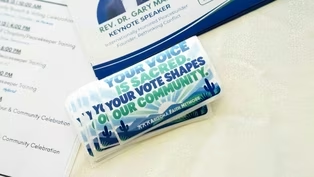
AMNA NAWAZ: A minister, a rabbi, and an imam walk into a polling place.
No, it's not the beginning of a joke.
It is a coordinated effort to train clergy to help keep the peace on Election Day.
Deema Zein has that story.
DEEMA ZEIN: In the final sprint to the midterm elections, a different kind of volunteer is getting ready in Arizona.
REV.
KATIE SEXTON, Arizona Faith Network: So that the voters' vote is counted.
DEEMA ZEIN: These clergy and faith leaders are training to stand outside polling places as poll chaplains and peacekeepers, a calming presence for voters on Election Day.
REV.
KATIE SEXTON: They keep the peace, they help people with any voting questions they might have.
DEEMA ZEIN: The Reverend Katie Sexton leads the Arizona Faith Network.
REV.
KATIE SEXTON: There has been a huge rise in political violence and partisanship and concern over being able to vote in safety.
So we have really mobilized our people of faith and our clergy to get out and make sure that folks can vote safely and securely on Election Day, that their voice is not compromised.
DEEMA ZEIN: Many Americans share that view.
In a PBS News/NPR/Marist poll this summer, 37 percent of respondents said violence may be necessary in order to get the country back on track, a share that had nearly doubled in the past two years and included more than a third of Republicans and Democrats.
Arizona has seen tension at the ballot box before.
In the 2022 midterm elections, a federal judge ordered members of a group monitoring drop boxes in Maricopa County to keep their distance after complaints that people in masks and carrying guns were intimidating voters.
RABBI SHMULY YANKLOWITZ, Arizona Jews for Justice: At some polls, we expect to see routine election activity, but at other polls we expect to see intimidation, people who are trying to scare away exactly the people who were already scared to show up in the first place.
DEEMA ZEIN: The training is part of a national campaign by Faiths United to Save Democracy, a nonpartisan coalition of faith and secular groups.
REV.
KATIE SEXTON: It is absolutely an interfaith effort.
Like, today, we're here in a Jewish synagogue.
We work with our Muslim communities.
We work across the Christian traditions, and we work throughout the state as well.
DEEMA ZEIN: The organization is recruiting poll chaplains in nine states this year.
They're trained on skills including de-escalation in case ICE agents are spotted at polling places.
Some who showed up for training say it's a way to get involved.
CINDY WEISER, Training Participant: This election feels really, really important.
And I wanted to find a space where I could contribute something.
There's -- often, we can feel powerless.
And this is one way to feel that we're supporting our community.
DEEMA ZEIN: On Election Day, the volunteers will wear identifying vests and badges outside polling places, answering questions and watching for potential trouble.
MEDINA MOORE, Arizona Faith Network: I'm expecting all good things, but we have seen not-so-great things.
So I'm just putting the good things out there so that they happen.
DEEMA ZEIN: When polls open on November 3, these volunteers plan to be there.
For "PBS News Hour," I'm Deema Zein.
AMNA NAWAZ: And that is the "News Hour" for tonight.
I'm Amna Nawaz.
On behalf of the entire team, thank you for joining us.
 New
Campaigns spend big with increasingly personal attack ads
Video has Closed Captions
Campaigns spend big to sway voters with increasingly personal attack ads (6m 52s)
 New
Candidates enter final week of campaigning
Video has Closed Captions
Candidates enter final week of campaigning with control of Congress at stake (6m 58s)
 New
Lula prevails in Brazil but Bolsonaro refuses to concede
Video has Closed Captions
Lula prevails in Brazil but Flávio Bolsonaro refuses to concede (3m 49s)
 New
Netanyahu faces first election since Oct. 7 and Gaza war
Video has Closed Captions
Netanyahu faces Israeli voters in first election since Oct. 7 and Gaza war (10m 33s)
 New
News Wrap: Anthropic preparing for initial public offering
Video has Closed Captions
News Wrap: AI giant Anthropic preparing for initial public offering (5m 43s)
 New
Spiritual leaders unite to help keep peace on Election Day
Video has Closed Captions
Spiritual leaders unite to help keep the peace on Election Day (3m 8s)
 New
Student movement ousts Serbia's right-wing ruler in election
Video has Closed Captions
Student-led movement ousts Serbia's right-wing ruler in historic election (6m 9s)
 New
Tamara Keith and Amy Walter on the House and Senate outlook
Video has Closed Captions
Tamara Keith and Amy Walter on the midterm outlook and possible redistricting backfire (9m 22s)
Providing Support for PBS.org
Learn Moreabout PBS online sponsorship
- News and Public Affairs

FRONTLINE is investigative journalism that questions, explains and changes our world.
 New Episode
- News and Public Affairs

Today's top journalists discuss Washington's current political events and public affairs.

 New Episode
 New Episode
 New Episode

 New Episode
 New Episode

 New Episode



Support for PBS provided by:
Major corporate funding for the PBS News Hour is provided by BDO, BNSF, Consumer Cellular, American Cruise Lines, and Raymond James. Funding for the PBS NewsHour Weekend is provided by...