
May 19, 2026 - Full Show
5/19/2026 | 26m 48sVideo has Closed Captions
Watch the May 19, 2026, full episode of "Chicago Tonight."
An agreement is reached to delay the phaseout of Chicago’s tipped minimum wage. And prioritizing affordability and accessibility near public transit.
Problems playing video? | Closed Captioning Feedback
Problems playing video? | Closed Captioning Feedback
Chicago Tonight is a local public television program presented by WTTW
WTTW video streaming support provided by members and sponsors.
May 19, 2026 - Full Show
5/19/2026 | 26m 48sVideo has Closed Captions
An agreement is reached to delay the phaseout of Chicago’s tipped minimum wage. And prioritizing affordability and accessibility near public transit.
Problems playing video? | Closed Captioning Feedback
How to Watch Chicago Tonight
Chicago Tonight is available to stream on pbs.org and the free PBS App, available on iPhone, Apple TV, Android TV, Android smartphones, Amazon Fire TV, Amazon Fire Tablet, Roku, Samsung Smart TV, LG TV, and Vizio.

WTTW News Explains
In this Emmy Award-winning series, WTTW News tackles your questions — big and small — about life in the Chicago area. Our video animations guide you through local government, city history, public utilities and everything in between.Providing Support for PBS.org
Learn Moreabout PBS online sponsorship>> Hello and thanks for joining us on Chicago tonight on Brandis Friedman.
Here's what we're looking at.
Faith leaders reach an agreement to get daily access to the ice facility in Broadview.
phase out of the tipped minimum wage is being delayed.
What that means for workers and restaurant owners.
And efforts to make developments near public transit affordable and accessible.
>> Well, not displacing longtime residents.
First off tonight, immigrants being held in the ICE detention center in Broadview will have access to spiritual care under a new agreement.
Community leaders from the coalition for spiritual and public leadership say the deal with the Department of Homeland Security went into effect last Friday.
They say faith leaders will be allowed to make daily visits.
The west suburban facility had been the site of many protests last fall, including among clergy who were denied access.
The agreement notes that while ICE agents will make, quote, reasonable efforts to grant some privacy for past oral communications, the agents will maintain oversight of designated areas for security.
The federal judge in this case has requested a status update in July.
And for those of you who want to participate in the opening ceremony for the Obama presidential center, but haven't quite gotten your invitation in the mail yet.
The foundation is hosting an official watch party on the midway plays Ot's.
While the center opens to the public on June 19th also known as Juneteenth.
The public can also score tickets to the Free Watch party on June 18th.
There you can watch a live stream of the ceremony in a picnic style atmosphere with an art market from local vendors and community organizations.
You can fill out the request form on the Obama center website.
Tickets for opening weekend at the library are already sold out.
But the campus will remain free and open to the public through the weekend and beyond.
The Cook County Land Bank Authority is touting a major milestone today.
Cutting the ribbon on its 2,500 redeveloped property since 2013.
We take parcels that no one else wants to touch.
>> We clear title we resolve lanes and we put them in the hands of people who want to build something better for their community.
And from there, there's impact ripple effect.
One parcel one project, one community at a time.
>> The authority and elected officials celebrated with a newly constructed to flout on the city's west side.
They say the building is part of a 6 building block wide transformation in Garfield Park.
The Land Bank works by selling tax delinquent and abandoned properties to community-based developers who rehab and sell the properties returning more than 70 million dollars in revenue to the county tax rolls.
The Chicago Sky lose forward.
Ricky Jackson for the rest of the season.
The team announced today that Jackson suffered a torn ACL in Sunday's win over the Minnesota Lynx.
The sky acquire Jackson from the La Sparks this offseason and she was off to a dominant start in the first 2 weeks of the season averaging 22 points a game and helping the team to a 3, 1, record.
The sky returns to Chicago tomorrow night for their home opener at Wintrust Arena.
Meanwhile, tickets are on sale today for the WNBA All-Star game being held in Chicago.
The league is hosting the skills and 3 point contest at Wintrust on July 24th.
Then the next day the All-Star game will be held at the much larger United Center.
Up next, an agreement is in the works to delay the ending of the city's tipped minimum wage.
What that could mean for Chicago's restaurant industry and workers.
>> Chicago tonight is made possible in part by the Alexandra and John Nichols family.
The Pope Brothers Foundation.
And the support of these donors.
>> Tomorrow city council members are set to vote on a compromise measure that would delay the phase out of the city's tipped minimum wage in March, Alder People had voted to block the phase out altogether after restaurant owners pushed back citing rising costs.
Mayor Brandon Johnson vetoed that measure, but it is not clear whether he will allow this new proposal to become law.
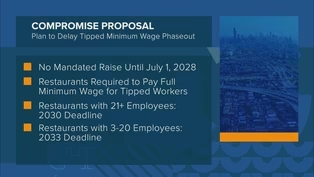
The plan would add 2 years for restaurants to pay full minimum wage for tipped workers.
But that means employees won't be getting a city ordered pay bump as previously scheduled this summer or next.
Joining us, our Cristina Gonzalez, member of the Illinois Restaurant Association and co-owner of this come out, his restaurant.
And Richard Rodriguez, state director for Illinois Service Workers United and he is with the one fair Wage campaign.
Thanks to you both for joining us.
Thank you for having so Kristina.
Let's start with sort of laying out what this proposal is tipped.
Workers would not receive the previously mandated raise until July first 2028 restaurants with more than 21 employees have to pay 100% of tipped worker wages by 2030.
And we should note the minimum wage 16, 60 $16.60 an hour and restaurants with more than 3 and fewer than 21 employees.
They would have until 2033 to reach that 100% pay level for their tipped workers as a restaurant owner.
Christina, what are your biggest concerns with this potential agreement?
I think my biggest concerns here the ecosystem, the very delicate ecosystem that we have as a restaurant industry with our customers and our servers.
>> Our tip servers, but not just our tip service also are back of the House workers as well.
There's a lot more people involved here and it's not just restaurant workers.
It's also anyone else who received steps.
People aren't seeing that.
So I think my biggest concern is that we want to make sure that it's something that's fair and equitable for everyone.
And you can't have a good negotiation if it's completely one-sided.
So we want to make sure that we take care of our servers, but also take care of our customers and that ecosystem back to that is very delicate.
So we want to make sure restaurants filling their seats.
They're coming hours.
If they're having hours, people aren't getting the pay so they make it pay per hour more.
But they're not exactly getting more money in their pockets to take all.
>> Are there any ways that this proposal helps restaurants or is there anything that you favor?
I think that it is helping because it's allowing, although it's not an ideal, proposal for We feel that it is the less harmful and a little bit more equitable for restaurants to be able to withstand the rising costs of everything.
It is not just one thing, but this is huge component of it.
Again, if we have to cover the rate the raise in wages, then we have to raise tacos and burrito prices and then people will come less than they will normally if they're coming 3 to 4 times, you're going from one to 2 times.
So Richard, your organization, one for wage, will have warned, though, that this delay would cut those immediate raises, as we mentioned, for some of Chicago's lowest paid workers.
>> At a time everyone is experiencing some financial turbulence right?
>> Where does the compromise leave tipped workers?
And what's been the reaction Let me first say thank you for having us here on the air tonight and having this conversation.
Thank you.
Stand up for being here with us as well.
Really looking forward to having a conversation with you, but we're very excited.
>> That ending of the sub minimum wage is still intact.
We had this debate back in 2023. and the city council spoke very loudly at that time ending the subminimum wage was a priority.
And I'm happy that we're coming back to the same conclusion that ending this a minimum wage.
It's it's a priority.
Now answer your question, how does this affect workers?
You know, if you're hearing from restaurant owners that the affordability crisis is causing too much pain and suffering of them.
Just imagine the lowest paid workers in the city of Chicago.
There were looking forward to getting a raise down.
They're not getting a raise.
Anybody that's listening here today.
If you're guaranteed raise over the next 3 years, you probably would be very excited.
Unfortunately, servers in the restaurant industry in the city, Chicago will not be saying that.
And that's and that's getting pushed off.
Know the mayor initially vetoed if I mean getting pushed off.
That is if this passes tomorrow.
>> The mayor initially vetoed the rollback of the tipped minimum wage Phaseout.
City Council did not override it, but how do you feel about going back to the negotiating table on this.
>> Yes, so we're ready to go.
Should an agreed upon this agreement wasn't easy.
And I know we heard from service workers talking about how they were relying on the increases that are ready took place and what effect that that had in their lives the one for wage ordinance was already a huge success restaurant have been growing in the city of Chicago.
just have been going up.
Workers have been working and we're very excited that the BA CPS had great reports on those successes.
And we're hopeful that this pause would be the end of the discussion and then we're not going revisit this again in the future.
>> Kristina know the measure to do what's right and you want to respond to.
I think that it is wonderful idea that we're all negotiating in and having these conversations.
I think it is a human issue that we all need to talk about from every perspective in every facet, I'd like to thank the Alders Burnett, Villegas and Nugent for all of their tireless work and efforts that we have here.
But of course, they are doing a great job and trying to advocate for the ecosystem.
We're talking not just about one report talking about the ecosystem that we have here in the restaurant industry.
And as for restaurants opening, we have a lot of restaurant something but where also the city of Chicago track.
We lost 500 businesses in the 1st half >> of this year.
We've lost 2100 jobs in in 2025.
So when we talk about businesses opening or licenses being renewed, first of all, other to every 2 years, I think the licenses are being renewed now and the city isn't tracking like which businesses are closing.
So although you have businesses opening, that's wonderful and great that people still have an American dream.
I love that my father was that started 53 years ago.
American dream.
He is an immigrant and for he was God bless But I love that.
But the other reality is those new restaurants that are opening.
How will the stay open if they are facing all of these economic difficulties as well?
So the measure would allow restaurants with between 3 and 21 employees and gives them extra time to reach that 100% level.
Do you think that runway will that help smaller restaurants?
>> I think it does help smaller restaurants because it if you start shifting this change immediately.
But first thing that's going to happen is going to be cutbacks, layoffs.
Shuttering doors is worst case scenario.
But you're going to have so many that we're going to have cross training, whereas we've been around for 53 years.
We've you know, which trusses which us is that just waited tables are saying I can't do the POS system.
I don't know how to back in only do this.
And so to cross train.
I have to take last hours and, you know, breaks our hearts because we're there where they've known me since I was 16.
So I look at that like trying find where we can position them so that they don't lose the hours that they need.
But honestly, if I have empty seats at my restaurants, I can't continue as a small business neither can other small businesses continue to do it.
If it keeps going up.
Richard, the phase out of the tipped minimum wage, it has been underway for a couple of years now.
What are some of the benefits that tipped workers have started to experience?
Yes, immediately workers were seeing raises.
>> Right.
And what does that mean in the midst of an affordability crisis?
We're restaurants are suffering, but imagine if you're a tipped wage worker right, making less than the minimum wage Lets be frank.
The minimum wage is to look to begin with.
We should be talking about a livable wage, not just the least that we can pay workers.
But what do workers really need to be able to survive on and as a livable wage?
2, to your point, I I have to respect for hearing.
>> In the sense if the employees right now we're making an average of $29 an hour and your waitresses are doing very well with those that those tips, if we continue using the tip credit, it allows businesses.
It staff.
It allows them to maximize their earnings with their tips.
It allows businesses to hire more staff to be able to continue to serve more customers also maintaining equitable prices for their customers.
We need those customers come through the door.
We need the service to serve them.
We need businesses to stay open so that we can keep that ecosystem knowing.
Let's not forget that we are also.
With these these higher wages.
Yes, they're making more per hour.
But if they're cut their hours are cut, then we have an issue because now they're not making more take before our time.
And know you want to respond, but I also want you remind us in the 45 seconds that we've got left of the history of >> the tips worker where that comes from for especially for servers.
Yes.
So let be very clear.
The restaurant industry will not fail right like it is going to adapt.
There are 7 states that already eliminated the subminimum wage.
Most people don't recognize this is already This is not no one has repealed that 7 states have eliminated the subminimum wage for decades.
>> Decades.
Anybody that's ever traveled to California, anybody to travel to Nevada, but it's ever travel to Oregon or Minnesota 2030, years.
The subminimum wage has been eliminated right?
So the fact that the restaurant industry is not going to be able absorb the rate increases to pay workers.
A livable wage is a fallacy.
It is showing already huge success.
And we're happy that that is going stage for that.
Employees are paid 16 60 an hour if they are not.
And if they don't make that up.
>> is required by law that it is paid to them.
So they are making a minimum wage.
think the fallacy here is to call it a sub minimum wage.
That's where we'll have to leave it and we'll see what the city Council does tomorrow.
My thanks to both of you.
Richard Rodriguez, Rodriguez and Christina Gonzalez, thank Thank Thank you.
Thank Up next, efforts to make areas around public transit more accessible and affordable.
We explore ideas right after this.
>> Chicago has made significant progress to ensure that developments near transportation options around the city.
don't mean nearby residents get pushed out.
That's according to a new analysis from elevated Chicago that looked at 5 years of what's called equitable transit oriented development or E T OD policy in Chicago.
It found that while the city has made significant progress to maintain affordability and accessibility for residents living near those developments, some neighborhoods aren't seeing the same investment as others.
Joining us now, our Juan Sebastian Rds executive director of elevated Chicago.
Nina E to Moody, a CEO of the Center for Neighborhood Technology and Oji Eggleston executive director of the Renaissance Collaborative and a community developer.
Thanks to all of you for joining us.
Thanks for having Thank you.
the report says, as we mentioned, the city has made progress on all of the recommendations in the city's each DOD policy plan.
It reads, quote, unanimously adopted by the Chicago Plan Commission in 2021, the plans, 42 recommendations focus on directing investment to historically disinvestment.
tease preventing displacement in areas with rising housing costs, expanding affordable housing near transit and creating more walkable.
People centered neighborhoods citywide come to you first.
What are some examples of that progress?
>> Yeah.
Thank you for having us again here, too.
We've seen a lot of progress and 3 big successes that I would want to highlight today include a policy, innovative investment in programming and collaboration and to walk through those on the policy 4 years ago.
Now, the city past the connected communities Ordinance was the most comprehensive reform of our of our land use and zoning laws to promote more equitable, affordable and accessible in near transit.
And in addition to that, shortly after that, the city also put a historic investment in utility projects, including investing in an elevated works technical assistance program that per match those grants with coaching and support for largely first time emerging developers to be able being their community visions to life.
>> And has been the ongoing sustained cross sector collaboration.
>> Live Chicago convene this utility working group with the city.
And that really has been the driver of all this excess being together.
City officials, community leaders, advocates policy researchers, developers all around putting this plan into action.
What would you say is still lacking in Chicago?
See to the policy plan yet?
So as you noted, we made progress on all of the recommendations yet nearly half still have to be fully implemented.
So there are some of barriers that we still see challenges we see in our zoning and how our city is owned and what kind of development we allowed to have near transit to give you an example.
It's illegal to build a to flat Earth.
You fly in many parts within walking distance of many parts of the city while it is legal to build a gas station or an auto repair shop.
And those are not really aligned with the opportunity that we have in our public transit system.
In addition to that, we in our report did look at where we've seen recent dot development projects and well, we have we are seeing some more investment in growth happening in the south and West sides when there's still so there's still need for more.
We still see opportunity in the far South side along the red line along the future line extension.
And we also see a lot of opportunity are on the orange line in the southwest side of the >> do your project Abrams, intergenerational village in Washington Park is a housing development, quote, designed to allow older adults to effectively raise and nurture children collaboratively, which sounds important, right?
Thank for talking but intergenerational child-rearing.
So you received support through the elevated works.
Technical Assistance program that won just mentioned developers.
What were some of the challenges that you're facing as a developer?
>> As one mentioned, the elevated works west set up for emerging developers.
I was new to the right, the Renaissance Collaborative as executive director.
And so I need a technical assistance.
The organization need technical assistance, one funding.
There's always a need for funding and through elevated working relationships that they were lout to develop for us.
We received additional funding for our projects, too.
Partnerships as a developer there.
Very important partnerships.
That must be established and maintained in through the relationships and with the emerging groups.
That one mentioned, we're able to establish strong partnerships and 3rd was to the technical assistance, branding and marketing as developers as entities and nonprofit.
We tend to have our heads down getting the work done.
But we're not promoting and marketing the important work that we're doing.
And so through technical assistance, shout out to right resources to provide that technical assistance for us and allowed us to develop a marketing strategy.
A branding plan to allow us to promote the building and ultimately bring in additional funding for our organization.
>> So, Nina, the report also calls for stronger and tied gentrification protections.
Why does more investment often mean displacement?
>> More investment often means displacement because when we're thinking about neighborhoods that had been put out of place or or or just invested and we're thinking about black and brown neighborhoods places where depending on zip bank will make a loan to you or, you investor won't take a chance on you just because of where you want to put your business, which puts the communities the been about communities that CMT and elevated Chicago cares about at a disadvantage.
So as the FT, we think about what are the structural ways that we can make sure that the hopes and dreams of our community actually is translated into policy and funding actually accelerate the impact that community, that this of solutions that communities already have, but don't have the resources to actually see get off the ground.
It tell me more about that.
How do we combat this?
We combat it through few different ways.
So recently, Illinois just pass a bill called Northern Illinois Transit Authority Act, which means that for our 3 major carriers, CTA, Metra and pace, they will be reconfigured into a new governance body.
If you've ever taken CTA already public transit, you know, it's like a man.
Why are these things connected?
Why cannot walk here to get on the Why can I make it?
Why can't I north north to south very easily without going through the And so this new kind configuration, Ford and transit authority and also to have all those 3 agencies work together, get people exactly what they deserve.
They deserve a transit system that is fully funded, which now it is.
They deserve a transit system that allows their grandmother to go to their clinic appointment for their monthly checkups.
They deserve a transit system that gets those hourly workers at those restaurants to the places that they need to go in order to get the opportunity that they need to have and also get students to places throughout.
Chicago they have more opportunity G so beyond housing.
Whatever kind of investments do you think should surround, you know, any additional transit stations?
We're gonna talk about the red line in just a little bit.
But what other sort >> investments do you think should go around What's important for every community?
>> Are various resources and assets within the community plays based.
So, for instance, what's very important about time the businesses that are established around the public transportation as well as health clinics that are important to public transportation.
So I think as you at those additional assets to communities that allows the communities.
Residents to not have to travel far and has the ability Travel within their own community.
So I think those things that are needed also, I think it's very important for additional affordable housing to be developed because gentrification is outpacing affordability.
And so as you bring those assets into the community and allows those residents to gain employment through those assets, one we've got about a minute left.
But the red line extension just broke ground for new stations will be built.
How could the city take advantage of this opportunity to expand eat dog into the far South Side?
>> Yeah, it's a it's a huge opportunity.
It's a historic moment in our city's history for making transit access.
>> 2 communities that have been left out of the CTA is public transit system.
I would say just as we're investing so much money into the expansion of transit, we need to put that matching investment into the community assets and amenities that oh, gee, was just mentioning in affordable housing in small business supports.
And we also need to put in strong policies to make sure that as this development is coming, that there is not the displacement that is happening because it is truly what makes equitable development, equitable.
When you make sure that the protections and uses resources are in place for existing residents also benefit from all this growth in this activity, OK, that's where we'll have to leave it.
Best of luck to you all.
Thank you for joining us.
My artist Nina and Wilson.
Thanks, everybody.
Thank you.
>> And that is our show for this Tuesday night.
Stay connected with our reporters and what they're working on by following us on Instagram at W T Tw Chicago and join us tomorrow night at 5, 30 10 city council members vote on a push to rid the Chicago Police Department of officers with ties to extremist groups.
That and more from City 2 now for all of us here at Chicago Brandis Friedman, thank you for watching.
Stay healthy and safe and have a good night.
>> A closed caption is made possible by Robert a cliff and good Congo, personal injury and wrongful death that serves
 New
NewCity Council Set to Vote on Delaying the Phaseout of Tipped Minimum Wage
Video has Closed Captions
The end of the tipped minimum wage in Chicago would be delayed for an additional two years. (10m 21s)
 New
NewReport Examines Equitable Transit-Oriented Development in Chicago
Video has Closed Captions
Some neighborhoods aren't seeing the same investment as others. (9m 4s)
Providing Support for PBS.org
Learn Moreabout PBS online sponsorship
- News and Public Affairs

Top journalists deliver compelling original analysis of the hour's headlines.

- News and Public Affairs

Today's top journalists discuss Washington's current political events and public affairs.












Support for PBS provided by:
Chicago Tonight is a local public television program presented by WTTW
WTTW video streaming support provided by members and sponsors.