
June 9, 2024 - PBS News Weekend full episode
6/9/2024 | 24m 9sVideo has Closed Captions
June 9, 2024 - PBS News Weekend full episode
Sunday on PBS News Weekend, what Atlanta’s recent water main break says about America’s aging infrastructure. Then, a look at a new vaccine with the potential to eradicate malaria, one of the world’s deadliest diseases. Plus, a doctor discusses his new book about gender identity and best practices for treating transgender youth.
Problems playing video? | Closed Captioning Feedback
Problems playing video? | Closed Captioning Feedback
Major corporate funding for the PBS News Hour is provided by BDO, BNSF, Consumer Cellular, American Cruise Lines, and Raymond James. Funding for the PBS NewsHour Weekend is provided by...
June 9, 2024 - PBS News Weekend full episode
6/9/2024 | 24m 9sVideo has Closed Captions
Sunday on PBS News Weekend, what Atlanta’s recent water main break says about America’s aging infrastructure. Then, a look at a new vaccine with the potential to eradicate malaria, one of the world’s deadliest diseases. Plus, a doctor discusses his new book about gender identity and best practices for treating transgender youth.
Problems playing video? | Closed Captioning Feedback
How to Watch PBS News Hour
PBS News Hour is available to stream on pbs.org and the free PBS App, available on iPhone, Apple TV, Android TV, Android smartphones, Amazon Fire TV, Amazon Fire Tablet, Roku, Samsung Smart TV, and Vizio.
Providing Support for PBS.org
Learn Moreabout PBS online sponsorshipJOHN YANG: Tonight on PBS News Weekend, what Atlanta's recent water main break says about America's aging infrastructure.
Then, a new vaccine with the potential to eradicate one of the world's deadliest diseases, malaria.
And a new book seeks to explain gender identity and the best practices for treating transgender youth.
MAN: I have patients who become severely depressed and anxious when their bodies start developing in a way that doesn't align with their gender identity.
And we have more and more research studies showing that when we offer these kids relief with these interventions, that their mental health is alive better.
(BREAK) JOHN YANG: Good evening.
I'm John Yang.
The day after Israel rescued four hostages from Gaza, Palestinians assessed the high cost of that operation, one of the deadliest days of the eight month war.
The Gaza health ministry says 274 Palestinians were killed and 700 others wounded during the Israeli assault inside the Nuseirat refugee camp.
Today, there were more Israeli airstrikes in central Gaza.
The military says it's targeting Hamas infrastructure.
Palestinians say enough is enough.
MOHAMED AL-TAHRANI, Resident of Al-Nuseirat Camp (through translator): For the millionth time, we deliver a message to the international community.
We do not want aid.
We want you to stop the war.
We do not know where to go.
They move us from right to left and from left to right.
They tell us to go to the south, come to the center.
JOHN YANG: Centrist Benny Gantz made good on his threat to quit Israel's war cabinet over Prime Minister Benjamin Netanyahu's handling of the war.
While underscoring the fractures and frustrations in the nation's leadership, it's not likely to force Netanyahu from office.
Exit polls in today's European Union parliamentary elections are pointing to a shift to the hard right.
There was voting in 27 E.U.
nations.
The big issues included the war in Ukraine, migration, climate policy, and the economy.
PANAGIOTIS MARKOPOULOS, Greek Voter (through translator): I voted with high prices in mind.
Prices are going up every day, and people cannot deal with it.
BEATRIZ CARVALHO, Portuguese Voter (trough translator): I hope my vote and the votes of other young people can prevail and show that the far right stops more than it has been so far.
JOHN YANG: Indications that his party is heading for a big loss has prompted French President Emmanuel Macron to dissolve parliament and call for new elections.
In France, President Biden ended his five-day visit with a trip to a U.S. world War I cemetery outside Paris.
Mister Biden and First Lady Jill Biden paid respects to the more than 2,200 U.S. troops buried there.
The president also said there's a deal with France to use profits from frozen Russian assets to help Ukraine.
Still to come on PBS News Weekend, a new vaccine fuels hopes of eradicating malaria.
And a new book delves into the science and personal stories behind young people struggling with gender identity.
(BREAK) JOHN YANG: For nearly a week earlier this month, the 6th largest city in one of the world's wealthiest nations told its residents to boil the tap water because it may have been contaminated.
That city was Atlanta.
U.S. drinking water is among the world's safest and most reliable.
But an aging infrastructure is posing challenges.
The American Society of Civil Engineers estimates that there's a water main break every two minutes.
Earlier, I spoke with Shannon Marquez, professor of environmental health sciences at Columbia University's School of Public Health.
I asked her why these problems are so common in the United States.
SHANNON MARQUEZ, Columbia University School of Public Health: Well, you know, there are a combination of things that are happening now, John, aging infrastructure from years of neglect, under financed systems, and having to make decisions that are more like Band-Aid approaches to addressing these challenges, as opposed to comprehensive rehabilitation.
That, coupled with what we are seeing with extreme weather events and climate change, are also really putting our water systems in jeopardy.
Many of these systems were constructed for a capacity that is really outgrown at this point.
JOHN YANG: Why the neglect?
Why the Band aid approach?
Is this just out of sight, out of mind?
SHANNON MARQUEZ: Well, in fact, if you think about what it's going to take to overhaul these systems, the amount of finance, the reality is that water utilities are faced with just being able to do what they can, patch the holes as they come, patch the main breaks as they come, and there's not enough resources.
It really is going to require federal level efforts.
And although we have the infrastructure bill, it's not nearly enough to really overcome these challenges.
One of the other challenges is the diversity of water systems.
The reality is that the governance and regulations around publicly owned treatment works versus community water systems.
You know, there is just a huge array of regs, and the structure of that makes it very inefficient.
So the reality is, depending on the size and the age of it, there are going to be different problems.
There's not a one size fits all solution to this problem.
JOHN YANG: How much would it take to really fix the system?
Is it more that the federal government has to do it, or is it the problem that we have, this sort of confederation of local Independent Water systems?
SHANNON MARQUEZ: So there's going to be a tremendous need with this funding gap.
I mean, the $55 billion that set aside is not nearly enough, partially because we also need to think about new approaches connecting these nodes.
There are something like 50 or 60,000 independent water systems in this country.
And the reality is, if you look at the growth and being more efficient, we need to come up with ways to connect them so that we can actually also address these challenges.
It's going to take far more as well, because we don't even have the data.
We don't actually have the information to know what all the challenges are.
What we are doing now is just reacting.
JOHN YANG: Are there ways to get around the problem of, as you say, in poor communities, underserved communities, is there a way to get around that so that the funding and the support is a little more even among communities?
SHANNON MARQUEZ: Well, I definitely think we have to have some creative investments, right.
We really need to think about partnering in ways that create solutions that make the funds more accessible.
So oftentimes, even when these programs, the loan programs are available, sometimes communities are missing out because they simply can't put together the package, the proposal to apply for the funding.
And then I also think that particularly in election years like now, we need to think about how water is a pressing political issue akin to whether it's health care or education.
We need to hold our government officials accountable at all levels to ensure that they're also thinking about this and prioritizing it, because we know it's disenfranchising the poor disproportionately.
And so it needs to be on the agenda in ways where we've never seen it before.
JOHN YANG: We've covered on this broadcast water problems in Flint, Michigan, in Benton Harbor, Michigan, in Jackson, Mississippi.
Is it a coincidence that these are all majority black cities?
SHANNON MARQUEZ: No, it's not a coincidence.
I mean, if you look at sort of the tenets of environmental racism and if you look at the troubled history we've had in this country, it is not a coincidence that once again, the disenfranchised tend to be those that have had really disproportional impacts on their livelihood across the board.
So whether it's health or education, these communities are facing the same challenges.
And so this water issue is just overlaid in the same way.
And so that should not be surprising to us.
What is surprising is how we continue to neglect these very same communities.
And so whether we're talking about, again, the education system in those communities, or healthcare and access to healthcare, and now thinking about water, just the mere fact that you're living in the U.S. and are planning your day relative to how you're going to access safe drinking water is quite shocking.
JOHN YANG: Shannon Marquez of Columbia University, thank you very much.
SHANNON MARQUEZ: Thanks so much John.
JOHN YANG: Malaria is one of the world's deadliest diseases.
Throughout Africa every year, it kills nearly a half million children younger than five.
But a new vaccine, only the second of its kind, holds the promise of saving thousands of lives and moving closer to eradicating malaria.
Ali Rogan has more.
ALI ROGIN: At the end of May, the Central African Republic became the first country to receive doses of the new R21/Matrix-M malaria vaccine.
It's intended for children between five months and three years old, who were among the most vulnerable to the disease.
UNICEF, the UN's main organization for children, says eight countries in Africa are set to receive these R21 shipments.
And experts say two vaccines are exponentially better than one, helping not just to immunize more people, but to reduce the illnesses spread.
Andrew Jones is the Deputy Director of Immunization Supplies for UNICEF.
Andrew, thank you so much for joining me.
The first vaccine was rolled out, approved more than two and a half years ago.
So what are the differences between this vaccine and the vaccine that was already available?
ANDREW JONES, Deputy Director of Immunization Supplies, UNICEF: They're very similar vaccines.
In fact, the first vaccine, which is called RTSS, manufactured by GlaxoSmithKline, is largely a copy of this vaccine.
So they're expected to have similar impact in kids.
The big difference when RTSS was released, it was being manufactured in Belgium, and it was being manufactured at relatively old plants.
They were quite limited in capacity, which was a challenge, because, as you can imagine, the demand for this vaccine has been massive.
And so this second vaccine has a much greater supply.
The other point to note is that the first vaccine has to be combined.
It comes in a powder and a diluent.
You mix the two together, whereas this R21 vaccine is fully liquid, so it's a little bit easier to use in the field.
ALI ROGIN: Do you have any sense of how many additional people are going to be able to be vaccinated now that there's two versions on the market?
ANDREW JONES: Well, the initial rollout starts a bit slow.
I mean, it's kind of one of these exponential things where the demand has been pending for a while, and then the message to countries was, well, you know, you're going to have to be a little patient.
This is going to take some time.
And so one of the differences with this vaccine compared to normal childhood vaccines is it's given at a different time.
So, childhood vaccines are given sort of in this age where they're two, three months.
This vaccine's delivered to kids over six months, with the last dose being when they're almost two years old.
They have four doses here.
Our main challenge right now is getting countries ready to accept it.
The additional doses no doubt in the next few years we would have been capped.
So 15, 20 million, we're now not capped.
So we're expecting that.
Well, this year and next year it's a gradual increase.
By 2026 and beyond, we'll see a lot more countries using this vaccine.
And, you know, half a million kids right now die from malaria every year, which is an enormous number.
And so being able to impact that, I mean, there are tools out there like bed nets, like spraying, but this is going to be an important new tool.
ALI ROGIN: What needs to occur for the countries that are receiving the vaccine to be ready to receive them?
ANDREW JONES: Yeah.
So there's a few interesting points.
I mean, one of this is, as I mentioned, is the fact that it's a non-traditional dosing, right?
So these four doses, last one being delivered very late.
So the big difference there is kids aren't necessarily coming to the clinics then.
So it's a new, what we sort of say a new touch point, right?
A new place where parents have to bring their kids.
So I think one of the things is just getting the advocacy and communication out there that you bring your kids back for that.
I think secondly is there's a lot of other interventions out there from malaria.
Right.
I mentioned this, many of the other vaccines against rotavirus, for diarrhea, there's no preventive measure, there's treatment and malaria.
The difference is there's other preventive measures like bed net.
So one of the other challenges is making sure, because this vaccine is only about 40, 45 percent effective, it's making sure that parents and community workers know to keep sleeping under bed nets and using spraying.
ALI ROGIN: Why has it in the past been so difficult to create these vaccines for parasitic borne diseases?
And does the rollout of these two malaria vaccines bode well for the development of other vaccines against other parasitic diseases?
ANDREW JONES: Yeah, it's a good question.
So the malaria parasite is a very tricky parasite.
It's always shifting and changing.
Even this vaccine is 40 or so percent effective.
Again, much like, as you know, in COVID is the time after the vaccination goes, your sort of protection drops.
So it's not as if it's like a single point, right?
It's changing, but 40 percent of a big number is still a big number.
Certainly people who want to eradicate malaria want to see a vaccine that's 80, 90 percent effective, where you can really look at disease elimination.
There are other products in development still a few years out that are aiming to do more in terms of eradicating the disease.
I think with everything we do, we learn more.
There is new TB vaccines that are underway.
There's talk about an HIV vaccine trials, and we would expect for something like an HIV vaccine, for example, we'd also see something that wasn't 90 percent effective.
So even this idea of, from a program perspective of working with a vaccine that's partially effective and what does that mean for your strategies is an important learning experience.
ALI ROGIN: Andrew Jones, deputy director for immunization supplies with UNICEF.
Thank you so much.
ANDREW JONES: Thank you.
JOHN YANG: According to the advocacy group the Human Rights Campaign, half of the states in America have passed laws or policies restricting treatment for young people diagnosed with gender dysphoria.
That's the discomfort or distress that might occur when someone's gender identity differs from their sex assigned at birth.
Some of those laws are on hold while court challenges work their way through the system.
The legislative debate on these measures has often been long on emotion, but short on science and medicine.
A new book seeks to use science and research to explain gender identity and treatments for transgender youth.
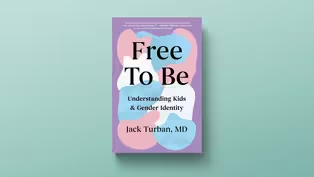
It's called "Free to Be: Understanding Kids and Gender Identity."
The author is Dr. Jack Turban.
He's the founding director of the Gender Psychiatry Program at the University of California, San Francisco.
Doctor Turban, thanks for joining us.
Let's begin with sort of the basics.
Gender identity, sex assigned at birth, what do they mean, and how can they be different?
DR. JACK TURBAN, Author, "Free to Be: Understanding Kids and Gender Identity": So gender identity is your psychological sense of yourself in terms of masculinity and femininity.
It's extraordinarily complicated, right?
We know from research that there is a biological basis of how we think about ourselves in terms of gender, but then we interact with society and culture to create this really complex understanding of who we are and how we think about ourselves.
Sex assigned at birth, also unfortunately complicated.
It could be based on your chromosomes, based on different sex organs.
But generally, there are these biological characteristics that end up being on your birth certificate.
And then -- so when I say sex assigned at birth, I'm usually referring to what's on someone's birth certificate.
JOHN YANG: And when they conflict, what happens?
JACK TURBAN: Yeah.
So, for most people, their gender identity aligns more or less with their sex assigned at birth.
But a lot of my patients, there's a misalignment, and so they may identify as transgender or gender non binary, which just means that they have a sense of themselves that doesn't align with their sex assigned at birth.
For some of those kids, they have really intense gender dysphoria, where there's distress related to their body not aligning with their gender identities.
For other kids, they don't have so much distress about their body.
And so the big thing I try and explain in the book is just this nuance of what gender related experiences are like and what those experiences are like for all different kids.
Early on in the book, you quote an endocrinologist named Dr. Norman Spack, who's sort of a leader in this field, as saying being transgender isn't a condition of the brain, but of the body.
Explain that.
JACK TURBAN: Yeah, so he's an endocrinologist.
I'm a psychiatrist.
We think about it a little bit differently.
The way he thinks about it is that their body has betrayed them, essentially, that their gender identity is who they are, and that's what's important.
And the endocrine interventions that he offers for some young people are meant to align the body with the gender identity that he thinks is really the core of who those people are.
JOHN YANG: And having said that, what are the implications of that for treatment of young people who are transgender?
JACK TURBAN: The way in reality we approach these kids is they have a comprehensive mental health evaluation to really understand their gender history, what other mental health conditions they may have, and also understand their relationship with their physical bodies for some of these young people, but not all, they might be candidates for certain medical interventions.
So things like puberty blockers or gender affirming hormones like estrogen or testosterone.
JOHN YANG: Now, a lot of these laws that have been passed in the states limit treatments on transgender minors, young people, they say that they're trying to protect them.
You're saying they're actually harming them.
Explain them.
JACK TURBAN: So, for a lot of these kids, these are really important interventions that improve their mental health.
So I have patients who become severely depressed and anxious when their bodies start developing in a way that doesn't align with their gender identity.
And we have more and more research studies showing that when we offer these kids relief with these interventions, that their mental health is a lot better.
So unfortunately, these bills just ban the treatment altogether so that none of the kids can access these treatments that we see help them.
JOHN YANG: A lot of the supporters.
These bills also point to Europe, where some countries are banning puberty blockers, other treatments.
There's a pediatrician in Britain named Hilary Cass who was commissioned to review the scientific data on this, and she said it was remarkably weak.
What do you say to that?
JACK TURBAN: I think a lot of people don't realize the nuances that were in that document.
In a lot of ways, it actually agrees with how we practice care in the United States.
So it recommended that you should do a comprehensive mental health evaluation before starting these interventions.
They should have a holistic view of the young person to understand if there are both medical and nonmedical interventions that might be appropriate.
The big area of divergence between her report and how doctors think in the United States is that she recommended that treatment only be provided in the context of a clinical trial where they're collecting more data.
I think us doctors don't quite agree with that because they worry about coercing people into clinical trials, and also that it just may not be feasible that there are so many of these young people who need care that we wouldn't be able to set that clinical trial up.
JOHN YANG: Use the word coercion.
Some of the supporters of these bills also talk about young people somehow being persuaded, somehow being coerced into being transgender.
What do you say to that?
JOHN TURBAN: Yeah, I think that's more, unfortunately, a political talking point than the reality of care.
When patients come to see me, if anything, they're frustrated that I'm really slowing them down.
We're doing these comprehensive mental health evaluations, making sure they really understand what these treatments do, what they don't do.
There are difficult conversations to be had, including around things like fertility preservation.
For these kids, that's often very difficult because it can exacerbate their gender dysphoria to go through that process.
And most kids don't even access the care because there is such a strain on the system.
They need to find a therapist who can do that mental health evaluation, then they need to get into the clinic.
Then they really need to get all the education from the doctors to their family.
So it's really a slow, involved process, and I would say the opposite of anyone being rushed into it or certainly not pushed into it.
JOHN YANG: Your book illustrates a lot of your points using case histories, using some of the patients you've been treating over the years.
How long have you been doing this?
And what drew you to this field?
JOHN TURBAN: Yeah, I first came to this about a decade ago as a medical student at the time, actually, and my mentor was a journalist.
And so before I even finished medical school, I was interviewing doctors who were taking care of these kids.
And I met doctors who did essentially conversion efforts or trying to force these kids to be cisgender.
They were not having very good success.
I met doctors who were practicing this affirming model of care, which just means supporting the kids, sometimes with medical interventions, sometimes with simple things like a new name or pronouns, helping them talk to their family about it.
And I was just really struck by the experiences of these kids, that they were going through such a difficult time.
And it seemed that these affirming models of care were helping them so much.
And so eventually, that inspired me to go become a child psychiatrist.
And I've been doing this, I'd say, for about a decade.
JOHN YANG: Doctor Jack Turban, thank you very much.
JOHN TURBAN: Thank you.
JOHN YANG: And that is PBS News Weekend for this Sunday.
I'm John Yang.
For all of my colleagues, thanks for joining us.
Have a good week.

Can a new vaccine eradicate malaria? Here’s what to know
Video has Closed Captions
Clip: 6/9/2024 | 5m 40s | Can a new malaria vaccine for children eradicate the disease? Here’s what to know (5m 40s)
New book dives into science of gender identity among youth
Video has Closed Captions
Clip: 6/9/2024 | 7m 2s | New book ‘Free To Be’ dives into medical science of gender identity for young people (7m 2s)

What water main breaks say about aging U.S. infrastructure
Video has Closed Captions
Clip: 6/9/2024 | 5m 49s | What frequent water main breaks say about America’s aging infrastructure (5m 49s)
Providing Support for PBS.org
Learn Moreabout PBS online sponsorship
- News and Public Affairs

FRONTLINE is investigative journalism that questions, explains and changes our world.

- News and Public Affairs

Amanpour and Company features conversations with leaders and decision makers.











Support for PBS provided by:
Major corporate funding for the PBS News Hour is provided by BDO, BNSF, Consumer Cellular, American Cruise Lines, and Raymond James. Funding for the PBS NewsHour Weekend is provided by...