Prairie Sportsman
Fast Forage: Sow Thistle, Harvesting Nature’s Bounty
Clip: Season 17 Episode 2 | 3m 55sVideo has Closed Captions
Forager Nicole Zempel explains how to identify the Sow Thistle.
Forager Nicole Zempel explains how to identify the Sow Thistle. She shares information on how to harvest and prepare the plant for consumption.
Problems playing video? | Closed Captioning Feedback
Problems playing video? | Closed Captioning Feedback
Prairie Sportsman is a local public television program presented by Pioneer PBS
Production sponsorship is provided by funding from the Environment and Natural Resources Trust Fund and Shalom Hill Farm. Additional funding provided by Big Stone County, Yellow Medicine County, Lac qui...
Support provided by:


Prairie Sportsman
Fast Forage: Sow Thistle, Harvesting Nature’s Bounty
Clip: Season 17 Episode 2 | 3m 55sVideo has Closed Captions
Forager Nicole Zempel explains how to identify the Sow Thistle. She shares information on how to harvest and prepare the plant for consumption.
Problems playing video? | Closed Captioning Feedback
How to Watch Prairie Sportsman
Prairie Sportsman is available to stream on pbs.org and the free PBS App, available on iPhone, Apple TV, Android TV, Android smartphones, Amazon Fire TV, Amazon Fire Tablet, Roku, Samsung Smart TV, and Vizio.
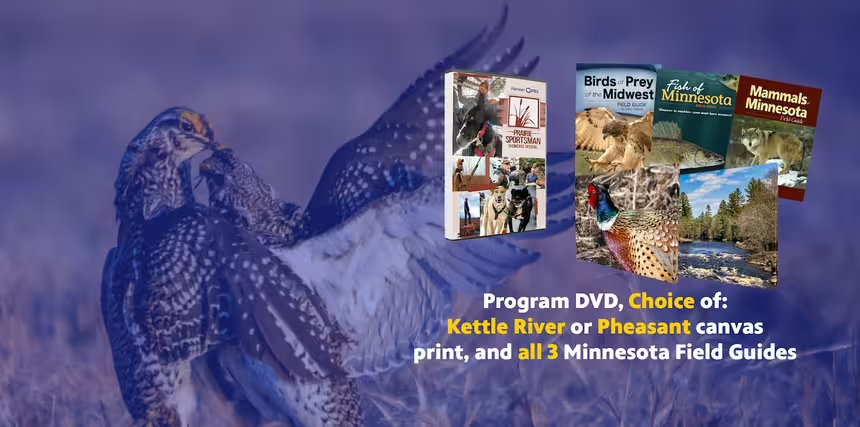
Prairie Sportsman Premium Gifts
To order, email yourtv@pioneer.org or call 1-800-726-3178.Providing Support for PBS.org
Learn Moreabout PBS online sponsorship(lively music) (light music) - So I am standing by actually a very gorgeous sow thistle.
Most would look at the sow thistle and want to eradicate it or just look at it as a useless weed.
In my world, there is no such thing as a weed; there is only native and non-native plants.
They all have their special unique gifts.
Now, the sow thistle is actually not a true thistle.
The scientific name is one I cannot pronounce, but it does translate into "sow" and "thistle".
So it was called the sow thistle because of the milky-like substance that does come from the stem of the leaves and from the stem itself.
This is actually the perfect stage for harvest.
And you can see it actually resembles a dandelion, and at different stages of growth, resembles some other common greens as well.
What I do with the sow thistle is I utilize the green leaves.
And before I do that, it's important just to kind of milk the stems.
And you can see the white, milky substance that comes out, but also the stem is hollow.
But even cutting it, the white milky substance is getting all over my knife.
But you can see that there.
So if you are gonna utilize the stem, just make sure that you milk it.
That substance is mildly toxic.
People have actually used it traditionally in the removal of warts.
What I do, though, is I stick straight to the greens, and I'm going to use those like I would any other leafy green.
The whole plant is edible.
It can be eaten cooked or raw.
I like to use the leaves because there is a bitter component to them.
And again, I love my salsas.
I like to just throw them, chop them up, throw them right into my salsas.
You can cook them down, kind of gets like a spinach.
You can incorporate that into pastas, soups, stews.
So really any way you want to use the green, use it.
And an ID characteristic of this plant is that the leaves attach right to the stem.
So to use the stem... and the flowers are edible as well.
But really, you're going to, again, milk the white substance out of that.
If you're cooking it down, it pretty much takes care of itself.
The stems, they're a little bit woody, but if you chop them up finely or you can go lengthwise, they just wilt down.
And you can use that just like you would the leafy greens as well.
But for me, I do tend to stick to the leafy greens.
And the flowers resemble a little bit like a dandelion.
Right?
Except the main difference is you get a lot of different flower heads at the end of a stem.
You can do a lot of things with those.
You can fry them up, you can saute them, you can deep fry them; you can do all kinds of things.
Research their nutritional benefits and your mind will be blown.
Video has Closed Captions
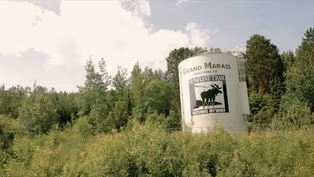
Preview: S17 Ep2 | 30s | Travel Minnesota’s iconic gunflint trail and visit the Chik-Wauk Museum and Nature Center. (30s)
 New
NewVideo has Closed Captions
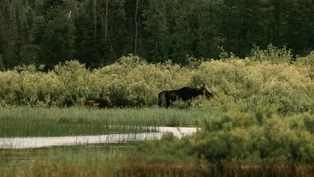
Clip: S17 Ep2 | 10m | Host Bret Amundson takes us on a journey north from Grand Marais to meet Jessica Berg-Collman. (10m)
 New
NewVideo has Closed Captions
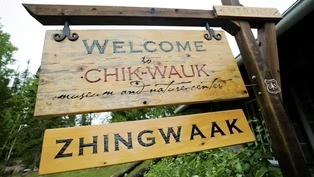
Clip: S17 Ep2 | 11m 36s | We visit the Chick-Wauk Museum and Nature Center. Chick-Wauk began as a resort in the 1930s. (11m 36s)
Providing Support for PBS.org
Learn Moreabout PBS online sponsorship
- Science and Nature

Explore scientific discoveries on television's most acclaimed science documentary series.

- Science and Nature

Capturing the splendor of the natural world, from the African plains to the Antarctic ice.











Support for PBS provided by:
Prairie Sportsman is a local public television program presented by Pioneer PBS
Production sponsorship is provided by funding from the Environment and Natural Resources Trust Fund and Shalom Hill Farm. Additional funding provided by Big Stone County, Yellow Medicine County, Lac qui...