Prairie Sportsman
A Trail of History
Clip: Season 17 Episode 2 | 11m 36sVideo has Closed Captions
We visit the Chick-Wauk Museum and Nature Center. Chick-Wauk began as a resort in the 1930s.
We visit the Chick-Wauk Museum and Nature Center. Chick-Wauk began its life as a resort in the 1930s, ceased operation in 1980, and gained new life as an educational center in the early 2000s. The center has a unique array of displays including Hubert Humphrey’s outboard motor and the Minnesota State Record Walleye.
Problems playing video? | Closed Captioning Feedback
Problems playing video? | Closed Captioning Feedback
Prairie Sportsman is a local public television program presented by Pioneer PBS
Production sponsorship is provided by funding from the Environment and Natural Resources Trust Fund and Shalom Hill Farm. Additional funding provided by Big Stone County, Yellow Medicine County, Lac qui...
Support provided by:


Prairie Sportsman
A Trail of History
Clip: Season 17 Episode 2 | 11m 36sVideo has Closed Captions
We visit the Chick-Wauk Museum and Nature Center. Chick-Wauk began its life as a resort in the 1930s, ceased operation in 1980, and gained new life as an educational center in the early 2000s. The center has a unique array of displays including Hubert Humphrey’s outboard motor and the Minnesota State Record Walleye.
Problems playing video? | Closed Captioning Feedback
How to Watch Prairie Sportsman
Prairie Sportsman is available to stream on pbs.org and the free PBS App, available on iPhone, Apple TV, Android TV, Android smartphones, Amazon Fire TV, Amazon Fire Tablet, Roku, Samsung Smart TV, and Vizio.
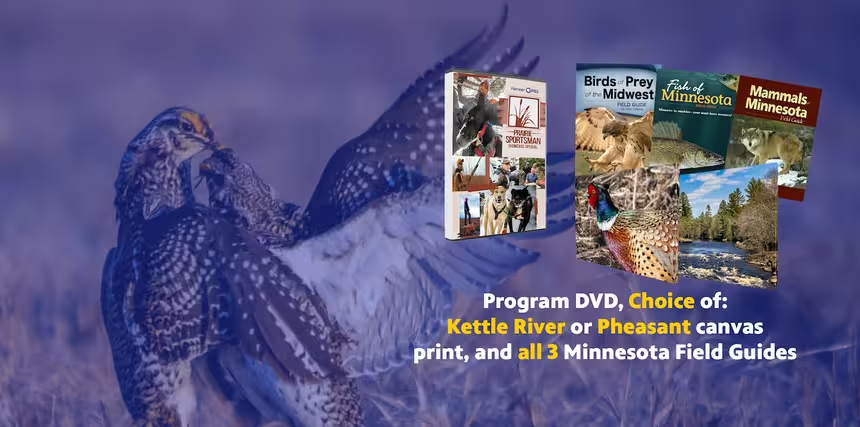
Prairie Sportsman Premium Gifts
To order, email yourtv@pioneer.org or call 1-800-726-3178.Providing Support for PBS.org
Learn Moreabout PBS online sponsorship(gentle music) - [Bret] It is no secret that the Gunflint Trail is rich with history, and tucked away at the top of the trail is a place where that history is preserved and on display.
(gentle music) - We're at Chik-Wauk Museum and Nature Center.
It's at the very end of the Gunflint Trail, 60 miles up from Grand Marais, Minnesota.
It's really at the end of the road.
And so it's really an amazing place.
(gentle music) I tell people you could actually spend several days just at the museum.
There's so much information and videos to see and a collection of, again, artifacts going back 10,000 years.
So a lot to see and do.
(gentle music) The first paleo-indigenous people came from the west, maybe crossing the Bering Land Bridge, and there's been people here ever since.
And then the fur trade happened; we've got artifacts of that.
And then logging happened in the mid-1800s.
And then after that, mining, there were some minerals discovered, never profitable.
There's a mine called the Paulson Mine just seven miles from here.
And then the last kind of human activity was resorts and tourism.
A lot of history, and we've collected a lot of that history.
(gentle music) One of the original Hamm's Beer commercials was filmed right here.
There's a commercial that we actually have here also showing the actor canoeing with his pet grizzly bear, actually a famous, famous commercial.
♪ Hamms, the beer you've been looking for ♪ (gentle music) - We have a replica cabin from 1950, an American Plan cabin, which means you took your meals in the main lodge.
We have a trapper's shack exhibit building just set up like an old trapper's shack.
(gentle music) We have a new exhibit on all the fires that have happened in the Boundary Waters and how that has changed the landscape over time.
So yeah, just a few of the items that you'd want to come up and check out.
(gentle music) - All right, so one of the things you can do here is really learn what life was like back in the day, maybe as in the time of the voyageurs and the French fur traders.
And this allows you to try to see if you're as strong as a voyageur by lifting the equivalent to what their packs are.
And you can do two different weights here.
The bottom one is the equivalent of one pack, but normally they'd lift two or carry two packs; portage two packs.
So let's see if I can carry one of the voyageurs' packs here, or at least lift it.
Too tall for this one.
All right, so then, strong.
I think I might've broke it.
- So this started as a resort in the early 1930s.
This building, the main lodge, is on the National Historic Registry And there's a little story: they built a lodge, and the night before the grand opening, a dog knocks over a kerosene lantern and the lodge burns to the ground.
So they had to rebuild, and they rebuilt it out of stone by hand, getting stones from the area.
And then they were able to open.
I think the first year of operation of this was in 1934.
It primarily catered to people that liked to come up and fish and operated as a resort until the late 1970s.
After that, the Forest Service purchased the resort in the early 2000s.
The Gunflint Trail Historical Society said, "Wouldn't it be great to have a museum and nature center that, you know, we can showcase this amazing area?"
And so they approached the Forest Service.
At that time, there was just this current building we're in, which is the main lodge of the resort.
It was just being used for storage and other things.
And so the board of trustees actually approached the Forest Service saying, "Could we put a museum in there?"
And then quickly they said, "We want to be more than just a museum."
And so the concept of having also a nature center took root.
(light music) - The Nature Center focuses on the natural history of the Gunflint Trail.
So we've got information on... we've got kind of different stations around the whole place.
So there's a section focused on plants, insects, birds, weather.
So we've got mammals and then fish and water, so kind of divided up into little sections.
But truly there's information in here about lots of different things: geology of the region.
Natural history is the theme, but there's a lot more to it than just that.
(light music) We do have some more hands-on things, and those are geared more towards children, but honestly, adults will do them too and enjoy it.
So we oftentimes have crafts.
We have maybe a coloring page to do.
You can touch the pelts.
You can also use our microscopes.
The microscopes are a big hit.
So there's a lot of different things like moss, lichens, little bugs like a dragonfly you can look at under the microscope.
(light music) One thing that kids love is we have dip nets and some containers and magnifying glasses, and the lake is just right outside the door.
And so they can take the nets, sometimes they even take their shoes off or have water shoes, and they'll walk into the water, they'll look through the gravel or look in the plants.
They'll find frogs.
They catch dragonfly larvae or little whirligig beetles, and they love that.
We have a screen that shows trail camera videos.
We have 10 trail cameras set up on-site, and so the videos are really cool.
We have bear, moose; lynx are common on there, but it's just fun.
People will sit there and watch, see the different animals that come through.
(lynx vocalizing) - So a lot of people come in the nature center because they hear about the state record walleye, and they're looking around the wall like, "Oh, where's the walleye?
Where's the walleye?"
And I'm like, "Well, I have the splake."
- [Mark] It's no longer the state record.
It was the state record splake.
- No one really cares about the splake as much as they care about the walleye.
So then I tell them to go to the watercraft building and see the walleye.
(lively music) - People come from all over just to see that fish, which was just donated a couple years ago.
So that's worth the trip in itself if you like to fish.
On loan from the family, we have Justine Kerfoot's canoe that she used her entire life.
She was the owner of Gunflint Lodge.
We have a freighter canoe from Benny Ambrose, who was the last person, along with Dorothy Molter, to be allowed to live in the Boundary Waters.
(lively music) And then we have a collection of motors there, one of which was owned by Hubert Humphrey, Vice President of the United States.
So it was his personal motor that he used coming up here.
(lively music) Also up at our watercraft building, we have an exhibit outdoors of lost resorts, those that have closed down.
And there's a lot that have, you know, were here and aren't here anymore.
(gentle music) We also have five or six miles of hiking trails, which has a vista of 360 degrees around the area.
You can see into Canada; you can see surrounding lakes.
So that hiking is another attraction that people come sometimes just to hike.
We're also kind of known as a Dark Sky headquarters of the Gunflint Trail, and so we have a camera on top of the museum that takes time-lapse photography every night, checking out for Northern Lights and all that good stuff at night.
(gentle music) We stay pretty busy.
We have over 9,000 visitors this summer.
We just had a couple celebrating their 60th wedding anniversary, and they did their honeymoon here at Chik-Wauk in, I think it was, 1965.
And so they were remembering their cabin and where they stayed.
(gentle music) We open Memorial Day, and we stay open seven days a week daily until the third week in October.
(gentle music) You know, I think that one of the biggest things that I hear is as people are leaving, I hear, "That was a lot more than I was expecting."
So it's a long way from everything, but worth the visit.
(gentle music)
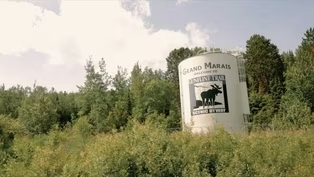
Video has Closed Captions
Preview: S17 Ep2 | 30s | Travel Minnesota’s iconic gunflint trail and visit the Chik-Wauk Museum and Nature Center. (30s)
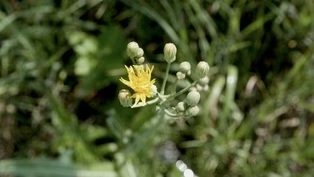 New
NewFast Forage: Sow Thistle, Harvesting Nature’s Bounty
Video has Closed Captions
Clip: S17 Ep2 | 3m 55s | Forager Nicole Zempel explains how to identify the Sow Thistle. (3m 55s)
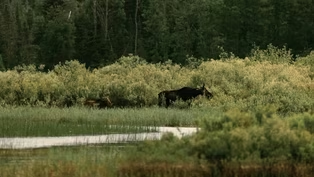 New
NewVideo has Closed Captions
Clip: S17 Ep2 | 10m | Host Bret Amundson takes us on a journey north from Grand Marais to meet Jessica Berg-Collman. (10m)
Providing Support for PBS.org
Learn Moreabout PBS online sponsorship
- Science and Nature

Explore scientific discoveries on television's most acclaimed science documentary series.

- Science and Nature

Capturing the splendor of the natural world, from the African plains to the Antarctic ice.










Support for PBS provided by:
Prairie Sportsman is a local public television program presented by Pioneer PBS
Production sponsorship is provided by funding from the Environment and Natural Resources Trust Fund and Shalom Hill Farm. Additional funding provided by Big Stone County, Yellow Medicine County, Lac qui...