
50 Years of the Dixon Gallery and Gardens
Special | 25m 18sVideo has Closed Captions
From private home to public museum, this film charts the history of The Dixon Gallery and Gardens.
2026 marks the Dixon Gallery and Gardens' 50th year of sharing world-class exhibitions, cultivating stunning gardens, and building robust educational programs. This new documentary from Last Bite Films details the history of this Memphis institution, that grew from the personal collection and home of Hugo and Margaret Dixon.
Problems playing video? | Closed Captioning Feedback
Problems playing video? | Closed Captioning Feedback
50 Years of the Dixon Gallery and Gardens is a local public television program presented by WKNO
50 Years of the Dixon Gallery and Gardens
Special | 25m 18sVideo has Closed Captions
2026 marks the Dixon Gallery and Gardens' 50th year of sharing world-class exhibitions, cultivating stunning gardens, and building robust educational programs. This new documentary from Last Bite Films details the history of this Memphis institution, that grew from the personal collection and home of Hugo and Margaret Dixon.
Problems playing video? | Closed Captioning Feedback
How to Watch 50 Years of the Dixon Gallery and Gardens
50 Years of the Dixon Gallery and Gardens is available to stream on pbs.org and the free PBS App, available on iPhone, Apple TV, Android TV, Android smartphones, Amazon Fire TV, Amazon Fire Tablet, Roku, Samsung Smart TV, and Vizio.
[Serene Orchestral Music] Art enhances life.
The Dixon is a combination of gardens and magnificent art and what it has done for our city is incalculable.
The Dixon is one of the most magical hidden gems of Memphis.
It's a beautiful thing to see so many folks here experience the culture and the magic that is art all together.
We're a tiny museum and we're tiny garden, really.
Where the brilliance is, is where the two fuse togethe and where we can find that synergy between the museum and the garden.
Margaret and Hugo Dixon are the heroes of the story.
But there are lots of others along the way.
Memphis is very blessed to have a place like this.
We have so many great institutions - the Civil Rights Museum, the new Memphis Art Museum.
We've got incredible parks, but I think what the Dixon brings is the combination of many of those things.
It's not just a museum, it's also a garden.
People can come and they can be exposed to fresh air and things they might not be seeing in their neighborhoods.
And yet they can also go in and see beautiful things on the walls and understand that there's more to it.
Hugo and Margaret Dixon had a vision for this place.
They knew exactly what they wanted to do.
Hugo Dixon was from England, and he had been a prisoner in World War I, and he began working for George H. McFadden Cotton Company in London when he was only 22 years old.
And so when he came to Memphis, he brought international perspectives.
There was not much art going on around Memphis.
We were still a hardscrabble town, recovering from the effects of the Civil War and World War I and World War II, and trying to get established as anything but a river town.
Margaret Dixon was a belle of the South.
She was also very active in the arts.
We have some of her drawings when she was at the Memphis College of Art.
Margaret was on the M. E. Norman, the ship that sank in the Mississippi River in 1925 and was rescued by the heroism of Tom Lee.
She was one of the last ones he recovered, and she had apparently a yellow parasol with her that helped her survive.
When they met in late 1925, they were engaged within months.
And so they get married in April of 1926.
They're in Dallas, Texas.
He's working in the cotton business.
They move to Houston.
They're about to build the Dixon residence in Houston, Texas, when Mr.
Dixon is offered the presidency of a branch of the McFadden firm.
And in 1939, they buy the property we operate on.
When they moved into the house in the 1940s, this became kind of like a hub of friendship I did come here early on and they said, Go swim in our pool And so that was a fun introduction to the house.
They were very generous people.
They were letting people borrow their spaces for weddings and parties.
It was an everyday kind of social situation.
I like to think that as social as they were, they would love that this is a community space and a lot of people come through.
Margaret and Hugo Dixon really began their collecting in the 1940s, when they moved here to Memphis.
So they had this beautiful home designed by John Staub, and began to look for special works of art to decorate their home.
First, they collected British Grand Manner portraits, because Mr.
Dixon was from England, and that was the kind of art that he was most familiar with.
Mr.
Dixon and Mrs.
Dixon became acquainted with a man named John Rewald, who was the first great scholar of French Impressionism.
He helped guide the Dixons to collecting in the Impressionist era.
One of the most notable is our Degas pastel, which is routinely described as one of the favorite works in the collection by our members and visitors.
Mr.
and Mrs.
Dixon never purchased a work of art without seeing it on the walls of their home first.
because they considered their collection an investment in pleasure.
They wanted to have a painting that they loved so much that it would bring them joy every day.
Mr.
Dixon's approach to collecting really is much the same as the Dixon Gallery and Gardens approach is.
We have to see things in person.
We have to know that they feel right here.
So we're, you kno, still following his example 50, more than 50 years later.
The Dixons began to think about what their legacy might be as early as the late 1950s.
Eventually, it became clear the Dixons would have to make some kind of plan for their home, for their gardens, for their art collection.
At a certain point, they elected to create the Dixon Gallery and Gardens.
Hugo and Margaret had no children and they wanted to leave something lasting for Memphis And so they left their collection of art, and they left an endowment.
They both passed away in 1974.
Mrs.
Dixon first, and Mr.
Dixon later in the year.
And it was really at that point that Eric Catmur, who was someone that the Dixons had known for years.
He worked in the cotton business.
Like Mr.
Dixon he was English by birth.
I knew Hugo for many, many years.
He was associated with my father before me and then I was in business with him.
Love was a very important thing, and I think we should all continue to remember that he left this garden, this gallery, their artwork and his money as a memorial to his wife, Margaret Oates Dixon.
Hugo Dixon was something of a mentor for my father, There were some early conversations about leaving the house and the gardens to the city.
At the death of the Dixons, he becomes the chair of the Hugo Dixon Foundation.
They had a beautiful house, they had an art collection, and they had a well developed garden.
But they didn't have a museum.
And so they had to start basically from scratch to create the museum.
And that was quite an undertaking.
Simple thing, a couple of meetings a year turned into a full tie job for Eric Catmur.
He really did us a tremendous service in the way he set up the institution, the way he cared for the foundation.
All the many, many things that go into our operation today he established.
When we opened as a museum in 1976, we had about 30 works of art in our permanent collection.
You know, it was a small collection, but it was really, really powerful.
Among the many things that Eric Catmur did was hire our first executive director, Michael Milkovich.
Right after Eric Catmur retired from the board, a man named Herbert Rhea took over as board chair Herbert Rhea and Eric Catmur hired our third director, a young man in his 30s named John Buchanan.
This is a real coup for Memphis.
We're talking about The Passion of Rodin, the latest exhibit here at Dixon Gallery and Gardens.
John Buchanan is the director of Dixon Gallery and Gardens.
We'd like to welcome you back to Wake-Up Call.
Hi, Denise.
I'm really happy to be here.
And thank you so much for coming to the Dixon Gallery and Gardens so we can share these wonderful sculptures with all of our community.
For our Rodin exhibition, whih opened in February of 1988, we saw 60,000 people in eight weeks, which was at that point a record for the Dixon.
I would say once a month, someone here will say, I remember when you had the Rodin exhibition.
I loved it.
I came ten times to see it.
Paintings from some of the world's best known artists are now on permanent display at the Dixon Gallery and Gardens.
The gallery has acquired 22 works of art by Renoir, Monet, Cezanne, and many others.
They come from the private collection of the Ritchie family of Texas.
Experts say the collection is worth $15 million.
This is one of the great days in the history of this museum.
We believe this is the largest gift of art in the history not only of Memphis and the Dixon, but of the state of Tennessee.
In 1996, we received a partial gift, partial purchase from Montgomery Ritchie in Texas.
And that was about 27 works of art that really complemented the Dixons' bequest perfectly.
In 2012, we bought a major pastel by Jacques-Emile Blanche in memory of our former director John Buchanan.
And in 2013 we added a sculpture by Augusta Savage called Gamin, and it was the first work by a Black American artist to enter our collection.
In 2017, we received a gift of nearly 30 works of American art from Susan and John Horseman.
They added American art from the early 20th century.
It tripled our holdings of works by women artists.
We've had a lot of great works of art come into the building since we opened in 1976.
They're all really true to Margaret and Hugo Dixon's vision and their collection and what they really loved.
So I feel like we've really honored them by strengthening what they gave us.
We are not for-profit organization.
We don't rely on federal or other government funding.
And so that's our biggest challenge, always being able to receive the funding that we need to continue to operate.
Dixon staff have a long tenure.
On average, tenure is well over ten years.
And because of that, they feel like family and they really collaborate as a family.
We come prepared to make something happen because we know that whatever we do on any given day is going to serve somebody in this community, is going to make an experience that somebody in this city is going to value and hopefully learn something from and hopefully share with somebody else.
Eighteen years ago when I came, there weren't many programs.
We did not have a space for education.
We were the roaming educators.
We were very, very lucky that Liz and Tommy Farnsworth asked our director, What do you need?
And the answer was very easy.
We need more space for education and community engagement.
The ability to have this building open when the museum is not open is what makes it so special.
You know, this is a community space.
We do invite other nonprofit partners to have meetings here.
And, you know, we judge art shows here for other organizations.
Students come from college and do classes here.
So it is a very open space.
The building continues to have potential for more.
My staff and I can sit down and create opportunities every day of the week.
We work with wellness programs for adults and youth, different abilities, too.
We work with folks now with Parkinson's, Alzheimer's.
We have something for everybody at the Dixon.
Outreach in the late 90s had become a very big dea in museums across the country.
In 1998, I started Art to Grow.
I felt the van was a very important part of it.
Every time we went to a school or a library, it would be a moving advertisement for the Dixon.
The Dixon fills in the gaps for the school system, who have taken away their arts programming for the most part by sending a van with arts programming to schools.
The galleries and the gardens have to come together.
We think we're at our very best when we're functioning as really one cohesive unit.
It's amazing how much planning goes into it.
It just doesn't happen overnight that all these different departments are working so seamlessly together.
When I started in 2007, it was definitely a pivotal year.
There's a lot of new energy with Kevin being hired.
Of course, Julie Pierotti came along and as well as Margarita Sandino.
So we sort of all have the same anniversary year.
One of the things that we've been successful at is increasing the attendance numbers.
A lot of that was making it more accessible.
We'd been talking about eliminating the admission fees at the Dixon for probably ten years.
The pandemic was an opportunity to explore eliminating the admission fees, which we did as a gift to the community when we got back open.
We were all sort of forced indoors and away from our normal routines.
And the Dixon saw this as an opportunity to have the garden be a sanctuary.
Because we were free, it introduced a lot of new people who now come here regularly.
Our visitors have gotten younger.
We see more large families coming to the Dixon all together, having this great family experience here.
What I really love about it is that all of Memphis is getting to fall in love with our collection, and realy feel like it's their own.
I grew up in the neighborhood right next to the Dixon, so we always came as a kid just to enjoy the gardens.
But I think now having my own kids, especially the last couple years or the last year that it's been free for everyone, we've come a lo just because with small kids, sometimes you don't get to coe for a long time, but you can pop in and out.
And then this year we just joined as members for the first time because I thought that was a good way to help it stay free for everyone for years to come.
Offering the Dixon Gallery and Gardens to our community for free is a necessity for our community.
It's something that all of our families and our friends and our students and teachers should take advantage of as well.
Hope Crutchfield, Hugo's sister was a landscape designer and so decided to take the time to create a beautiful garden that to this day, you can come and visit.
It's a series of three garden rooms almost an Italianate or French style formal gardens.
And those three rooms were not accessible because they had steps.
We sort of made a parallel set of gardens that are wheelchair accessible, and so it allowed an entrance into each of those rooms without disturbing sort of the spine of the garden, which is the axis that sets up the whole formal gardens, which is the three garden rooms.
When Mrs.
Dixon started formulating how this museum would function, being a member of the Memphis Garden Club she traded meeting space, working space, educational space with the Memphis Garden Club for a partnership that brought her an army of volunteers.
We had almost 6000 volunteer hours last year.
The willingness of people to give of their time is a reflection of your relevance in the community.
And if we're using that metric in the garden, then we're knocking it out of the park.
I think we're one of the few museums that actually has a cutting garden where we can actually grow the cut flowers.
They're beautiful works of art that are in the museum that are changed out regularly, and people like that.
And it's all the special things that we do here.
If you come here during April, the tulips are blooming.
If you come here, later, you got the magnolias blooming.
You have this canopy of oak trees.
Where else could you see this?
We actually have our best attendance numbers betwen March 15th and April 15th.
People are ready for spring.
The tulips speak to people in a way that no other flower can We've got plans for the anniversary.
We've ordered about 600,000 tulip bulbs.
I think it's going to be really, really stunning in the spring here at the Dixon in celebration of 50 years.
Oh my gosh, I could go on about the Dixon.
It is such a precious secret garden that pulls in all sorts of art from whether it's international or whether it's local artists.
We realized that the Dixon had become shut off from the very vibrant arts community in Memphis, and we knew we could change that really easily.
So we had two hallway galleries, the Mallory and the Wurtzburger galleries, and we decided to dedicate those spaces to regional contemporary art.
Memphians want to support Memphis artists, and we want to support Memphis artists.
He's moved into a studio in what's called the 10th Street Studio Building.
We started the Curators Circle in 2016 to build financial support for acquisitions and to programmatically add significant works of art to our collection.
Three, four, maybe five pieces of artwork are set up that the team at the Dixon has assembled over the year.
Members of the circle choose what the museum will acquire that year.
And Kevin and Julie do the explanations of what each painting is and what it represents.
Hassam is the American impressionist.
I mean, he's the American artist.
And so 1890 is - anybody watch The Gilded Age?
It's that moment.
It's New Yok becoming New York.
It's becoming the New York we know it to be today.
After you're finished listening to everything, you've asked all your questions, you receive a ballot and everyone gets to vote.
Whoever wins, that's the artwork that the museum acquires and puts on its walls.
The winner is the Hassam, number two.
It's a lot of fun, great excitement, great energy.
People love to come to these parties.
But they serve a purpose too.
The Dixon is without question a treasure in Memphis.
Some people call it a hidden treasure, but I know exactly where to find it, and I hope everybody else does too.
The Dixon really makes sure that they are open to the general public, but that they also recognize that we have a diverse community, and we try to put n events and exhibits that really appeal to everyone in one way or another at some time bringing young children to art, helping them understand it, helping them appreciate i so that they become art enthusiasts throughout their lives.
Well, for the next 50 years, I hope I'm leaving another good base for the next leaders in education at the Dixon, and make sure that this is a museum that is for the community, is not for me, or for a curator or for a director.
It is for them.
We are here for people.
That's what Hugo and Margaret Dixon wanted this to be.
Open to everybody.
I feel like we're poised to go for the next 50 years in a very strong position.
The Dixon has allowed this small staff a platform to funnel our passions.
It's kind of moe than just an occupation.
My vision for the Dixon for the next 50 years - what I really hope is that more Memphians take advantage of what we're doing here, and that the world gets to know a little bit better how special this place is.
Now, where the Dixon will go in the future.
You know, that remains to be seen.
It's a rapidly changing world, and I don't want the Dixon to get stuck in a place where it slips into a kind of irrelevance.
That would be the worst thing I could imagine.
For right now, I think the same things that I brought to the Dixon when I got here 18 years ago.
Special exhibitions that are ambitious and meaningful.
Education programming that helps us reach a broader community in this city, the broadest possible community in this city, and then world class horticulture projects that absolutely wind up delighting our audience, especially in the spring.
I mean, there'll be other things that will happen.
We will transition and evolve.
What amazes me about 50 years at the Dixon is that Hugo and Margaret Dixon had a vision for this place.
They knew exactly what they wanted to do and they proceeded to outline it.
They made it very clear.
They made it very easy for those behind them to follow their vision.
I am a lover of the Dixon.
I think I walked into the Dixon's doors just about the time it opened 50 years ago, and I haven't left.
It is a magnificent treasure in Memphis.
Once you come to the Dixon, I'll bet you that you come back again and again and again.
♪ [Soft Orchestral Music]
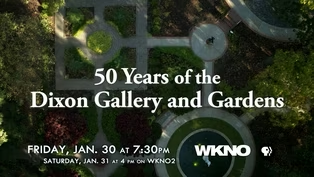
Fifty Years of The Dixon Gallery and Gardens - Coming Soon
A new documentary about the Dixon Gallery and Gardens premiering on WKNO (30s)
Providing Support for PBS.org
Learn Moreabout PBS online sponsorship













Support for PBS provided by:
50 Years of the Dixon Gallery and Gardens is a local public television program presented by WKNO