Living St. Louis
Searching for Snakes on the Shawnee National Forest's "Snake Road"
Clip: Season 2026 Episode 11 | 5m 56sVideo has Closed Captions
Snake Road closes to allow snakes to migrate between their winter and summer habitats.
Snake Road, otherwise known as Forest Road 345, closes for a few months every spring and fall to allow snakes to migrate between their winter and summer habitats. Producer Veronica Mohesky went to the Shawnee National Forest, just two hours south of St. Louis, to see if she could find any reptiles on the move.
Problems playing video? | Closed Captioning Feedback
Problems playing video? | Closed Captioning Feedback
Living St. Louis is a local public television program presented by Nine PBS
Support for Living St. Louis is provided by the Betsy & Thomas Patterson Foundation.
Living St. Louis
Searching for Snakes on the Shawnee National Forest's "Snake Road"
Clip: Season 2026 Episode 11 | 5m 56sVideo has Closed Captions
Snake Road, otherwise known as Forest Road 345, closes for a few months every spring and fall to allow snakes to migrate between their winter and summer habitats. Producer Veronica Mohesky went to the Shawnee National Forest, just two hours south of St. Louis, to see if she could find any reptiles on the move.
Problems playing video? | Closed Captioning Feedback
How to Watch Living St. Louis
Living St. Louis is available to stream on pbs.org and the free PBS App, available on iPhone, Apple TV, Android TV, Android smartphones, Amazon Fire TV, Amazon Fire Tablet, Roku, Samsung Smart TV, LG TV, and Vizio.
Providing Support for PBS.org
Learn Moreabout PBS online sponsorshipFor a few months, every spring and fall, a certain road in the Shawnee National Forest has to be closed to vehicles to allow for the safe passage of snakes.
So the closure started back in 1972 and most likely what was happening is there were vehicular collisions during certain times of the year when snakes are more active.
So by closing the road it prevented a lot of those mortalities and continues through to this day.
The road is open for foot traffic, for visitors to view the snakes and to enjoy a beautiful hike.
That's Mycha Scoggins, a wildlife biologist with the National Forest.
But why did the snake cross the road?
Well, to get from the bluffs to the swamp.
So snakes are cold-blooded creatures.
They depend on temperature.
And so come wintertime, they need to go into kind of a state of hibernation to ride out that winter.
So they'll go and seek shelter in the bluffs, under the rocks.
And then when the ground temperature starts to warm in the spring, that's what signals them to wake up.
Once it hits those temperatures, they will emerge from the rocks, make their way across the road and into the swamp.
And that's where they'll spend most of their summer, hanging out, feeding, making babies.
And then in the fall, the snakes return to the bluffs as the temperatures decline.
These bluffs provide an important habitat for the snakes.
The geological formations at Shawnee National Forest aren't very common in Illinois, and they influence the biodiversity of the area.
The Shawnee is situated in a really neat spot in the Midwest.
So it's kind of where all these areas merge.
So we get a lot of overlap of, you know, southern species, we're just at the very tip of there.
The northern species, we're at the very tip of their range.
So we get a lot of species diversity here.
Scoggins took us to Snake Road, otherwise known as Forest Road 345, in early April to see if we could find any snakes on the move.
About how many snakes could we expect to see here today?
It'll depend.
Obviously snakes are very temperature dependent and it is a little earlier in the day still.
Hopefully we can see a couple.
I mean one or two would be a good start.
As the day goes on it tends to ramp up a little bit and on hotter days you're going to see more snakes.
Okay.
There are 22 species that can be recorded on Snake Road.
Obviously, some of those species are much more commonly seen than others.
There are some that we might only see one every couple years.
And then there are snakes like the cottonmouth that is highly abundant and we see pretty much daily.
So there are, we could see some venomous snakes today?
Yeah, there are three species of venomous snakes out on the road.
One is gonna be cottonmouth, also commonly known as a water moccasin.
There is the copperhead and then the timber rattlesnake.
With that being said, it is important to keep a distance from the wildlife, for your safety and for theirs.
We do not want to disturb them in any way if we can avoid it.
But most of the time, if you remain a respectful distance away from the snakes, they're pretty calm.
They'll see you, they'll notice you, they might stop for a bit, and then once you just kind of sit there and hang out and don't pose a threat, they'll continue on their way.
I spotted a snake pretty soon into our walk, but it was a little camera shy.
Skoggin said it was most likely a cottonmouth.
I think one of the biggest misconceptions people think of when they hear snake road is, you know, there's just thousands of snakes all the time squirming around, and that is absolutely not true.
There's many days that I go out there and I don't see a single snake.
There are big days that we call them that you might see 20, maybe 30 snakes on the road.
And we weren't the only ones searching for snakes that day.
Since 2023, the Shawnee National Forest, in partnership with the University of Illinois Extension, has recruited volunteers to collect data on Snake Road.
And basically what we're just doing is we're trying to figure out the species that are out there, the abundance or their population size.
Is it an adult or is it a baby?
What species is it?
How big is it?
And it also helps us monitor if there's any injured or dead snakes.
It's still pretty new, the data itself, but I think it's going to teach us a lot in the future.
Luckily, one of the volunteers found another snake for us to see.
So this is a plain-bellied water snake.
They are the second most common species we find here on the road, and they are most commonly confused with the venomous cottonmouth.
They have an all-dark back and then a plain yellow belly that you can often see underneath of their chin.
One of the easiest ways to tell them apart is venomous snakes tend to have that elliptical pupil, whereas non-venomous snakes will have a round pupil.
And then that yellowing is really going to be your biggest telltale that it's a plain-bellied water snake.
Scoggins says though some people are afraid of snakes, we should remember they are a vital part of our ecosystem.
They are responsible for keeping a lot of other species in check, including amphibians and rodents.
Those are their two big main resources of food.
And so without snakes, we would probably have an overabundance of both of those.
And Snake Road has offered a really neat opportunity for people to be able to experience snakes in a way that you wouldn't normally in the woods.
I just think it's a great way to be slowly introduced.
We've actually had a lot of volunteers that have started with us who were not fans of snakes.
They wanted to learn more and this was kind of how they did that for themselves.
And a lot of them now are big advocates for the snakes out there.
 New
NewGame Nite Hosts “Gamer Garage Sale”
Video has Closed Captions
Clip: S2026 Ep11 | 4m 8s | Game Nite provides a community space for local gamers to learn new games, make friends and more. (4m 8s)
 New
NewInterview with Liv Ciara, First Runner Up on Season 29 of The Voice
Video has Closed Captions
Clip: S2026 Ep11 | 5m 40s | Liv Ciara discusses her time on The Voice and what's next for her music career. (5m 40s)
 New
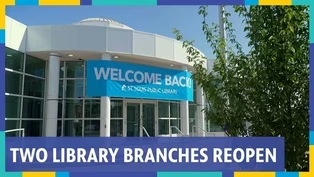
NewSt. Louis Public Libraries Reopen a Year After May 16 Tornado
Video has Closed Captions
Clip: S2026 Ep11 | 4m 23s | The library recently celebrated the reopening of two branches damaged during the May 16 tornado. (4m 23s)
Providing Support for PBS.org
Learn Moreabout PBS online sponsorship













Support for PBS provided by:
Living St. Louis is a local public television program presented by Nine PBS
Support for Living St. Louis is provided by the Betsy & Thomas Patterson Foundation.