HIVE
HIVE
11/10/2024 | 25m 18sVideo has Closed Captions
"HIVE" is a heartfelt documentary about Hank B., a beekeeper and carpenter.
“HIVE” is a heartfelt documentary short following Hank B., a local beekeeper and skilled carpenter whose passion for honey bees extends far beyond conventional practice. Set amid buzzing hives and vibrant blooms, it offers a touching portrait of Hank’s bond with his winged companions, highlighting his dedication to sustainability and the sweet alchemy of carefully spinning honey.
Problems playing video? | Closed Captioning Feedback
Problems playing video? | Closed Captioning Feedback
HIVE is a local public television program presented by WQED
HIVE
HIVE
11/10/2024 | 25m 18sVideo has Closed Captions
“HIVE” is a heartfelt documentary short following Hank B., a local beekeeper and skilled carpenter whose passion for honey bees extends far beyond conventional practice. Set amid buzzing hives and vibrant blooms, it offers a touching portrait of Hank’s bond with his winged companions, highlighting his dedication to sustainability and the sweet alchemy of carefully spinning honey.
Problems playing video? | Closed Captioning Feedback
How to Watch HIVE
HIVE is available to stream on pbs.org and the free PBS App, available on iPhone, Apple TV, Android TV, Android smartphones, Amazon Fire TV, Amazon Fire Tablet, Roku, Samsung Smart TV, and Vizio.
Providing Support for PBS.org
Learn Moreabout PBS online sponsorshipPeople have asked me before, "Did the bees ever remember you?"
I don't honestly know.
However, I can find a lot of relaxation.
Watching them coming in and out, watching them coming in and out, knowing they're working.
In the springtime, it's really nice to watch them.
I'll get up closer to the hive because they're bringing pollen in.
And the pollen coming in is yellow, it's red, it's green, it's gray, just so many different colors.
And to think that they're doing this constantly, day in and day out, day in and day out, and they don't die providing us with food.
And the food that they provide is honey.
My name is Hank B. I'm a keeper of the bees.
I started with one or two hives over 10 years ago, got through the winter following year.
I had like three or four and I didn't realize what was involved in it.
Learning how to manage the hives, to look for certain things to happen, to make sure you had a queen available was she laying brood.
Same thing after a flow, you go in and look at the frames, you see if the honey's ready to pull.
I picked up a mentor, actually I picked up two mentors at the time.
One was named Greg, the other one was Gil.
These guys were invaluable to me, showing me how to work the hives how to watch the bees and stuff like that there.
And then I'd call them every now and then even today I'll call them up and say Greg this happened to the hive, what should I do here, what should I there.
So here I am today, probably over 10 years into this thing.
I have about right now 16 to 18 hives.
I have 14, 15 in my backyard and some out at a farm and some down my brother's.
Just amazing creatures, truly amazing creatures.
My name is Greg Gilbert and I've been a beekeeper for 15 years and met Hank, been with Hank for probably about 10 out of those 15 years.
It tends to be easier for beekeepers to mentor one person at a time, although some, some do more than one at a time.
But, uh, Gil, Hank had contacted Gil, I think, and, um, Gil was already mentoring me.
And so he said to me, he said, I think you should mentor Hank.
And so like, we kind of met through, through that chain of events and, uh, just thrilled to meet Hank.
He's been, he's just super enthusiastic about the bees and he's just always innovating and thinking ahead and, uh, working hard, you know, and he's really a good ambassador too.
He does a lot in the community with classes and teaching other people, you know, the benefits of honeybees and beekeeping.
So, but that's how we ended up getting together.
Once I got started and I looked at what it cost to make boxes and frames and things like that, so I said, "Well, that's all there is to it.
I'll start making my own equipment."
So from then on, I've been making my own boxes.
Right now, I'm going to say roughly, I have about, I don't know, 75 to 80 boxes that I've made.
When I first started, there was something called Wax Foundation, this is what the bees build on.
And Wax Foundation was more natural to me than anything else.
They now have plastic foundations with wax covers on them.
They're more durable, but I stay with what I have as far as the wax foundations.
I just think it's more natural.
I'm in the process now of resupplying them, taking out some of the old frames and putting in new frames.
The bees, after probably about three or four years, will do a lot of work in that frame.
So when a bee's in a cocoon, she will make a cell around her.
So as more bees use that, that cell gets smaller and smaller.
So when the eggs develop, the bees coming out are smaller and smaller.
So if I can give them a new foundation and a new cell, I'll get, I hope, healthier bees out of it.
Interesting to look at is that we have brood here which is new bees are going to hatch and this band that are all the way around them is all honey.
So when they hatch they'll have food for them right away.
And the other side is the same way.
Brood, honey, and then honey in the corners.
There's basically three types of bees that are in a hive Number one, we have a queen.
The queen is responsible for only the population of that hive.
She's the one that's got to lay that thousand eggs a day.
She's the one that's got to provide for the workforce.
Next one down is we have the worker bees.
They're all girl bees.
They do all the work.
From the time they're born, they will clean out the cells.
They will become guard bees.
They will be foraging bees.
They will be a group of bees will take care of the queen.
So the girls do all the work.
We have a drone bee.
That's the boy bees.
The drones are a little bit bigger, not as big as the queen, but they're a little bit bigger.
The drones do not sting.
They have no stingers.
They have a single purpose and that is to mate with the queen.
Once the drone mates with the queen, he dies.
So that's the end of that.
The ones that do survive that do not fortunately or unfortunately get mated will come back to the hive.
The worker bees, the girls will chase all those drones out of the hive.
And I guess the reason behind this is that first of all, you didn't do nothing to provide us with honey.
You didn't build any comb.
You didn't do anything other than sit around waiting to take a flight to see a queen.
So we're kicking you out.
They will probably kick 90% of the drones out of that hive.
So there'll be a couple left, but very, very few, very few.
The little building behind me is my bee shack.
Right now I've got three hives in there.
I use it to bring in new bees.
If I got a nurse bee, I want to start a new hive, which I've got two in there I'm starting now.
And it's in a smaller box.
It's only in a five frame as opposed to a 10 frame box.
So I can go in there and I can look up, I can pick it up, I can look at it.
It's a lot easier to inspect them.
I can feed them a lot easier than I can feed the main hive.
So the bee shack was just an addition, which will probably continue.
I do collect rainwater for the bees and stuff like that down there.
I have a pond at the other end of the garden where the bees will go for a drink of water.
They need water just like we do.
So currently I have one, two, basically two and a half solar setups down here.
So we're running on DC power.
I don't have to worry about a power shortage because I got the DC power.
As long as the sun's out, it's charging the batteries.
The batteries are charging, the system is running.
I've got a garden in there with some things in it that the bees will pollinate there as well.
So I contacted a gentleman and he gave me an idea of what kind of flowers to use around here.
So I planted a whole set of flowers for that.
And of course sunflowers, bees love sunflowers It's nice in the middle and the summer, I guess, late summer to go in and see one of these big yellow flowers with just bees all over it.
So this is all solid honey.
It probably weighs... A normal frame like this would probably weigh about 5-6 pounds.
This one is more like probably 8-10 pounds.
But that's very... not keeping up with putting the right frames in at the right time.
I think if we just do something very small like this here... I don't think it's going to run because it's pretty solid at this point.
But anything bad about wearing a veil doing this... I can't taste it.
Roger is a friend of mine.
He's been, we've been friends for close to 60 years, I guess.
He's an electronic wizard.
And I talked to him one day and asked him if Andy, that's his son, would be interested in setting up an electronic scale weight that we could weigh the bees and see how they were doing, how they're progressing, how much weight they're gaining.
And Andy came over one day and I told him what I'd like to do.
And I says, we can buy them commercially.
He says, no, no, no, let's build one.
So we had to, first you have to do, I did a lot of prototyping.
A lot of stuff was set up on my bench.
It consisted of a set of four load cells that Hank with his woodworking skills created kind of a platform for everything to sit on so that all four of the load cells were engaged and accurately measuring the weight of the hive.
And then a temperature humidity sensor that we had to, we just wired into the same system.
So there's two main components to the system.
The hive units attaches to the hive itself.
That consists of for each hive, the load cell for weight and temperature humidity sensor.
That data is collected every, I think every 30 seconds or so.
And then every minute or so, it is uploaded to what we call the ZBTS server.
And that server basically just keeps a copy of the data.
The data is stored on the hive units as well as the server.
And that server is connected to a local Wi-Fi network that we set up down here too.
And then to view the data, we created an Excel spreadsheet that automatically links to those individual text files that house the date, time, and weight, temperature, humidity.
And then graphs everything shows you weekly plots, daily plot, etc.
As an example, I had a hive that was weighing in at about 120 pounds.
So over a period of about a week, I could see this graph starting to gain weight, gain weight, gain weight.
So I got to the point where the graph was only set for 200 pounds.
And I had a hive that was over 200 pounds.
So I had to call Andy up and say hey, we need to change this scale because my hive is weighing more than 200 pounds.
During the winter, you wanna see what they're doing.
You wanna see what the temperature is.
You wanna make sure they're still alive.
So that's electronic end of it is very, very helpful for me at this point.
The bees will start to go out looking for nectar.
They'll look for it in February, believe it or not.
Maple trees are blooming in February, mid-February, late February.
The bees will go out and collect the nectar off of that.
They have what's called a honey stomach.
So they'll basically draw the nectar out of the bottom of the flower to put it in their stomach where it's mixed with some products that the bees produce.
They'll take it back to the hive.
This nectar then will be passed off to another bee in the hive and they'll take that nectar and again put it into their bee stomach.
It'll mix and then they'll eventually put it into a cell.
And nectar has a high water content and so they have to dry it down.
And as they dry it down, once they get the water content down from 75, 80% down to around 15%.
They're driving the water out of the nectar so that only the nectar remains.
So the transferring of this nectar through the different bees and the substances that the bees add to it ends up to be what we call honey.
After a certain point, when the bees know that that is below 20%, they'll cap that.
See that all the white stuff?
That's all capped.
It's ready to go.
Same thing on this side.
It's probably a third capped but they're drawing the comb out and it looks really good.
I'd say that one.
Let's pull one more.
That side, no, this one here.
Okay.
Here's another one.
That's a good, good example of what a frame of honey should look like.
All capped, ready to go.
(birds chirping) And I mean, you should, you can note that the honey in this form is, it stays edible virtually forever.
It'll crystallize under the cappings after some time but it still remains edible.
And even in your jar, if it crystallizes, it's still edible.
It's the only food substance on planet earth thats like that.
It requires no preservation, no refrigeration and remains edible indefinitely.
Some of them may not be capped, but one of the tricks that Greg had told me, he says, well, if it's not capped, he says, just shake it down.
If anything drips down on it, then you know that it's honey and it's not done enough.
So I'm just gonna give this one a couple shakes.
I don't see anything coming off of it.
So if I was gonna spin it, I could probably spin this one because what's in there is honey and it's good.
Once we pull the frames out and we know that they're less than 20%, we'll take them in and we'll basically, we have to uncap and we have to take that wax that they've sealed that cell with.
We take a knife or we have an uncapping tool that we uncap it, one cap both sides of it and then we put it in a centrifuge.
And it basically spins at a high RPM forcing the honey out.
Now the interesting part of it is a frame probably will weigh, a single frame will weigh somewhere between seven and eight pounds, but we'll spin out what we can.
There's also gonna be residue left.
And that residue and that spun out frame is I'll bring it back down and give it to the bees.
They'll take them and they'll clean every single drop of honey off of that thing.
So then I've got a brand new clean dot frame with no honey that I can put back in the hive for the fall flow.
Now kind of interesting is that we do raw honey.
That's all we do.
I stay away from chemicals for my hives and I don't mix anybody else's honey with mine.
If I don't have any honey, then I don't sell any honey.
Local honey is the best I think, because you know who made it for first of all, you're supporting a local beekeeper, somebody who's right in your neighborhood.
And then also some of the store-bought honey, you don't know really where it comes from.
Honey in the United States is sourced from all over the world.
And some of it's been super filtered or heated to give it shelf life.
And so if you're buying raw honey locally, those things haven't happened.
It's not been super filtered usually and it's not been heated.
And so all the good stuff that the bees put in is still in there.
And so that's the biggest benefit health-wise, you're just getting a higher quality product.
I'm definitely not a connoisseur of taste.
However, the spring honey to me is very mild, has a very floral taste to it, very subdued taste.
When people try this stuff, one of the first things they'll tell me about it, it says, wow, that's the best honey I've ever tasted.
And you have a choice because that honey being as mild and kind of a delicate taste to it, the fall honey comes in a little bit with a little bit more gusto, I guess.
It's a little bit stronger, a little bit stronger taste.
It doesn't have that nice floral taste of the spring, but it has kind of a woody taste to it because we're looking at getting honey from wild weeds as opposed to the sweet smelling flowers.
Goldenrod honey, when it comes into the fall, it's very, very pungent.
Some people liken the smell to socks.
It's kind of yeasty, kind of, it's a smell all of its own, but you can definitely smell it.
And you know when the bees are making it because you don't have to get anywhere near the bee yard.
You can be 30, 40, 50 yards away and you can smell the goldenrod in there.
Although it tastes wonderful.
It tastes like butterscotch.
It's very good honey, but when they make it, it's pretty stinky.
So interesting is they have never changed their recipe.
Chemists and people like that are trying to duplicate honey.
They just cannot get it the way the bees make it.
Honey is filled with amino acids.
There's like 26 amino acids in honey.
There are antibacterial, antifungal properties of honey.
If you get cut, you can put honey on it.
If you get burnt, you could put honey on it.
There's another beekeeper who's, I think his grandson had allergies terribly bad.
He was taking pills and shots and his grandson within about six months, no more allergies at all.
No more pills, no more thussin'.
Just take the honey.
So it's really, really great.
And the reason it's so good for allergies is because if it's raw honey, there is still pollen in that honey.
There is still some things called propolis in the honey.
So if you're taking your body and you're giving it a little bit of pollen and your body starts to build up an immunity to that, then suddenly your allergies may just disappear.
So from a standpoint of other being delicious food and healthy food, I think it's also a very medical food.
When I was working with Greg and trying to follow his way, he basically told me, he says, "You've got to do what you're comfortable with.
There's no set rules.
There's no policy.
There's no book that says you've got to do it exactly like this."
And there's a little saying around beekeeping.
It says, "If you took three beekeepers and you put them in a room and gave them a question to answer, it's almost guaranteed that you're going to come out with five answers."
And that's how beekeeping is.
I mean, my way of doing it and Lisa's way of doing it and Greg's way of doing it and Bob's way of doing it, I mean, we all do something different.
There are some basics.
You've got to feed them when they need it.
You've got to take care of the mites.
You've got to take care of stuff like that there.
But other than that, how you manage them, that's your technique.
When I first started, I only knew of about two or three people that got into bees and took care of bees.
I've tried to mentor people, and I'm finding a lot of interest from people now.
Realizing the importance of pollination and realizing how important the bees are, they'll call me and say, "Hey, I just bought a hive.
What should I do?
How should I take care of them?"
And a lot of people will go out and charge it for this.
That's ridiculous.
Somebody's trying to make our world better.
My goodness, if they're willing to go through the expense of putting it together, I've got time for them.
I'll help them anyway I can.
If I have to provide them with bees, I'll provide them with bees or show them how to take care of stuff.
I think that's important.
I love going to the schools and talking to the kids about them.
Everybody says, "Oh, really, really?
Oh, I didn't know that.
I didn't know that."
So the education of these food providers, I think is very important for all of us to know about.
I think one of the neatest things, one of the two of the neatest questions that I've ever had for the kids is, "Have you ever got stung by a bee?"
My answer to that is, "Not today."
The other one was, two little kids were in class, and they're asking each other.
One little kid says, "Where did the bees come from?"
I'm scratching my head, and the other little kid next to them says, "Oh, they come from God."
These were like second graders.
I couldn't believe it.
Just amazing.
They were put here for us.
We've got to respect them.
We've got to keep them.
We've got to take care of them.
Video has Closed Captions
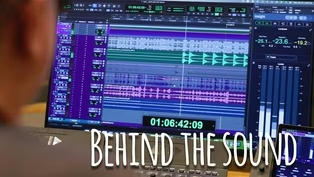
This is about the sound design process for "HIVE" with Red Caiman's Jesse Naus and Shawn Jackson. (4m 20s)
Video has Closed Captions
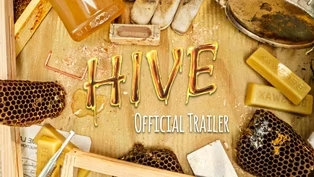
This is the trailer for a heartfelt documentary about Hank B., a beekeeper and carpenter, "HIVE". (1m 6s)
Providing Support for PBS.org
Learn Moreabout PBS online sponsorship













Support for PBS provided by:
HIVE is a local public television program presented by WQED