HIVE
Behind The Sound
Clip: 11/10/2024 | 4m 20sVideo has Closed Captions
This is about the sound design process for "HIVE" with Red Caiman's Jesse Naus and Shawn Jackson.
This is about the sound design process for "HIVE" with Red Caiman's Jesse Naus and Shawn Jackson.
Problems playing video? | Closed Captioning Feedback
Problems playing video? | Closed Captioning Feedback
HIVE is a local public television program presented by WQED
HIVE
Behind The Sound
Clip: 11/10/2024 | 4m 20sVideo has Closed Captions
This is about the sound design process for "HIVE" with Red Caiman's Jesse Naus and Shawn Jackson.
Problems playing video? | Closed Captioning Feedback
How to Watch HIVE
HIVE is available to stream on pbs.org and the free PBS App, available on iPhone, Apple TV, Android TV, Android smartphones, Amazon Fire TV, Amazon Fire Tablet, Roku, Samsung Smart TV, and Vizio.
Providing Support for PBS.org
Learn Moreabout PBS online sponsorshipWelcome to Red Caiman, My name is Jesse Naus.
I'm one of the engineers here.
Shawn is in studio A right now, mixing HIVE.
Let's go and check that out.
You know what a documentary there's not as.
It's not like a action movie or a science fiction film where there's a lot of craziness going on.
This is more about making the audience feel like they're just there while the interview is happening.
My name is Shawn Jackson.
My title is Audio engineer.
I like to go by noise stylist.
Mostly.
What I do is sound design and mixing for films, television commercials.
The mixing part is really just taking that stuff from on set, cleaning it up.
We don't want to get rid of all the noise because we we want to keep that environment that they're in, but we also want to get rid of what becomes annoying.
And that's usually your higher frequencies.
So you might have some sort of insect or bird that might be in there because you can't control them.
Or sometimes what you get is a low end rumble.
And so when you take that and you increase the level up to like for in cinema, those sounds can get really annoying really fast for the audience.
And so it's getting rid of those.
But keeping the general environment sound, because we get rid of all the noise, it starts to feel fake.
It doesn't feel real anymore.
One of the first things we do when looking at a project in terms of the audio is number one, we have to look at what what's already been acquired.
What was done on set?
And we look at how much of that, you know, we have to work with.
In a situation like this with hive, we realized really quickly the bees are the focal point.
There's a lot of shots within this that is very bee centric.
Very much about the bee.
So we realized really quickly that we needed to go back out to the location.
So we actually went out to the location with specific microphones and really concentrating on capturing the sounds of the bees.
So we took out a 5.1 microphone so that we could capture the bees in surround.
It was just capturing it there on the location and giving you that sense of space, giving you that sense of just being right in with the bees around the hive.
And then we also used, smaller microphones that we could get really in tight to, like the entrance of the hives and actually also put inside the hives themselves.
The bees could actually crawl on the microphone the same as the video crew did with a camera.
So it was just recreating that same feel of.
So while the camera's moving through the hive, so is the microphone and the audio.
So it all matches up and, you know, really makes you feel like you are there.
We didn't take everything into consideration in that.
Number one, the bees don't like foreign objects that are close to their hives.
So we learned really quickly that we couldn't leave the microphones for an extended period, or the bees would start to put some sort of coating on the microphones that could damage them.
So we had to think a lot about that very quickly, when we were on set.
The nice thing with this is me and Ryan to work together in the past, not only at a company together, but also on some other projects.
So it made this project very easy.
It's sort of that trust thing of like, we're just going to go do what we do now, you know, and make that work with the the visuals that we get back.
So a lot of it is that, is that planning up front.
A lot of people sometimes wait till they're almost done with their edit or it's fully complete to then think about audio post.
But I like to be involved a lot earlier than that.
It just makes it go a lot smoother because you get all that information up front, as opposed to just trying to figure it out.
Once the project's almost done.
What we discovered while we were on set, you have a lot of interference.
You got headphones on, but you're hearing a lot of different things where the microphones are.
Once we brought it back into the studio and we started really listening to it.
It gets a little creepy of how detailed, especially inside the hive and the noises the bees make.
Sort of freaked us out a little bit, and especially when we started putting in surround sound and really encapsulating ourselves in it.
It's a little weird.
As you'll see watching this documentary, hopefully everybody's a little creeped out by it.
Video has Closed Captions
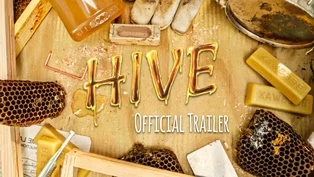
This is the trailer for a heartfelt documentary about Hank B., a beekeeper and carpenter, "HIVE". (1m 6s)
Providing Support for PBS.org
Learn Moreabout PBS online sponsorship













Support for PBS provided by:
HIVE is a local public television program presented by WQED